TotalEnergies CEO Just Exposed the $10 Secret That Makes the Hormuz Oil Panic Look Overblown
The Iran war has the oil world bracing for catastrophic Hormuz shipping costs, but TotalEnergies CEO Patrick Pouyanne just dropped a number that reframes the entire crisis and hands a surprising advantage to one integrated energy giant.

Oil has become the thread running through the global inflation story. The Iran war has disrupted production, refining, shipping, and the routes connecting them, pushing energy costs higher across transportation, manufacturing, food, and household budgets.
In July, U.S. consumer prices rose 3.4% from a year earlier, while energy prices jumped 14.7% and gasoline climbed 24.6%, according to the U.S. Bureau of Labor Statistics. Brent crude recently traded near $93 a barrel as the Strait of Hormuz remained constrained. That makes the shocking number just revealed by TotalEnergies (NYSE:TTE | TTE Price Prediction) CEO Patrick Pouyanne particularly important: The cost of moving a supertanker through Hormuz may be far lower than investors feared.
The Surprising Hormuz Price Tag
Pouyanne discussed the Middle East’s energy-security crisis during ONS 2026 in Stavanger, Norway, where the ONS Foundation and Munich Security Conference jointly hosted a summit focused on energy security and geopolitics.
The setting was appropriate. The Iran war has turned Hormuz into a bottleneck for global energy, with vessel traffic well below its prewar average. Reuters reported that traffic had fallen from roughly 125 to 140 vessels a day before the war. Yet Pouyanne’s estimate cuts through some of the panic.
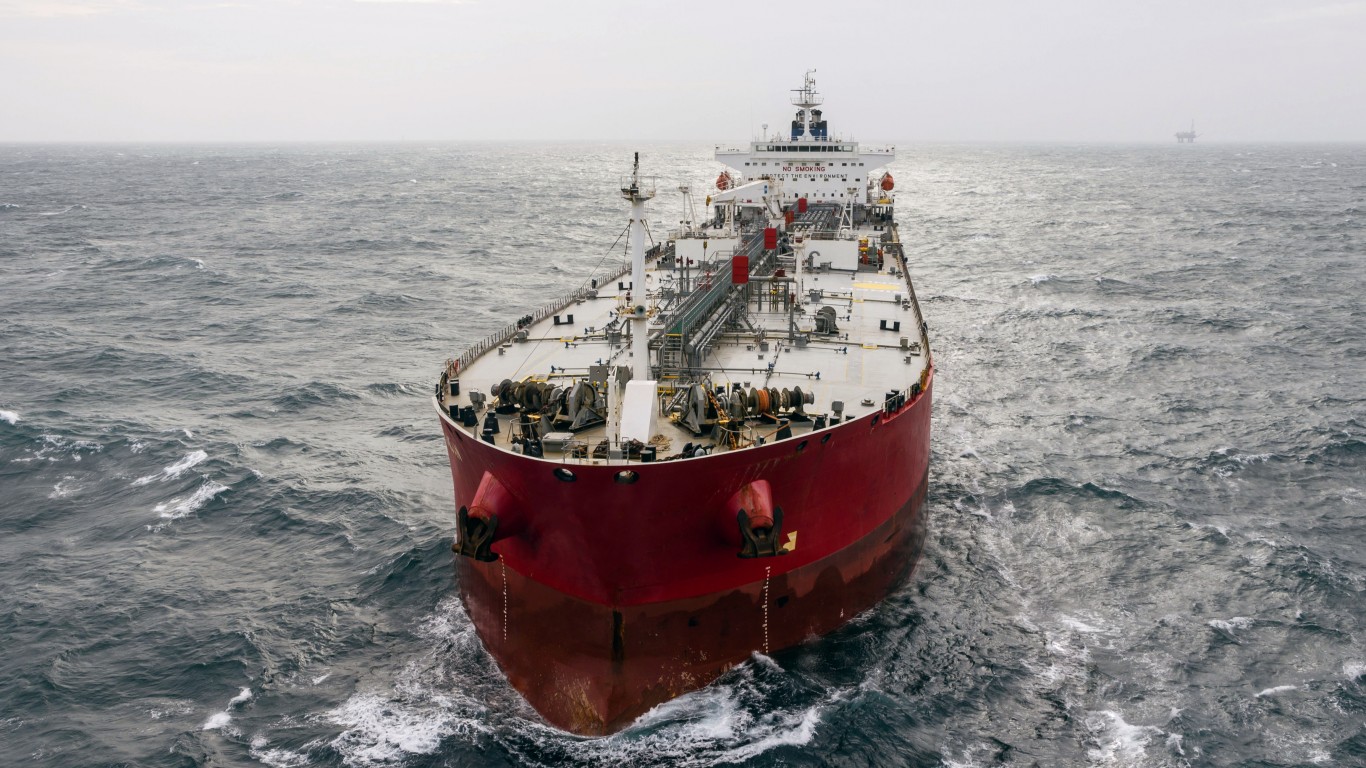
He said moving a Very Large Crude Carrier, or VLCC, carrying roughly 2 million barrels through the Strait costs about $20 million for a round trip, including freight and insurance. That works out to approximately $10 a barrel.
For a market bracing for five-figure-million-dollar shipping bills, that’s a remarkably manageable number.
Iraq Is Paying Buyers to Take the Risk
Iraq’s state oil marketer, SOMO, offered discounts of roughly $25 to $30 a barrel on Basrah crude for August cargoes loaded inside the Gulf. Argus reported the discounts reached $29.80 a barrel for Basrah Heavy. In other words, the discount more than covers the estimated Hormuz transportation premium.
That is important for TotalEnergies because its trading arm, Totsa, is deeply involved in Middle Eastern crude flows. Reuters reported this month that Totsa was offering Iraqi Basrah Medium crude outside the Strait at nearly $10 a barrel above Dubai benchmarks, helping buyers avoid the security risk of sending ships into Basrah.
The economics are striking, too. If producers are desperate for lifters and crude can effectively be secured around $50 to $60 a barrel, a $10 transportation premium can still leave considerable room for profitable trading.
More importantly, the math suggests Hormuz traffic is becoming more efficient than the worst-case scenarios implied.
TotalEnergies Is Built for This Market
That gives shareholders an important investing clue. TotalEnergies isn’t simply an oil producer waiting for crude prices to rise. Its integrated model combines upstream production, refining, marketing, LNG, and trading. During the second quarter, its trading activities generated another roughly $500 million of outperformance, according to the company’s earnings call.
The broader numbers were even stronger. TotalEnergies generated $9.8 billion in second-quarter cash flow and $6 billion in adjusted net income, while its gearing ratio (debt-to-equity in the U.S.) fell to 13.1%. It also authorized another $1.5 billion of share buybacks.
The war is still a serious risk. Another attack could again choke Hormuz, while higher insurance costs and limited tanker availability can quickly change the economics. For example, India’s largest private sector company, Reliance Industries, recently paid $23 million to $25 million to charter a VLCC carrying 2 million barrels of Iraqi crude.
Key Takeaway
In short, Hormuz isn’t normal yet — but the shipping economics are looking better than feared.
For investors, that favors TotalEnergies. The company has already demonstrated that its trading and refining operations can monetize volatile markets, while its upstream portfolio provides additional leverage to elevated oil prices.
With a quarterly dividend of 0.90 euro per share, up 5.9% from 2025, and another $1.5 billion authorized for buybacks, TotalEnergies is returning substantial cash while navigating the crisis.
The war could worsen. But if Hormuz continues normalizing, TotalEnergies looks increasingly like one of the better-positioned energy stocks for a market where logistics — not simply oil in the ground — determine who gets paid.
Contact [email protected] for any questions or corrections.
After two decades of patrolling the dark corners of suburbia as a police officer, Rich Duprey hung up his badge and gun to begin writing full time about stocks and investing. For the past 20 years, he’s been cruising the markets looking for companies to lock up as long-term holdings in a portfolio while writing extensively on the broad sectors of consumer goods, technology, and industrials. Because his experience isn’t from the typical financial analyst track, Rich is able to break down complex topics into understandable and useful action points for the average investor. His writings have appeared on The Motley Fool, InvestorPlace, Yahoo! Finance, Money Morning, and, of course, 24/7 Wall St. He has been featured in both U.S. and international publications, including MarketWatch, Financial Times, Forbes, Fast Company, and USA Today.