NVIDIA CEO Warns of ‘Horrible Outcome’ If China Optimizes AI Models for Huawei Hardware Instead of American Chips
Jensen Huang rarely sounds rattled, but a recent exchange caught analysts off guard and revealed just how much one strategic shift by China's DeepSeek could reshape the entire foundation of American AI dominance.

This post may contain links from our sponsors and affiliates, and Flywheel Publishing may receive compensation for actions taken through them.
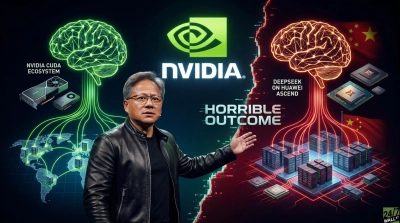
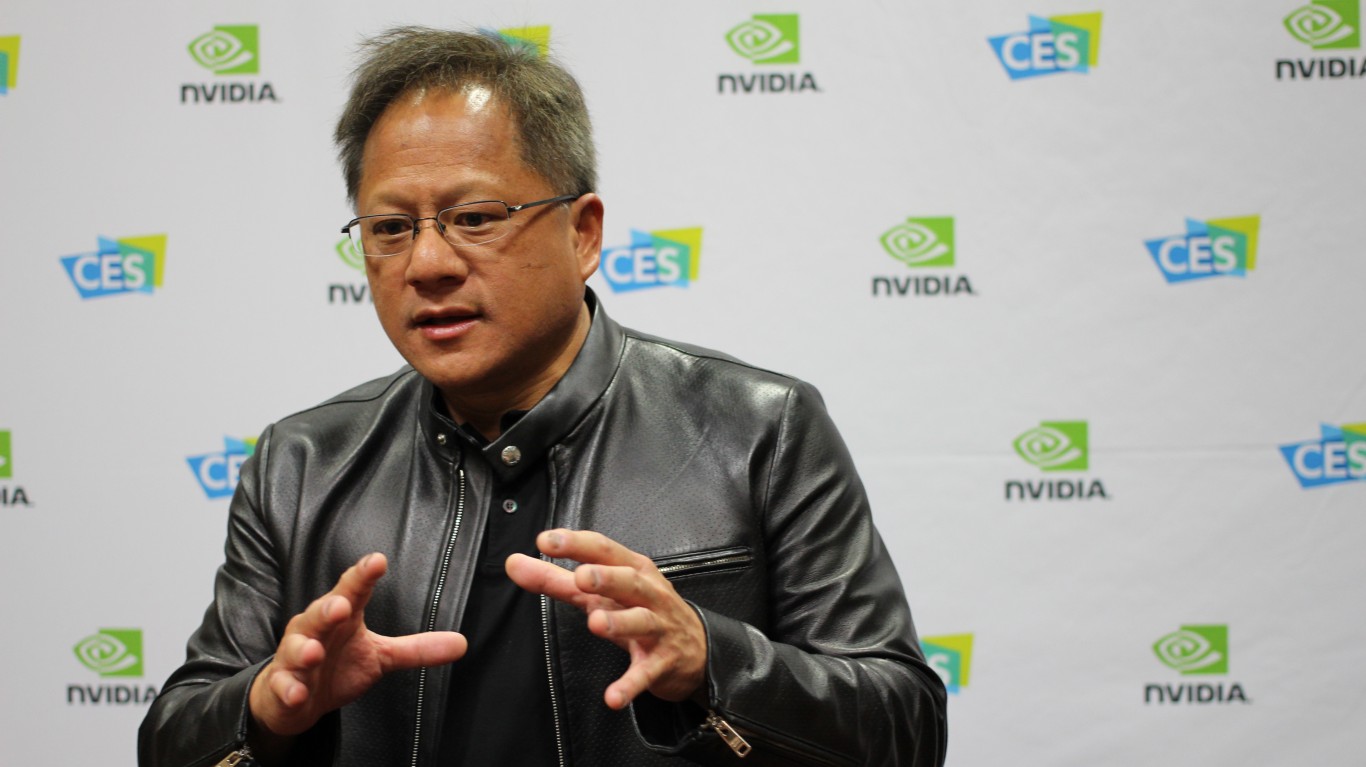
Jensen Huang doesn’t rattle easily. The CEO of NVIDIA (NASDAQ:NVDA | NVDA Price Prediction) has spent the past three years narrating an AI buildout that has pushed his company to a $5.18 trillion market cap. So when he turns visibly defensive, investors should pay attention.
On a recent Prof G Markets segment, China analyst Alice Han and host Ed Elson dissected a tense exchange between Huang and podcaster Dwarkesh Patel. Huang warned that if China’s DeepSeek optimized its next-generation models for Huawei silicon before NVIDIA hardware, “that is a horrible outcome for our nation,” adding that AI models running best on non-American chips “is bad news for us.” Elson called it “the first time I’ve seen him as defensive.”
What Huang Is Really Worried About
The fear is structural. If DeepSeek, whose V4 model already handles a 1 million token context window on par with Gemini and the leading U.S. labs, shifts its training stack to Huawei accelerators, NVIDIA loses the network effect that has made CUDA the default substrate of global AI. Han noted DeepSeek’s funding will likely be “state-led” rather than venture-backed like Anthropic or OpenAI, and that hardware access remains the critical bottleneck.
Huang made the same case on NVIDIA’s Q1 FY2026 call: “The question is not whether China will have AI, it already does. The question is whether one of the world’s largest AI markets will run on American platforms.” He pegged the China AI accelerator TAM at roughly $50 billion, a market NVIDIA has effectively been locked out of. The H20 ban already forced a $4.5 billion inventory write-down, and Q1 FY2027 guidance of ~$78.0B explicitly assumes zero China Data Center compute revenue.
The Numbers Behind the Anxiety
NVIDIA’s underlying business has not blinked. Q4 FY2026 revenue hit $68.13 billion, up 73% YoY, with Data Center Networking alone climbing 263% YoY on NVLink demand for GB200/GB300 racks (8-K filing). Full-year FY2026 revenue reached $215.94 billion. Wall Street’s consensus target sits at $269.17, with 48 Buy ratings and nine Strong Buy ratings against just two Hold ratings. Forward P/E is 24x.
Shares are up 22.12% over the past year and 18.44% year to date through Aug. 12.

What To Watch
Reddit’s r/stocks community is already debating the threat directly, with one heavily-engaged thread asking “how do TPUs not pose a threat to GPU” drawing 221 comments. Han flagged that U.S. export policy has gone “off, on, off, on,” leaving NVIDIA strategically exposed. Huang’s defensive posture suggests the China question is no longer hypothetical, and the next earnings cycle will reveal whether the Vera Rubin roadmap and Grace Blackwell momentum can outrun a parallel Chinese AI stack.
Contact [email protected] for any questions or corrections.
Joel South covers large-cap stocks, dividend investing, and major market trends, with a focus on earnings analysis, valuation, and turning complex data into actionable insights for investors.
He brings more than 15 years of experience as an investor and financial journalist, including 12 years at The Motley Fool, where he served as an investment analyst, Bureau Chief, and later led the Fool.com investing news desk. He has also co-hosted an investing podcast and appeared across TV and radio discussing market trends.