Broadcom’s Brilliant Strategy Keeps Me Buying, Especially Now
Every time Broadcom slides, one investor hits buy without hesitation, and the reasoning behind that reflex goes deeper than a simple dip-buying instinct.

This post may contain links from our sponsors and affiliates, and Flywheel Publishing may receive compensation for actions taken through them.
I keep buying Broadcom. Every paycheck, every dip, every time the market hands me a chance under $400, my finger finds the buy button. This latest slide is doing it again.
Broadcom (NASDAQ:AVGO | AVGO Price Prediction) closed at $392.99 last Friday, down 8.13% in a week and 5.94% on the session. To me that reads as an invitation to add.
The Thesis in Plain English
Broadcom sells two things every hyperscaler now needs: custom silicon (ASIC) co-designed with the customer alongside dominant high-speed switching silicon (Tomahawk and Jericho) that lashes those chips together into working clusters. When Google, Meta, OpenAI, or Anthropic decides to build proprietary AI hardware to escape GPU pricing, they still buy the networking from Broadcom. This dual-engine strategy captures AI capital expenditure from both sides, and enterprise lock-in here reads more like a utility than semiconductor cyclicality.
The Receipts
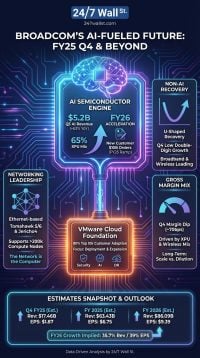
Start with growth. Q2 FY2026 revenue hit $22.19 billion, up 47.9% YoY, with AI semiconductor revenue of $10.80 billion, up 143%. Management guides Q3 to $29.4 billion in total revenue and $16 billion in AI semi, over 200% YoY growth. Hock Tan expects full-year fiscal 2026 AI semi revenue of $56 billion, and he has reiterated the company is on track to exceed $100 billion in AI sales in 2027. AI bookings have passed $30 billion against $10.8 billion shipped, and visibility now runs to 2028.
Then the cash. Free cash flow was $10.26 billion in Q2, 46% of revenue. Adjusted EBITDA ran at 69% of revenue. Operating income grew 85.07% YoY. Broadcom generates returns today and hands them back.
Then the capital return. The dividend has climbed for 15 consecutive years, most recently a 10% hike to $0.65 per quarter. A $10 billion buyback runs through December 31, 2026, and $7.8 billion of that already went to work in Q1. That is a durable capital-return machine sitting on top of AI hypergrowth.
Why Not the Obvious Alternative
The reflex AI-silicon trade is NVIDIA (NASDAQ:NVDA). I own some. My money keeps landing here instead. Broadcom trades at a forward P/E of 21 against a trailing P/E of 65, with a PEG of 0.44 and an analyst target of $527.88. I am paying a growth-stock forward multiple for a dividend compounder with 46% FCF margins, $19.63 billion in cash, and total liabilities declining 3.76% YoY. Pure GPU exposure comes at a richer valuation without that dividend record.
The Risk Worth Naming
Customer concentration is real. A handful of hyperscalers drive the AI franchise, and if one shifts internal design work or dials capex, a quarter can look ugly fast. The Q2 earnings-day reaction was a 12.59% decline despite the beat, exactly that flavor of jitter.
My conviction holds because the customer roster keeps widening. Two additional customers arrive with $6 billion in purchase orders, Anthropic added 5 gigawatts of next-generation TPU compute beginning 2027, OpenAI has 1.3 gigawatts contractually committed for 2027, and Meta signed for 3 gigawatts through end of 2028. Concentration risk moderates as gigawatt commitments spread.
Why the Buy Button Stays Live
I own a business printing 46% FCF margins into the biggest capex build in modern history, run by a CEO who under-promises and raises the dividend every year. At 21x forward earnings with $56 billion in AI revenue guided this year, that is a compounding machine on sale, and I am buying every share the market hands me under $400.
Contact [email protected] for any questions or corrections.
Alex Sirois is a financial writer with experience spanning both retail and institutional investing. He has written for InvestorPlace and held roles at BNY Mellon and Bernstein, giving him a perspective that bridges Main Street portfolios and Wall Street analysis.
Alex holds an MBA from George Washington University and has built his career across multiple industries, including e-commerce, education, and translation — a breadth of experience that informs how he breaks down complex financial topics for everyday investors. His writing is conversational, actionable, and grounded in long-term, buy-and-hold investing principles.
At 247 Wall St., Alex focuses on delivering analysis that is both accessible and useful, with a clear emphasis on helping readers make more informed decisions with their money.