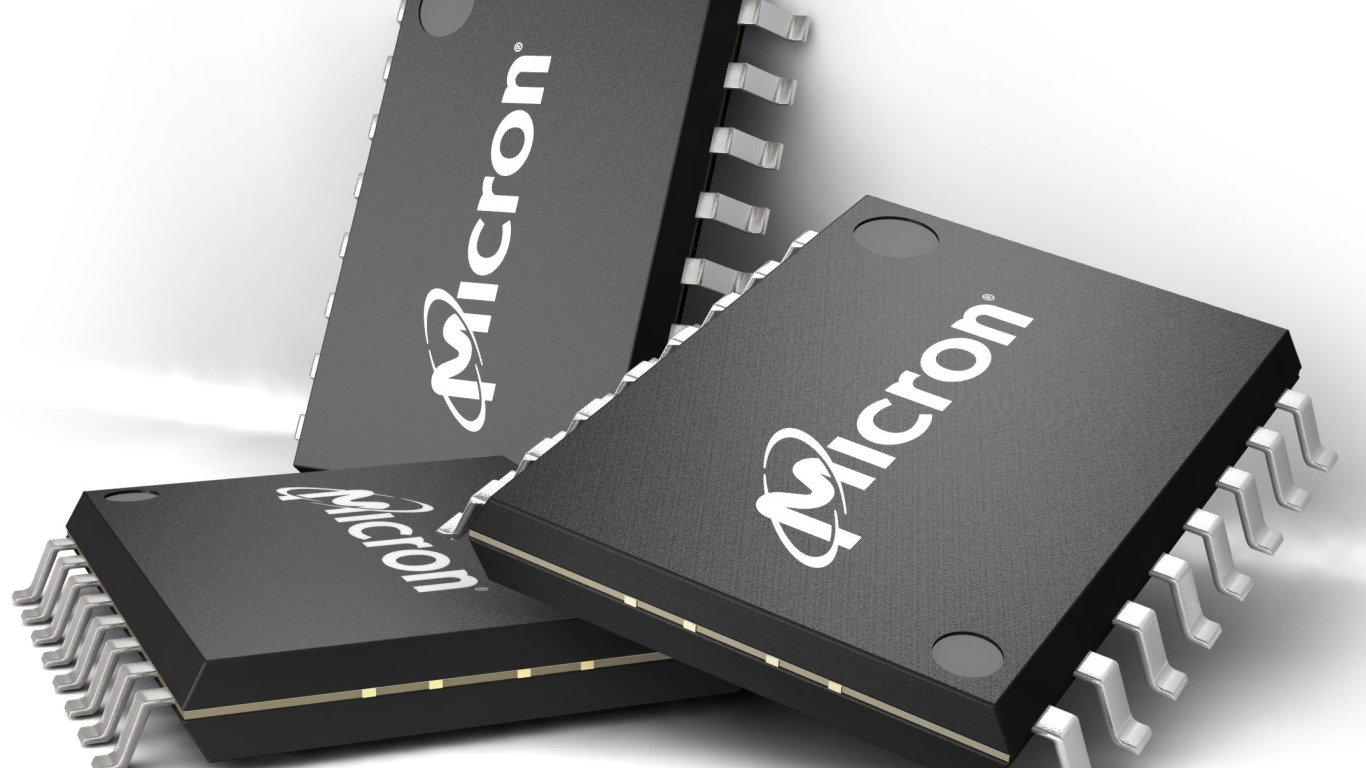
Nvidia Is Cutting Rubin Ultra’s Memory. Is Micron’s HBM Boom in Danger?
Nvidia is quietly testing stripped-down memory configurations for its next flagship AI chip, and the ripple effects could hit Micron shareholders before most of them even see it coming.


The artificial-intelligence buildout is creating an unusual problem for semiconductor investors: demand is arriving faster than the supply chain can deliver the most advanced components. High-bandwidth memory, or HBM, is at the center of that squeeze because AI accelerators need enormous amounts of fast memory to keep their processors fed with data.
That has been a major tailwind for Micron Technology (NASDAQ:MU | MU Price Prediction) and SK hynix (NASDAQ:SKHY), whose HBM businesses are expanding alongside AI infrastructure spending. Now, however, a new wrinkle has appeared: Nvidia (NASDAQ:NVDA) is reportedly testing lower-memory configurations for its next-generation Rubin Ultra accelerators. That has raised concerns about “despec” risk.
What Does Despec Mean For Micron?
Despec simply means reducing the amount or performance of a component from its original specification.
For Micron shareholders, that matters because every AI accelerator equipped with less HBM represents fewer memory bits sold. If Nvidia moves Rubin Ultra from a planned 1 terabyte of HBM to configurations as low as 192GB, the potential hit to memory demand could be meaningful.
The concern is not theoretical. According to BofA Global Research note, Nvidia is evaluating Rubin Ultra configurations ranging from 192GB to 288GB because of HBM supply constraints and HBM4e qualification delays.
But there is an important catch: Less memory comes with a performance penalty.
The Numbers Point Toward A Bottleneck, Not A New Normal
BofA’s analysis says performance falls sharply below 500GB, making a return to much higher memory capacities more likely as supply improves. Nvidia’s own July technical documentation shows its standard Rubin GPU already supports up to 288GB of HBM4 and 22 terabytes (TB) per second of memory bandwidth.
That makes the current despec look more like an engineering compromise than a change in what AI systems ultimately need.
Ironically, the broader HBM supply chain is moving in the opposite direction. BofA says upcoming HBM4e and HBM5 generations are already being designed around 12-high and 16-high stacks, supporting roughly 500GB to 1TB of memory per accelerator. In other words, the industry is building more memory capacity into future products at the same time Nvidia is testing lower-capacity Rubin Ultra configurations.
BofA also argues that roughly 1TB ultimately becomes a “must-have” for Rubin Ultra, particularly as physical AI workloads demand larger memory pools.
What This Means For Micron Investors
Nvidia’s testing of 192GB and 288GB configurations could reduce HBM content per Rubin Ultra accelerator during the initial ramp. That could create a temporary volume headwind for Micron and SK hynix if constrained HBM4e availability forces Nvidia to ship lower-memory versions.
But the bigger trend remains intact: AI workloads are becoming more memory-intensive, not less. Nvidia says Vera Rubin is designed for agentic AI and massive long-context workloads, with the platform already ramping into production. Those workloads make memory capacity increasingly important, while physical AI adds another demand driver.
Granted, investors should watch Rubin Ultra’s final configuration closely. A prolonged shift toward lower-memory accelerators would change the HBM growth story.
Key Takeaway
For Micron shareholders, “despec” risk is worth monitoring but doesn’t yet undermine the investment thesis. The 192 GB to 288 GB configurations appear tied to near-term HBM4e supply and qualification constraints, while performance deteriorates below 500GB and the industry is already moving toward 500GB-to-1TB accelerators.
In the end, that looks more like a temporary supply bottleneck than a collapse in HBM content. The momentum behind Micron and SK hynix remains intact as AI accelerators demand more memory, not less.
Contact [email protected] for any questions or corrections.
After two decades of patrolling the dark corners of suburbia as a police officer, Rich Duprey hung up his badge and gun to begin writing full time about stocks and investing. For the past 20 years, he’s been cruising the markets looking for companies to lock up as long-term holdings in a portfolio while writing extensively on the broad sectors of consumer goods, technology, and industrials. Because his experience isn’t from the typical financial analyst track, Rich is able to break down complex topics into understandable and useful action points for the average investor. His writings have appeared on The Motley Fool, InvestorPlace, Yahoo! Finance, Money Morning, and, of course, 24/7 Wall St. He has been featured in both U.S. and international publications, including MarketWatch, Financial Times, Forbes, Fast Company, and USA Today.