Tesla vs. SpaceX: Which Musk Stock Offers the Better Bet on the Future?
Tesla just posted record deliveries while SpaceX reported explosive revenue growth, and for the first time investors can compare both Musk empires on equal footing. The numbers point in a direction that may surprise anyone who has been betting on…

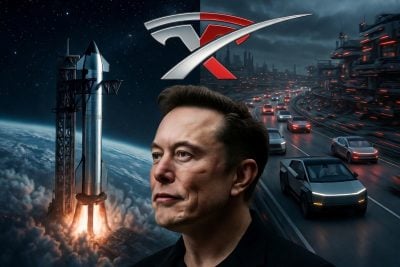
Tesla (NASDAQ:TSLA | TSLA Price Prediction) and SpaceX (NASDAQ:SPCX) just gave investors two very different versions of the Musk future. Tesla posted record deliveries of 480,126 vehicles but watched operating margin collapse to 1.4%. SpaceX, fresh off its $85.7 billion IPO, grew revenue 92% year over year. The comparison is finally possible on the same terms.

One Business Is Investing, the Other Is Compounding
Tesla’s quarter shows a company mid-transition. Revenue reached $28.24 billion, but EPS came in at $0.33 against a $0.5367 estimate, and free cash flow turned negative at $1.09 billion. CFO Vaibhav Taneja said plainly, “We are in a big investment cycle and expect our operating expenses largely driven by R&D to continue to grow in 2026 and beyond.” The $25 billion capital budget is going toward Optimus, Cybercab, a semiconductor fab, and AI compute.

SpaceX is spending even harder, but the return curve looks different. Capital expenditures hit $18.4 billion in a single quarter, with $15.8 billion of that supporting AI compute infrastructure. Adjusted EBITDA still climbed 191% to $3.5 billion. Starlink is the reason. Subscribers doubled to 12.0 million, and enterprise and government revenue grew 108% year over year, giving SpaceX a recurring revenue base Tesla still lacks outside FSD.
Where the Strategies Really Diverge
Tesla is betting that autonomy converts its installed base into a fleet. FSD attach exceeded 55% of new North American deliveries, and Robotaxi now operates in seven U.S. metros. Musk keeps stretching the promise, saying the ideal target is “99.999999% reliable”. That standard reflects the difficulty of the problem, but it also means Robotaxi cannot scale within the timeline retail investors have priced in.
SpaceX is running a different playbook: launch a service that already works, then multiply capacity. Elon claimed Starlink V3 satellites are “about an order of magnitude more capable” than V2, and SpaceX plans to fly ten times as many.
| Lens | Tesla | SpaceX |
| Core Bet | Autonomy and Optimus | Starlink plus AI compute |
| Q2 Free Cash Flow | Negative $1.09B | Funded by $100B cash |
| Key Vulnerability | Regulatory approval timing | Starship execution |
What I’m Watching Into 2027
For Tesla, I want proof that unsupervised miles continue to compound at “more than 10% a week” without a serious incident. That growth curve would justify the P/E near 359x.
For SpaceX, the critical mass Elon cited is about 1,000 V3 satellites, which management targets around the second quarter of 2027. If that constellation arrives on schedule, the $100 billion annualized revenue run rate by year-end starts to look reachable.
Why I Lean Toward SpaceX Right Now
On the metrics available today, SpaceX looks like the stronger setup. Tesla is trading on stories that Musk has been telling since 2019, and the stock is down 23.26% year-to-date because investors are noticing. SpaceX has the harder physics problem in Starship, but the connectivity business is already profitable and expanding into aviation, defense, and mobile markets. Management said, “We have never lost an enterprise customer.”

I would rethink this view if Robotaxi expands cleanly into ten more cities by early 2027, or if Starship suffers another setback that pushes V3 deployment out. Until then, SpaceX is the Musk bet with the shorter distance between promise and cash flow.
Contact [email protected] for any questions or corrections.
Omor Ibne Ehsan is a writer at 24/7 Wall St. He is a self-taught investor with a focus on growth, cyclical, and dividend equities that have strong fundamentals, value, and long-term potential. He also has an interest in high-risk, high-reward investments such as penny stocks.