Iran Just Raised the Stakes in the Gulf—These 5 Stocks Stand to Benefit
Iran's latest threat against US energy assets in the Gulf sent oil past $91 a barrel, and the money is already rotating into a handful of names before most investors notice the trade is live.

Iran told Reuters on September 7 that US energy assets in the Gulf are vulnerable after the latest round of clashes, and the market is already pricing the threat: WTI printed $91.48 per barrel on September 1, up 9.0% in a week. If Tehran follows through, the money is already moving into the five names below. Miss the rotation and you are buying the top.
1. Transocean (The Rig Shortage No One Is Pricing)
Transocean (NYSE:RIG | RIG Price Prediction) is a rig lessor. It owns and leases the ultra-deepwater and harsh-environment floaters that operators need when Middle East supply gets unreliable and majors race to sanction non-OPEC barrels. CEO Keelan Adamson told investors that “supply disruptions around the world, continued growth in oil and gas capex, and strong demand for our rigs all reinforce our view that we are in a multi-year upcycle for offshore drilling.”
The Q2 2026 numbers back him up. Transocean carries a $7.1 billion backlog at an implied average dayrate above $450,000, added $3.1 billion in contracts year to date including the Equinor award, and posted 97.0% fleet-wide revenue efficiency. Management expects deepwater utilization to move well into the 90% range during 2027.
The stock has already begun to move: RIG is up 88.71% over the past year and 41.65% year to date through September 4. That is the setup nobody is watching. The heavyweight below is the one everybody already owns.
2. Diamondback Energy (The Permian Cash Machine)
Diamondback Energy (NASDAQ:FANG) is the pure-play US shale barrel that gets repriced every time an Iranian drone flies. Its production sits in the Permian, not the Persian Gulf, and its CEO Kaes Van’t Hof has been the loudest voice on Wall Street framing the trade. On the Q2 call he said “the disruption of oil flows through the Strait of Hormuz has triggered the largest supply shock in the history of the global oil market” and told investors he believes the restocking required to rebuild global inventories has structurally raised the floor for oil prices.
Q2 2026 turned that thesis into cash. Diamondback booked adjusted EPS of $6.48 on $5.56 billion in revenue, beating estimates by 8.32% and 12.3%, with a realized oil price of $96.82 per barrel versus $63.23 a year earlier and free cash flow of $2.33 billion. The board doubled the buyback authorization to $16.0 billion, with $9.9 billion remaining.
Shares are up 34.77% year to date through September 4. Fine. Now ask who monetizes the barrel after Diamondback pumps it.
3. Marathon Petroleum (The Refiner Running Hot)
Marathon Petroleum (NYSE:MPC) is the crack-spread trade. When Gulf tensions curtail foreign refinery runs and US fuel prices hit a record Labor Day high, according to the Associated Press, MPC captures the spread. Management said on the Q2 call that global refining downtime is running roughly 4 million barrels per day above historical norms, driven by Persian Gulf disruptions and Ukrainian strikes on Russian infrastructure.
Q2 results were a monster. MPC delivered EPS of $17.73 versus a $13.9518 consensus, revenue of $51.99 billion, and R&M margin of $36.33 per barrel versus $17.58 a year earlier. Systemwide crude utilization ran 94%, with Gulf Coast refineries at 100%, and the company returned over $2.8 billion to shareholders in the quarter with $6.1 billion left on the buyback.
The market has noticed. MPC is up 141.93% year to date and 30.97% in the past month alone through September 4. Which brings us to the ships that move the barrels the refiners cannot get any other way.
Marathon Petroleum Refining Snapshot
| Metric | Q2 2026 | Year Ago |
|---|---|---|
| R&M adjusted EBITDA | $6.66B | $1.89B |
| R&M margin per barrel | $36.33 | $17.58 |
| Net income to MPC | $5.14B | $1.22B |
4. Scorpio Tankers (The Rerouting Trade)
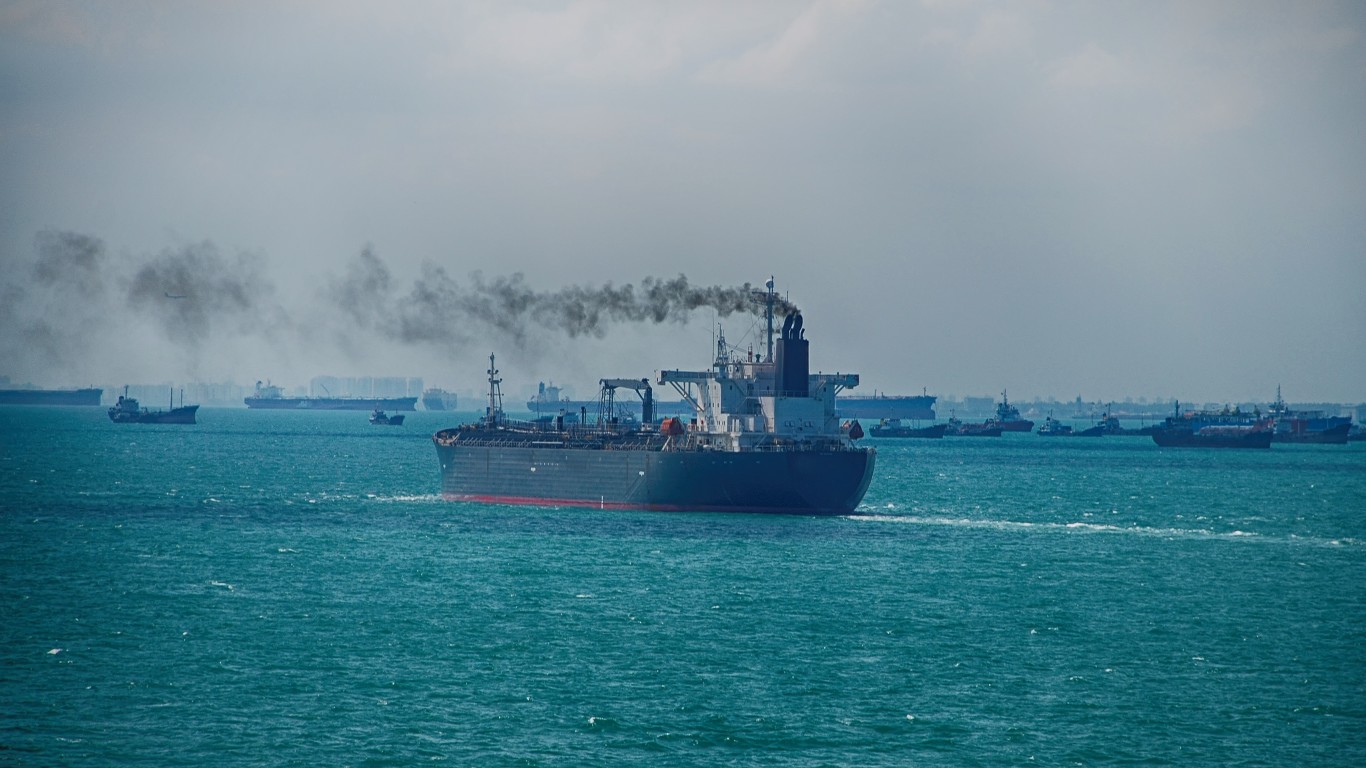
Scorpio Tankers (NYSE:STNG) operates the product tankers that carry gasoline, diesel, and jet fuel around the world. When Hormuz traffic reroutes and Red Sea risk pushes owners around the Cape of Good Hope, sailing distances balloon and ton-mile demand spikes. Management described the setup bluntly: “I’ve never seen a July or August market like this. This is not what you would consider to be a normal summer low.”
For Q2 Scorpio posted revenue of $408.73 million, up 77.5% year over year, and average daily TCE revenue more than doubled to $52,661 from $25,569. Q3 is already booking at elevated levels: LR2 spot rates at $65,000 per day with 34% booked, MR at $29,000 per day with 46% booked. The balance sheet is fortified with roughly $2.0 billion of unrestricted cash plus a $483.2 million undrawn revolver.
STNG has rallied 64.86% year to date through September 4. Solid. But there is one operator whose fleet is levered directly to the choke point itself.
5. Frontline (The Payoff Trade on the Choke Point)
Frontline (NYSE:FRO) is the pure-play VLCC and Suezmax operator whose earnings live and die by the Strait of Hormuz. CEO Lars Barstad did not hedge on the Q2 call: “The current market dwarfs the previous cycles.” Frontline cited an 82% reduction in crude oil exports from inside the Strait of Hormuz and a 23% increase in idling days per VLCC, both of which tighten effective fleet supply even as headline volumes fall.
Q2 delivered a profit of $659.2 million, or $2.96 per share, the best quarter Frontline has ever recorded, with Q2 VLCC TCE of $152,700 per day and Suezmax of $111,400 per day. Management then paid the money out: the latest declared dividend of $2.61 per share is the largest in Frontline’s recent history, and Barstad framed the capital-return posture starkly: “Our proposition to investors continues to be that we pay everything out.”
The market has already awarded the payoff. FRO is up 127.11% year to date and 133.08% over the past year through September 4. It is the cleanest way to own the choke point without predicting whether it closes.
Year-to-Date Price Performance
Trade in One Breath
Iran’s warning is the catalyst; the setup is already in motion. Offshore rigs get scarcer, US shale barrels get bid, refiners bank the crack, and the tankers that carry what is left charge whatever the market will pay. Every one of these names posted a blowout Q2 into the same disruption Tehran is now threatening to widen. Waiting for confirmation means paying up.
Contact [email protected] for any questions or corrections.
Chris Lange is a financial and geopolitical writer with more than a decade of experience covering a myriad of topics. He has published thousands of articles for 24/7 Wall St., with past coverage focused heavily on stocks, IPOs, healthcare, defense, global affairs, and technology.
His work has been quoted, or referenced by a number of outlets including Business Insider, USA Today, Yahoo Finance, MSN, The Motley Fool, and many other publications. A graduate of Southwestern University, he studied business with a focus on investments and has previous experience in banking and startups.
When not reading or writing the news, he is following his passion for Lacrosse, playing chess, or building solar projects with his dad.