Prediction: Amazon Stock Could Be the Sleeper Winner of the AI Boom
While investors chase the obvious AI winners, Amazon has been quietly building something that its own CEO calls a potential trillion-dollar annual revenue business, and the market still has not fully priced it in.

Amazon (NASDAQ:AMZN | AMZN Price Prediction) has spent much of 2026 in the shadow of flashier AI names, but the Q2 print made clear that Andy Jassy is running one of the highest-velocity AI franchises in the market.
AWS just reported its fastest growth in 18 quarters, the AI and chip businesses each cleared a $25 billion run rate, and the stock still trades at a discount to Microsoft on trailing earnings.
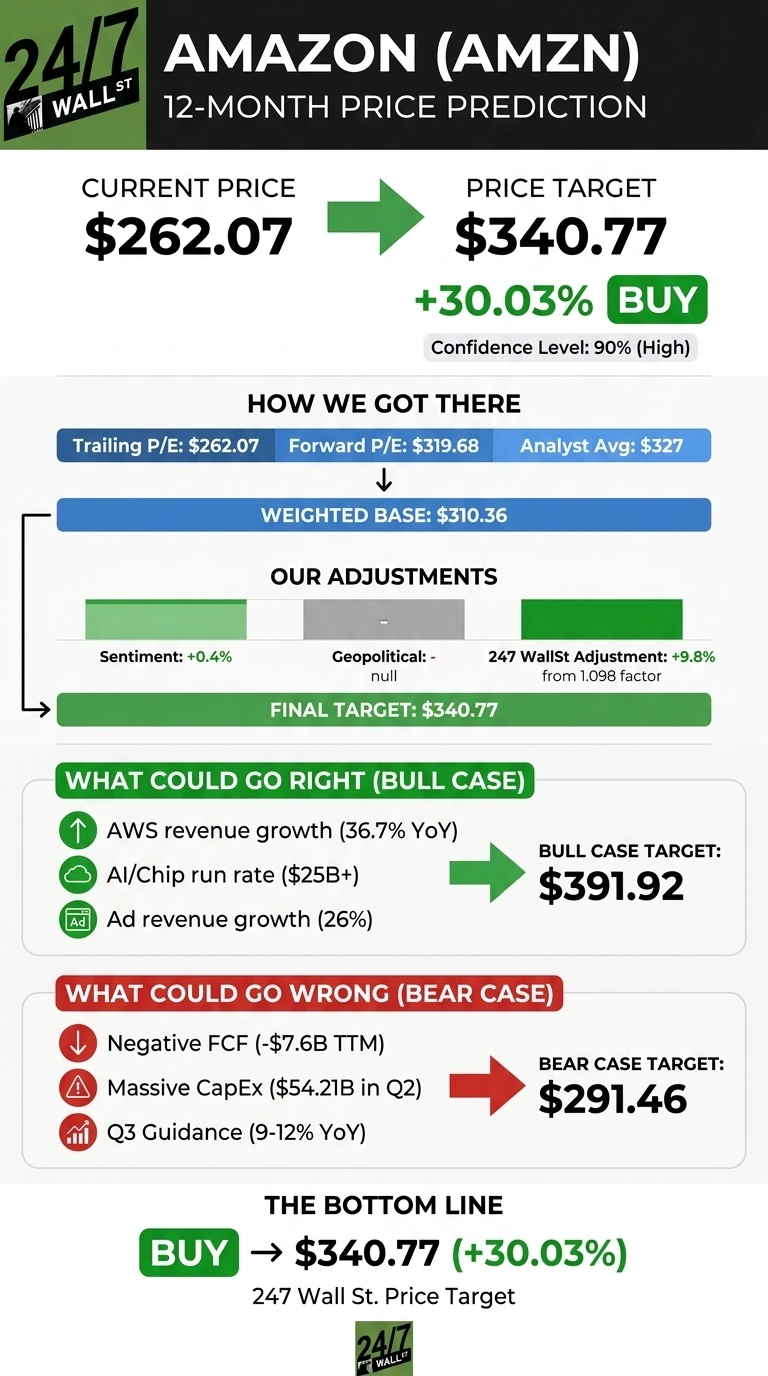
Our 24/7 Wall St. price target for Amazon is $340.77 over the next 12 months, implying 30.03% upside from the current $262.07. Our recommendation is buy with a confidence of 90%, which we consider high.
| Metric | Value |
|---|---|
| Current Price | $262.07 |
| 24/7 Wall St. Price Target | $340.77 |
| Upside | 30.03% |
| Recommendation | BUY |
| Confidence Level | 90% |

An AWS Reacceleration the Market Is Only Starting to Believe
Shares are up 12.91% in the past month and 13.54% year to date, with the 52-week range at $196 to $287.20.
The Q2 2026 report on July 30 delivered revenue of $200.61 billion, up 19.62% YoY and beating expectations by 2.12%. AWS grew 37% to $42.23 billion at a 39.4% operating margin, and the AWS backlog now sits at $496 billion.
Operating income jumped 43.24% to $27.46 billion. Reddit sentiment briefly turned bearish around Aug 17-18 on AI debt concerns but has recovered to a composite score of 62.56.

Why Bulls See $390 or Higher
Our bull-case path reaches $391.92 within 12 months. The drivers are concrete. Anthropic has secured up to 5GW of Trainium capacity, and OpenAI committed roughly 2GW starting in 2027. Jassy said AWS capacity will double by the end of 27 versus 25 and that both 27 and 28 capacity is largely reserved.
Advertising grew 26% to $19.81 billion, and management now argues AWS could ultimately become “a trillion dollar annual revenue business“. Polymarket assigns a 0.86 probability to 2026 capex above $200B, validating the demand story.

What Could Go Wrong
The bear-case path lands at $291.46. Trailing free cash flow has turned negative at -$7.6 billion as capex hit $54.21 billion in the quarter alone, and 2026 capex is guided near $200 billion. GAAP EPS is inflated by a $53.4 billion non-operating gain from Anthropic.
Q3 guidance implies 9% to 12% growth with an 80 basis point FX headwind. That said, Jassy noted servers “break even” in under three years and monetize for five to six, meaning today’s capex should convert into future free cash flow on a multi-year lag.
How Amazon Compares to Microsoft and Alphabet
Microsoft (NASDAQ:MSFT) is the closest hyperscaler comp. Azure grew 43% last quarter and MSFT trades at a P/E of 27. Alphabet (NASDAQ:GOOGL) is the other. Google Cloud accelerated to 82% growth in Q2 2026, yet Alphabet trades at just 15 times earnings.
| Company | P/E | Cloud Growth |
|---|---|---|
| Amazon | 21 | 37% |
| Microsoft | 27 | 43% |
| Alphabet | 15 | 82% |
Against Microsoft, Amazon looks cheap for comparable cloud momentum, which makes our target look conservative. Against Alphabet, Amazon looks pricier, which keeps us from pushing beyond the base case.
Amazon Price Prediction 2026-2030
Our 24/7 Wall St. price target of $340.77 with a buy rating and 90% confidence rests on one factor: AWS reaccelerating into a demand curve that is largely presold through 2028.
The bull thesis strengthens if capex-to-revenue conversion begins to show through in 2027 free cash flow. It weakens if AWS growth slips back below 30% while capex holds near $200 billion. On the current data, the risk-reward skews positive.
| Year | 24/7 Wall St. Price Target |
|---|---|
| 2026 | $289 |
| 2027 | $340.77 |
| 2028 | $400.56 |
| 2029 | $475.42 |
| 2030 | $509.30 |
These projections assume Amazon continues executing on Trainium, Bedrock, and advertising monetization. Significant upside or downside could result from AI capex ROIC surprises or a broader consumer slowdown. The other side of that capex, the power, cooling, and networking suppliers absorbing the buildout, is where we spent a separate free report, here.
Contact [email protected] for any questions or corrections.
Vandita Jadeja is a financial publisher with over a decade of experience writing about financial topics, including investment, savings, retirement, insurance and banking. Vandita is a Chartered Accountant who loves to debunk financial concepts for readers.
Her work has appeared on sites that include The Motley Fool, InvestorPlace, and Benzinga. She covers investing and focuses on stock picks and price prediction for 24/7 Wall St.
When not looking for the next stock investment opportunity, she can be found traveling, reading, chasing sunsets and enjoying her iced latte.