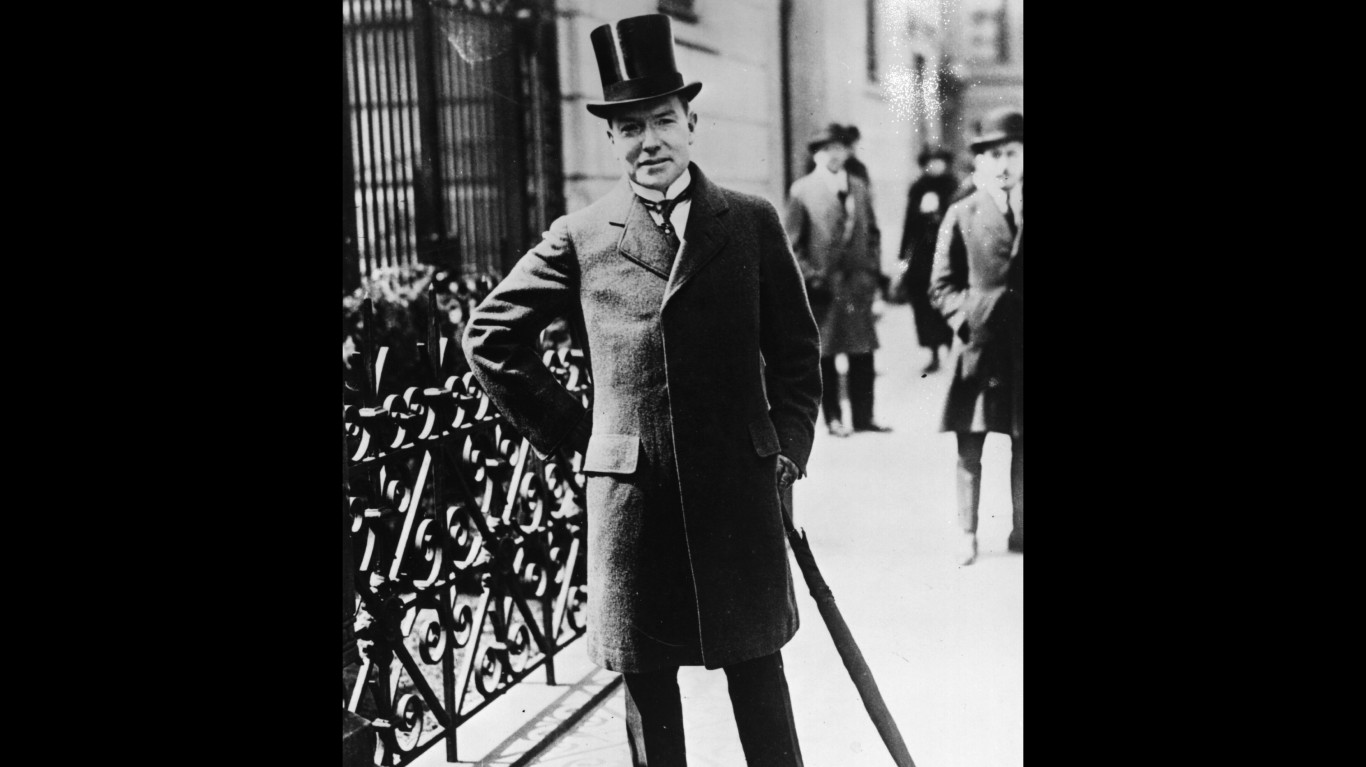
Cornelius Vanderbilt Was America’s Richest Man. He Left No Trust. 4 Generations Later, His 120 Descendants Had Zero Millionaires.
The Commodore built the largest private fortune in American history and handed it to his heirs without a single legal restriction, trusting that his instructions would be enough. They were not, and what happened next became the cautionary tale every…


Although the Gilded Age produced fortunes that seemed engineered to outlast the men who built them, Wall Street’s oldest lesson about dynastic money keeps repeating itself. Cornelius “Commodore” Vanderbilt died in 1877 with a fortune estimated at $95 million to $105 million, a sum widely cited at the time as larger than what sat in the U.S. Treasury. By any accounting anyone bothered to keep, he was the wealthiest American of his era. He handed the money over outright, without a trust, and what followed has become the case study every estate attorney reaches for when a client waves off structure as overkill.
The Commodore had been the richest person in the country by the 1860s. His will left roughly 95% of the fortune directly to his son William Henry Vanderbilt, with instructions that the money not be wasted. Those instructions carried moral weight, not legal weight. No trust structure protected the assets, no professional trustee gated distributions, no spendthrift clause restrained future heirs. What the second generation received, it received outright.
Second Generation Actually Grew It
The story is often told as a straight line from riches to ruin, and that reading is wrong. William Henry Vanderbilt was the richest American from 1877 until his own death in 1885, and during those roughly eight years he approximately doubled the family fortune to more than $200 million by expanding the New York Central Railroad. The second generation compounded the inheritance rather than squandered it.
The dispersion started later, and it happened through mechanics that had nothing to do with taxes. The federal estate tax did not exist in 1877. What eroded the Vanderbilt position was a different kind of arithmetic: a fortune divided across a widening family tree with each generation, held in trophy assets with brutal carrying costs, and tethered to a railroad industry that had stopped being the growth engine of America’s future. Later heirs built ten Fifth Avenue mansions, all of which had been demolished by 1947, alongside yachts and legendary entertaining, without the operating income discipline that had defined the first two generations.
Thirty Years to Fall Off the List
The collapse of relative wealth was faster than the buildup. By 1907, within thirty years of Cornelius’s death, no Vanderbilt sat among the richest people in the United States. Within forty-eight years, one of his direct descendants died penniless. In 1973, 120 of Cornelius’s descendants gathered at Vanderbilt University for the family’s first reunion. That figure represents the attendees, not a total count of living heirs. According to family historian Arthur T. Vanderbilt II, writing in Fortune’s Children: The Fall of the House of Vanderbilt, not one of those 120 attendees was a millionaire. Some later commentators have questioned whether the reunion’s guest list fully represented the family’s financial picture, since roughly 80 of the 120 were direct descendants and the total living count of Cornelius’s heirs in 1973 was substantially larger. The core point, however, is not in dispute: the fortune that had dwarfed the U.S. Treasury was essentially gone in under a century.
The reason is structural. Nothing in the legal architecture of the Vanderbilt estate required discipline from anyone who inherited. What the family lacked was a container.
The Rockefeller Counterexample
The contrast that estate lawyers keep on the shelf is the Rockefellers. In 1934, John D. Rockefeller Jr. placed the bulk of the family fortune into irrevocable dynasty trusts, and those trusts have carried assets through six generations without a single federal estate tax bill. The 1934 trusts predate the generation-skipping transfer tax Congress created in 1976 and were grandfathered under it. The mechanics of that structure are covered in a companion piece on the Rockefeller trusts, and the broader arc of the industrial families that built the country is tracked here.
What the Modern Version Looks Like
The modern equivalent is still legal and still in use. Dynasty trusts are typically paired with the federal estate and generation-skipping transfer exemption. For 2026, the basic exclusion amount is $15,000,000 per individual, up from $13,990,000 for decedents who died in 2025. That increase is now set in statute: the One Big Beautiful Bill, signed into law in 2025, made the higher exemption permanent and ended the sunset that had been scheduled under the prior tax framework. Perpetuity-friendly jurisdictions for trust formation include South Dakota, Nevada, Delaware, Alaska and Wyoming. The relevance for the Vanderbilt lesson is spendthrift control, restricted distributions and professional management: the three protections a raw bequest cannot supply.
This structure is built for estates large enough to exceed the exemption. It is not a mass-market tool, and nothing here is investment or legal advice. Readers with taxable estates should consult an estate attorney (a free checklist covering beneficiary forms, titling and trust choices is available here: Die With a Plan). The Vanderbilt fortune was not taxed away, because the tax did not yet exist. It was dispersed, spent and outgrown, which is what unstructured wealth tends to do when the container is a signature on a will rather than a trust indenture. Long term, American capital still compounds. It just does not always compound inside the same family.
Editor’s note: This article has been updated to correct a reference to Cornelius Vanderbilt’s “grandchild” dying penniless (the primary source, Fortune’s Children, uses “direct descendant”), to add context noting that some later commentators have questioned the breadth of the 1973 reunion as a representation of the family’s finances, and to note that the 2026 federal estate tax exemption of $15,000,000 is now set in statute following passage of the One Big Beautiful Bill.
Contact [email protected] for any questions or corrections.
AJ spent 10 years writing about financial markets at The Motley Fool. His coverage centers on technology stocks and the broader macroeconomic trends, from interest rates to geopolitics, that shape where markets are headed next. AJ is drawn to the stories where big-picture economics and individual companies collide.