Leading Economist Warns Chip Tariffs Could Make the AI Buildout More Expensive
A Heritage Foundation economist is challenging the Trump administration's push for semiconductor tariffs, arguing that the timing could saddle chip buyers with higher costs before a single new American fab is ready to ship product.

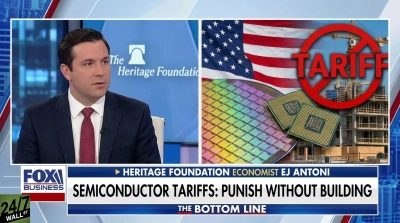
EJ Antoni, chief economist at the Heritage Foundation, a conservative think tank, used a recent appearance on Fox Business’s The Bottom Line to push back on reports that the Trump administration is considering new tariffs on foreign semiconductor imports as part of a push to restore chip manufacturing to the United States. He argues that the administration risks raising import costs before domestic manufacturers can add more supply.
Chip Tariffs Can Raise Prices Before Factories Raise Output
Antoni’s core objection is that there is no domestic supply to shift toward today instead of importing: “We absolutely need to win the race. We need to make all the stuff here, but we need the input. So it does not make sense right now to tariff when there is nowhere else we can get it from at the moment but overseas,“ he said.
With CPI at 3.4% in July 2026 and the U.S. trade balance at -$73.3B in June, added import costs on chips would land on already-tight supply. Recent memory supercycle coverage has flagged supply constraints as the binding limit, and Antoni argues additional tariffs might not be able to positively impact supply in the short term.
“Tariffs Are a Negative Incentive”: The Alternative
In Antoni’s view, negative incentives like tariffs could work even better when complimented with positive incentives: “Tariffs are a negative incentive. It is telling you what not to do, but it is not telling you what to do. It is the difference between bopping your dog on the nose because he does something bad and giving him a treat because he does something good,” he said.
Antoni cites the failure of prior trade deals and the Biden administration’s CHIPS Act as evidence that mandates and subsidies without clear performance metrics do not work. His alternative: “If you want to incentivize production here, then give time-limited subsidies that are tied to actual production. How about tax and regulatory reform that is going to reduce the cost here and just provide a natural market incentive for people to move production here?”
Micron’s $50 Billion Boise Buildout Puts Tariff Timing in Focus
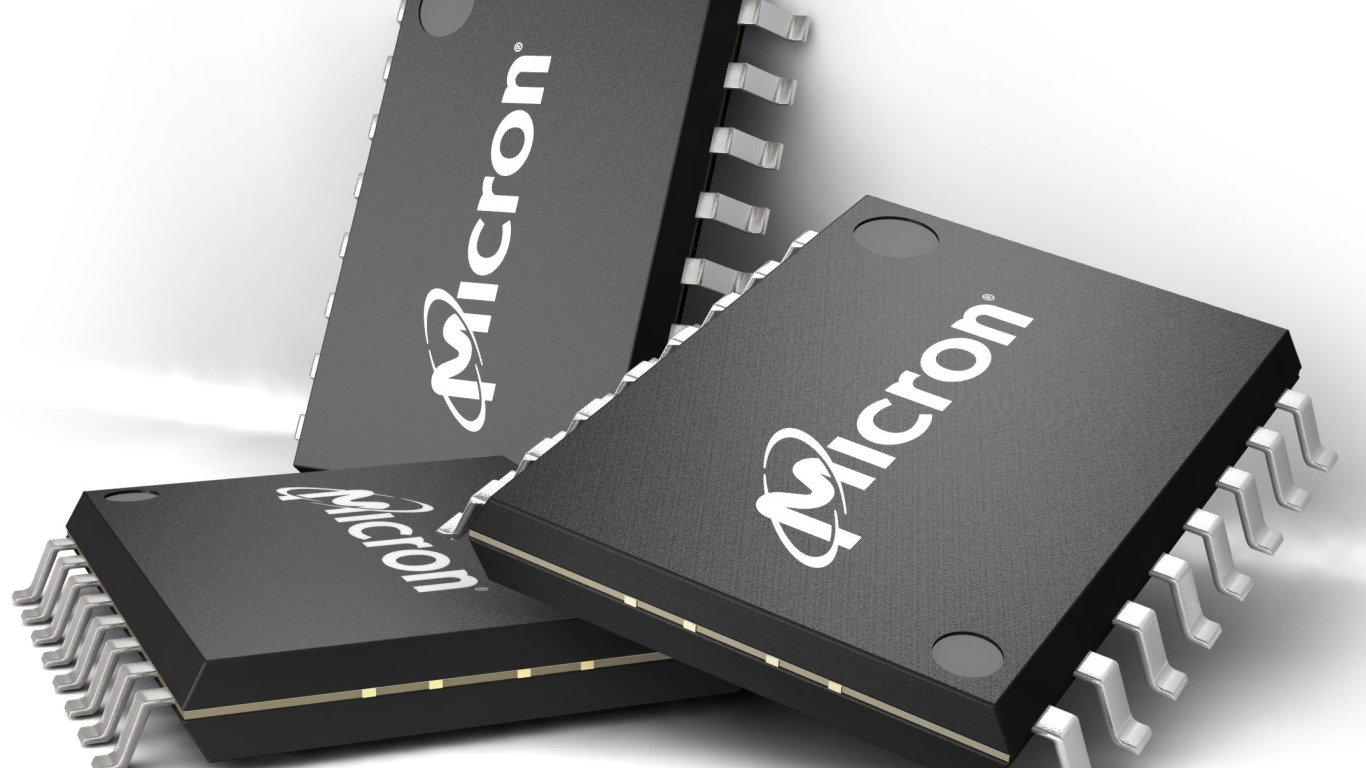
Micron’s (NASDAQ:MU | MU Price Prediction) $50 billion Boise buildout is supported by up to $6.2 billion in CHIPS Act funds, alongside a $100 billion campus in Clay, New York, with the first Boise fab targeted for 2027 and the second for late 2028. Micron has been described as the only U.S. company manufacturing high-bandwidth memory at scale. But with much of the capacity still years away, Antoni’s concern is that tariffs could raise chip costs long before new U.S. fabs are ready to offset foreign supply.
Reference material on U.S. and EU chip strategies notes that the U.S. is on track for 30% of global production by 2032 under current policy, a target that assumes those buildouts land on schedule.
Key Takeaways
Antoni’s warning is about the gap between raising tariffs and bringing factories online. If import costs rise before domestic supply can respond, chip buyers could face higher expenses with few immediate alternatives.
Contact [email protected] for any questions or corrections.
Thomas Richmond is a financial writer and content strategist with 5+ years of experience covering stocks and financial markets. He has published over 250 articles focused on individual stock analysis, helping investors better understand business fundamentals, stock valuations, and long-term opportunities.
Thomas previously served as a Content Lead at TIKR, a stock research platform, where he helped scale the company’s blog to hundreds of articles per month and contributed to a weekly newsletter reaching more than 100,000 investors.
He specializes in breaking down complex companies into clear, actionable insights for everyday investors, with a focus on fundamentals-driven research.
His work has also been featured on platforms including Seeking Alpha and Sure Dividend.
Outside of work, Thomas enjoys weight lifting and soccer.