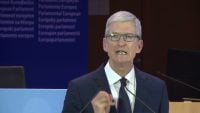
Tim Cook Sold 3.1 Billion iPhones
Tim Cook moved billions of iPhones and doubled Apple's slice of the S&P 500, yet one looming question about his legacy may overshadow all of it: did sitting out the AI arms race save Apple or doom it?

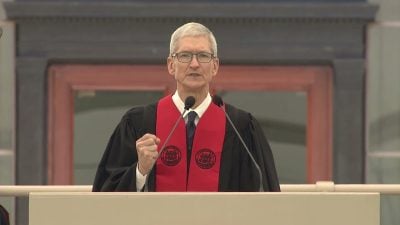
According to International Data Corporation, Apple (NASDAQ: AAPL | AAPL Price Prediction) sold 3.1 billion iPhones under Tim Cook’s leadership. The FT says Apple’s market cap went from about 3% of the S&P 500 to 6% today. Toward the end of that run, Apple’s relation to the S&P flattened at between 6% and 8%. In the last few years, companies have gained on Apple’s place. at the top of the market cap ladder.
In particular, its market cap dropped below Nvidia’s (NASDAQ: NVDA). Apple’s hardware sales core gave way to Nvidia’s AI chips. Nevertheless, Apple remains in No. 2 at $4.78 trillion. Nvidia’s is $5.25 trillion. For all their AI prowess, every other stock in the Magnificent 7 sits behind Apple in value.
If there is one criticism of Cook’s tenure, it is that he could not come up with a product that came anywhere close to the iPhone’s success. Apple’s co-founder Steve Jobs launched the first iPhone in 2007, so it is nearly two decades old. That is a very long time to have a single flagship product. However, Cook updated it so often and added features. The iPhone has been the most profitable smartphone. For most of Cook’s tenure, it has been the best-selling. From time to time, Samsung moved ahead.
It is hard to say what Cook’s reputation will be regarding AI. His attempt to build Apple’s own software did not work. Its top engineers went to other companies. Cook eventually adopted Google’s Gemini product, which it will pay $1 billion a year for. Gemini will power Apple Intelligence and Siri. Apple seems to have gotten the better deal financially, but Gemini gets huge distribution across Apple’s installed hardware base. That will help it compete with OpenAI and Anthropic.
Another benefit Apple may end up having in the AI sector is that it is not in the race for expansion that is costing OpenAI, Anthropic, Microsoft (NASDAQ: MSFT) and several others hundreds of billions of dollars to build AI data centers. If AI growth slows, these moves will become among the worst decisions in US business history. Apple will not have drained its bank account betting on a single horse.
Cook will have sold a lot of iPhones. But will staying on the AI sideline look brilliant or like a huge mistake?
Contact [email protected] for any questions or corrections.
Douglas A. McIntyre is the co-founder, chief executive officer and editor in chief of 24/7 Wall St. and 24/7 Tempo. He has held these jobs since 2006.
McIntyre has written thousands of articles for 24/7 Wall St. He is an expert on corporate finance, the automotive industry, media companies and international finance. He has edited articles on national demographics, sports, personal income and travel.
His work has been quoted or mentioned in The New York Times, The Wall Street Journal, Los Angeles Times, The Washington Post, NBC News, Time, The New Yorker, HuffPost USA Today, Business Insider, Yahoo, AOL, MarketWatch, The Atlantic, Bloomberg, New York Post, Chicago Tribune, Forbes, The Guardian and many other major publications. McIntyre has been a guest on CNBC, the BBC and television and radio stations across the country.
A magna cum laude graduate of Harvard College, McIntyre also was president of The Harvard Advocate. Founded in 1866, the Advocate is the oldest college publication in the United States.
TheStreet.com, Comps.com and Edgar Online are some of the public companies for which McIntyre served on the board of directors. He was a Vicinity Corporation board member when the company was sold to Microsoft in 2002. He served on the audit committees of some of these companies.
McIntyre has been the CEO of FutureSource, a provider of trading terminals and news to commodities and futures traders. He was president of Switchboard, the online phone directory company. He served as chairman and CEO of On2 Technologies, the video compression company that provided video compression software for Adobe’s Flash. Google bought On2 in 2009.