Meta’s Next Trillion Dollars Could Come From AI. Here’s Our Price Target for 2027
Meta's stock is down sharply, capex is ballooning toward $145 billion, and Wall Street's average target stops well short of four digits. So what would actually need to happen for shares to reach $1,000 by 2027?

This post may contain links from our sponsors and affiliates, and Flywheel Publishing may receive compensation for actions taken through them.

I’ve watched Meta (NASDAQ:META | META Price Prediction) transform from a social media company into what CEO Mark Zuckerberg now calls a “full-stack technology company” spanning data centers, custom chips, foundation models, and consumer apps. That reinvention hasn’t been kind to the stock lately.
Shares are down 12.2% year-to-date and off 21.43% over the past year, weighed down by a Q2 miss, $2.4 billion in legal charges, and sticker shock over $130 to $145 billion in 2026 capex. Yet Meta’s AI flywheel is quietly compounding. Here’s the path for shares to hit $1,000 by 2027.

Wall Street Sees Upside, Just Not $1,000 Yet
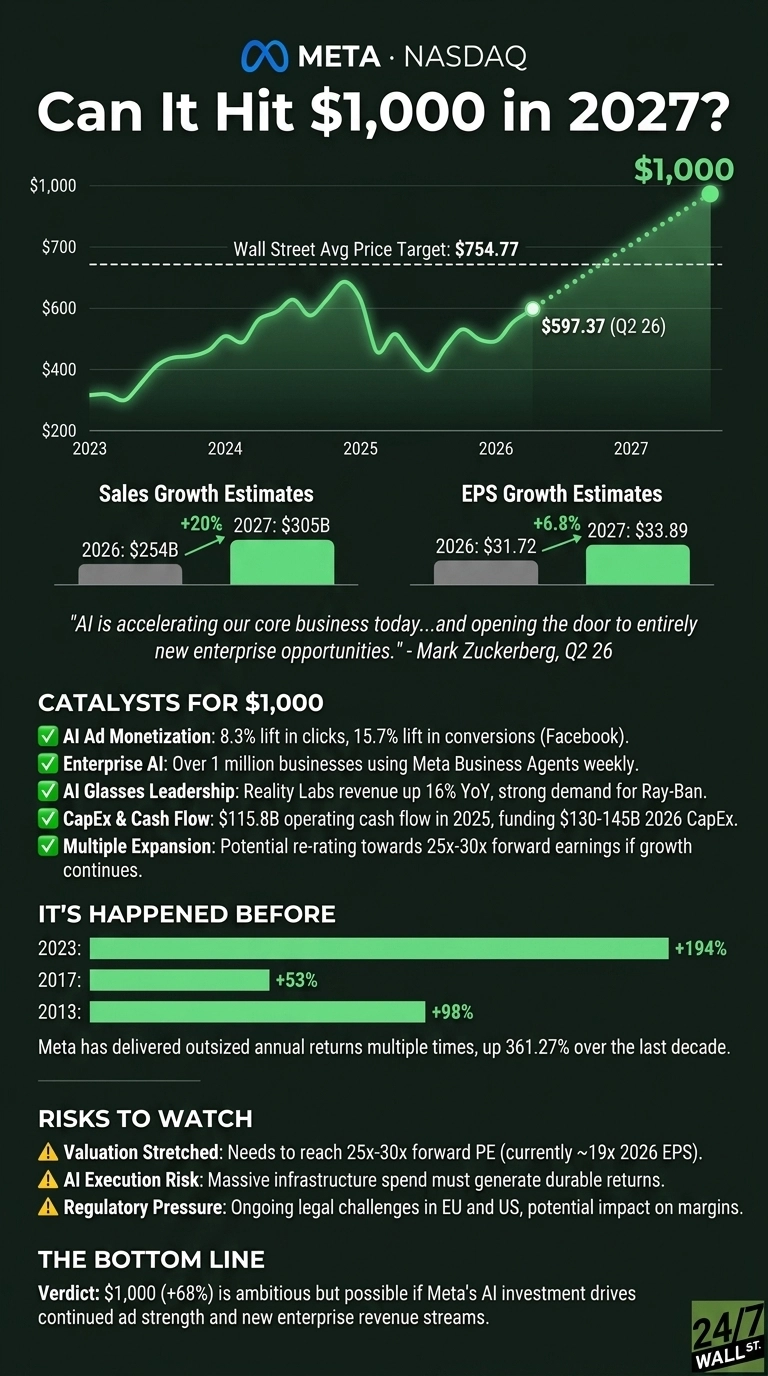
The Street’s average target sits at $754.77, with 47 buys, 8 strong buys, 7 holds, and zero sells. Analysts model 2026 EPS of $31.72 rising to $33.89 in 2027, with a high-end 2027 estimate reaching $40.31.
Revenue is projected to climb toward $305 billion in 2027. Estimate revisions have skewed negative in the past 30 days after the Q2 miss, but bulls will note Meta had beaten consensus in 5 of the last 6 quarters before that stumble.

Path to $1,000 Per Share
At today’s price near $594.61, Meta trades at roughly 19x 2026 EPS and 18x 2027 EPS. To hit $1,000, shares would need to gain about 68% and trade near 30x forward earnings on consensus, or closer to 25x if Meta reports toward the high-end 2027 estimate of $40.31. That’s a premium to the S&P 500’s 22x forward multiple, but reasonable for a business compounding earnings at this scale.
What could push Meta to $1,000?
- AI-driven ad monetization. Zuckerberg said on the Q2 call that “on a dollar basis, our ads business is reporting faster year over year revenue growth than any other company’s reported ad business.” Advantage Plus already exceeds a $75 billion annual run rate, and new ranking models drove an 8.3% lift in Facebook ad clicks and 15.7% uplift in conversions.
- Enterprise AI as a new revenue line. Over 1 million businesses now use Meta Business Agents weekly, and Zuckerberg noted “there will continue to be a significantly higher margin on selling intelligence rather than selling compute directly.”
- AI glasses. The Ray-Ban and Oakley lines are selling ahead of plan, with Reality Labs revenue up 16% year over year to $431 million.
- Cash-flow firepower. Meta generated $115.8 billion in operating cash flow in 2025, funding both the buildout and $26.2 billion in buybacks.
Meta’s History Says 68% Isn’t a Reach
Meta has posted multiple years of outsized gains, and shares are still up 361.27% over the past decade.
A move from the mid-$500s to $1,000 by late 2027 would roughly retrace the 2023 recovery playbook. It also aligns with Meta’s five-year base-case scenario, which projects shares reaching $1,336 by 2031.
Bottom Line on $1,000
Hitting $1,000 requires roughly 68% upside from current levels, a re-rating toward 25x to 30x forward earnings, and continued proof that Meta’s AI capex is generating durable returns.
With $120 billion in cash and investments, industry-leading ad monetization, and Zuckerberg betting the company on personal superintelligence, the ingredients are there (we reverse-engineered what the biggest tech winners looked like early and put the pattern in a free playbook). Returns at this level shouldn’t be expected every year, but we’ve outlined the blueprint for how Meta could see outsized returns in 2027.
Contact [email protected] for any questions or corrections.
Vandita Jadeja is a financial copywriter who loves to read and write about stocks. She believes in buying and holding for long term gains. Her knowledge of words and numbers helps her write clear stock analysis. She has contributed to several publications, including the Joy Wallet, Benzinga, The Motley Fool and InvestorPlace.