Cramer Says the Magnificent Seven Are Finally Cheap and Most Investors Will Miss It
Jim Cramer is calling the Magnificent Seven a generational buying opportunity, but the argument only holds for some of them, and getting that distinction wrong is an expensive mistake.

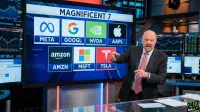
On September 3, 2026, CNBC’s Jim Cramer told viewers, “we’re witnessing the revenge of the Magnificent Seven, and most people don’t even seem to know it”. His argument, learned at Goldman Sachs, is that everything is a buy at a price, and this group has finally reached it.
The real question is narrower than his framing suggests. These companies are spending fortunes on AI infrastructure, and the market has stopped crediting them for it. Either that capital converts into free cash flow growth, in which case current prices look obvious in hindsight, or the market is correctly pricing capital destruction
Cramer thinks the first. I think he is mostly right about two names, half-right about two, and wrong to lump the last two into the same argument.
Why the Group Fell Out of Favor
Cramer said that outside Apple, “Amazon, Alphabet, Meta, Microsoft, Nvidia, and Tesla have become forlorn losers… perennially disappointing falling way behind the market”. The mechanism is straightforward. Heavy capex depresses free cash flow now in exchange for profits later, and markets discount distant profits harshly when they doubt them.
The numbers make that concrete. Meta Platforms (NASDAQ:META | META Price Prediction) guided 2026 capex to $130-145 billion and free cash flow collapsed to $784 million from $8.55 billion a year earlier. Amazon (NASDAQ:AMZN) posted trailing free cash flow of negative $7.6 billion against $53.1 billion in quarterly capex.
The bet is that these dollars come back multiplied. Andy Jassy said data centers can be monetized for 30-plus years once servers go in. That is a long time to wait for a market fixated on the next quarter, and it is also why the power, cooling, and networking suppliers behind these builds keep showing up in our free report on seven AI infrastructure names that aren’t chipmakers.
Amazon and Alphabet Have the Cleanest Cases

Cramer said “Amazon is cheap… Andy Jassy is willing to wreck Amazon’s balance sheet like the old days… because they’re going to make fortunes”. AWS grew 37% year over year to $42.23 billion, its fastest growth in 18 quarters, with backlog at $496 billion. The falsifiable test is whether AWS operating income grows faster than depreciation once these data centers monetize.
Alphabet (NASDAQ:GOOGL) is more interesting. It trades at a trailing P/E of 17x, against Google Cloud’s 82% year-over-year growth. Per the company’s Q2 8-K, revenue rose 24.2%.
Cramer skips the harder question: whether search economics survive AI assistants. My read is that Gemini’s 950 million monthly users and enterprise traction suggest Alphabet is capturing the substitution rather than losing to it. That is worth owning at 16 times earnings.
Meta’s Legal Overhang and the WhatsApp Question
Meta’s Q2 included $2.4 billion in legal charges and $1.2 billion in severance from an 8,000-employee reduction. The stock is down 16.88% over the past year.
The WhatsApp claim needs interrogation. An asset is only undervalued if there is a credible monetization path. Family of Apps Other revenue hit $1 billion for the first time, up 73%, driven by WhatsApp paid messaging. That is a real path, though small against the market cap. At 22 times earnings, Meta is priced for the legal overhang to fade, with WhatsApp treated as optional upside rather than a second engine.
NVIDIA and Tesla Don’t Belong in the Same Argument

NVIDIA (NASDAQ:NVDA) trades at a forward P/E of 24x after Q2 revenue more than doubled to $96.22 billion. Management guided fiscal 2028 growth of roughly 70% as supply-constrained. Cramer noted the Hugging Face acquisition addresses the perception that NVIDIA is a training-only story. The valuation implies growth ends soon, while the order book points the other way.
Tesla (NASDAQ:TSLA) is a different animal. It is down 16.31% year-to-date, with a trailing P/E of 392x and an operating margin of 4.6%. Grouping seven companies together was always a marketing convenience.
Verdict
Cramer said, “the Magnificent Seven finally are cheap compared to the rest of the market, and I think it’s time to buy”. Alphabet and Amazon are the two I would own at these prices. Microsoft (NASDAQ:MSFT) and NVIDIA are fairly valued for what they deliver. Meta requires believing legal costs are one-time. Tesla is a venture bet dressed as a Mag 7 stock.
The falsifiable test is capex converting into free cash flow growth, beyond revenue growth alone, over the next four quarters. If AWS and Google Cloud margins hold while depreciation accelerates, Cramer is right. If they compress, the market was right to look away.
Contact [email protected] for any questions or corrections.
Omor Ibne Ehsan is a writer at 24/7 Wall St. He is a self-taught investor with a focus on growth, cyclical, and dividend equities that have strong fundamentals, value, and long-term potential. He also has an interest in high-risk, high-reward investments such as penny stocks.