SpaceX Stock Is Still Below Its First Closing Price. One Analyst Sees 450% Upside From Here
SpaceX debuted as one of the most anticipated IPOs in history, yet the stock still sits below its first closing price while one analyst has staked out a target that towers above every other call on Wall Street.

This post may contain links from our sponsors and affiliates, and Flywheel Publishing may receive compensation for actions taken through them.

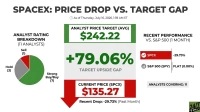
SpaceX (NASDAQ:SPCX | SPCX Price Prediction) closed at $149.74 against a Wall Street consensus price target of $222.32, leaving roughly 48% of implied upside between the current price and the average analyst call.
Elon Musk’s rocket, satellite, and AI compute company priced its historic IPO earlier this year and briefly touched $225.64 before the selling started. Even after a strong bounce off the summer lows, the stock still trades below where it closed on day one as a public company. That is the gap Wall Street thinks the market has mispriced.
SpaceX matters because it is now a genuine mega-cap, with a market value near $1.85 trillion, and because its Starlink, Starship, and Grok franchises touch nearly every hot theme investors are chasing. When a name this big trades this far below target, it is worth understanding why.
Post-IPO Hangover With Fundamentals Intact
The drop was mostly a valuation reset driven by supply and sentiment. Shares slid from the $225.64 52-week high to a low of $104.83 as the post-IPO quiet period ended and lockup-related supply hit the market. The AI-compute build-out did not help. SpaceX spent $18.37 billion in capex in a single quarter, with $15.83 billion aimed at AI compute (the same power, cooling, and networking demand we mapped in a free report on seven AI infrastructure stocks that aren’t chipmakers), and management pointed to two more quarters at similar intensity.
Fundamentals actually beat. Q2 revenue came in at $7.81 billion, blowing past the $6.82 billion consensus, and adjusted EBITDA jumped 191% year over year. The market still faded it. Investors saw the $541 million net loss, the $327 million in related-party interest expense, and the pending $60 billion Cursor acquisition, and decided that scale did not yet mean profits.
Why Raymond James Sees $800
The Street-high target belongs to Raymond James analyst Brian Gesuale, who carries a Strong Buy and an $800 price target. From $149.74, that implies roughly 434% of upside, well above the 40% threshold that turns a call into a thesis worth studying.
Gesuale frames SpaceX as the foundational industrial and orbital infrastructure monopoly of the 21st century, with three legs to the stool. First, an orbital and AI compute monopoly where Starlink is the backhaul backbone and satellite-borne clusters run the edge. Second, Starship-driven cost deflation that hands SpaceX an unassailable moat, enabling the company’s 100,000-satellite constellation. Third, optionality on point-to-point terrestrial payload delivery and defense contracts like spaceborne missile tracking.
The near-term catalysts are concrete. Management has told investors it expects to hit $100 billion of annualized revenue run rate by the end of this year, pulled its internal $1 trillion revenue target from 2031 into 2030, and just signed $6.7 billion of new cloud-services contracts in the first weeks of Q3. Starship Flight 14 is the next binary event.
The consensus stance backs the bull view. Of 35 covering analysts, the ratings split runs 6 Strong Buy, 22 Buy, 5 Hold, and 2 Sell, with 80% bullish sentiment overall.
Peer Reactions Diverged
SpaceX fell largely on its own dynamics. The launch and satellite complex has been choppy, but not in unison.
Rocket Lab (NASDAQ:RKLB) trades at $63.81, down 14.33% over the past month as investors digested the Iridium deal and Neutron timeline. Consensus sits at $111, implying roughly 74% upside, with 3 Strong Buy, 11 Buy, and 4 Hold ratings.
AST SpaceMobile (NASDAQ:ASTS) sits at $62.13, off 14.46% year to date after a brutal Q2 double miss. Consensus of $79.61 implies around 28%, with an unusually cautious mix of 1 Strong Buy, 3 Buy, 7 Hold, 1 Sell, and 1 Strong Sell.
The largest analyst-implied upside in the group sits with SpaceX itself, both on the consensus and on the Raymond James Street-high. Wall Street clearly views SpaceX as the deepest dislocation in the space complex.
Numbers Behind the Dislocation
SpaceX trades at $149.74, roughly 48% below the $222.32 consensus target set by 35 analysts. The stock is up 19.48% in the past month but down 6.96% over the past year. The S&P 500, by contrast, is up 13.38% year to date and 20.11% over the trailing year.
The Raymond James Street-high $800 target implies about 434% upside, more than nine times the consensus gap. Analyst targets are directional, but the spread between where SPCX trades and where nearly every analyst thinks it belongs is unusually wide for a mega-cap.
Bull and Bear Paths for SPCX
The bull case strengthens if Starship reaches full reusability on schedule, the $100 billion ARR target lands, and the AI compute segment converts its $47.5 billion backlog into cash. That path gets the stock back to consensus fast and puts the Raymond James number in view over multiple years.
The bear case builds if capex intensity keeps net income negative, Cursor integration slips, or Starship suffers a public failure that resets the timeline. A 196x forward multiple leaves no room for execution stumbles.
My lean is constructive. The bull case has hard catalysts on the calendar, the peer group is not offering better setups, and a mega-cap trading below its debut close with 80% bullish analyst coverage is a dislocation worth watching through the volatility.
Contact [email protected] for any questions or corrections.
Alex Sirois is a financial writer with experience spanning both retail and institutional investing. He has written for InvestorPlace and held roles at BNY Mellon and Bernstein, giving him a perspective that bridges Main Street portfolios and Wall Street analysis.
Alex holds an MBA from George Washington University and has built his career across multiple industries, including e-commerce, education, and translation — a breadth of experience that informs how he breaks down complex financial topics for everyday investors. His writing is conversational, actionable, and grounded in long-term, buy-and-hold investing principles.
At 247 Wall St., Alex focuses on delivering analysis that is both accessible and useful, with a clear emphasis on helping readers make more informed decisions with their money.