Iran War Triggers Historic Oil Demand Wipeout: Plunge Ranks as Second-Worst in 60 Years
The IEA has revised its 2026 oil demand outlook by more than 3 million barrels per day in just eight months, and the agency now warns the worst may still be ahead if Strait of Hormuz traffic fails to resume…

The International Energy Agency just made the call that reframes the entire 2026 oil market. In its September report, the agency slashed its forecast for global oil demand by 940,000 barrels per day, now projecting worldwide consumption will fall by 2.5 million barrels per day this year. That ranks as the largest annual demand drop since the 2020 pandemic and, by the IEA’s own reckoning, sits comparable in scale to the four largest oil demand shocks of the past 60 years. Only COVID, which erased roughly 8 to 9 million barrels per day, ranks larger in the modern era.
Price is the trigger, and the price is a function of the Iran war.
How Fast the Forecast Collapsed
The speed of the deterioration is the story. In January, the IEA expected 2026 consumption to grow by more than 700,000 barrels per day. By April, that flipped to a mild decline of 100,000 barrels per day. August brought a downgrade to negative 1.6 million. September’s cut to negative 2.5 million means the agency has revised its outlook by more than 3 million barrels per day in eight months.
The supply side explains why. The U.S. Energy Information Administration’s May outlook estimated that Iraq, Saudi Arabia, Kuwait, Qatar, Bahrain and the UAE collectively shut in 10.5 million barrels per day of crude production in April after Strait of Hormuz traffic ground to a halt. The Pentagon now says direct U.S. costs from the conflict have run well over $33.4 billion, and the IEA warned last week that the global refining system is “stretched to the limit” as Gulf flows fail to normalize.
What Americans Are Actually Paying
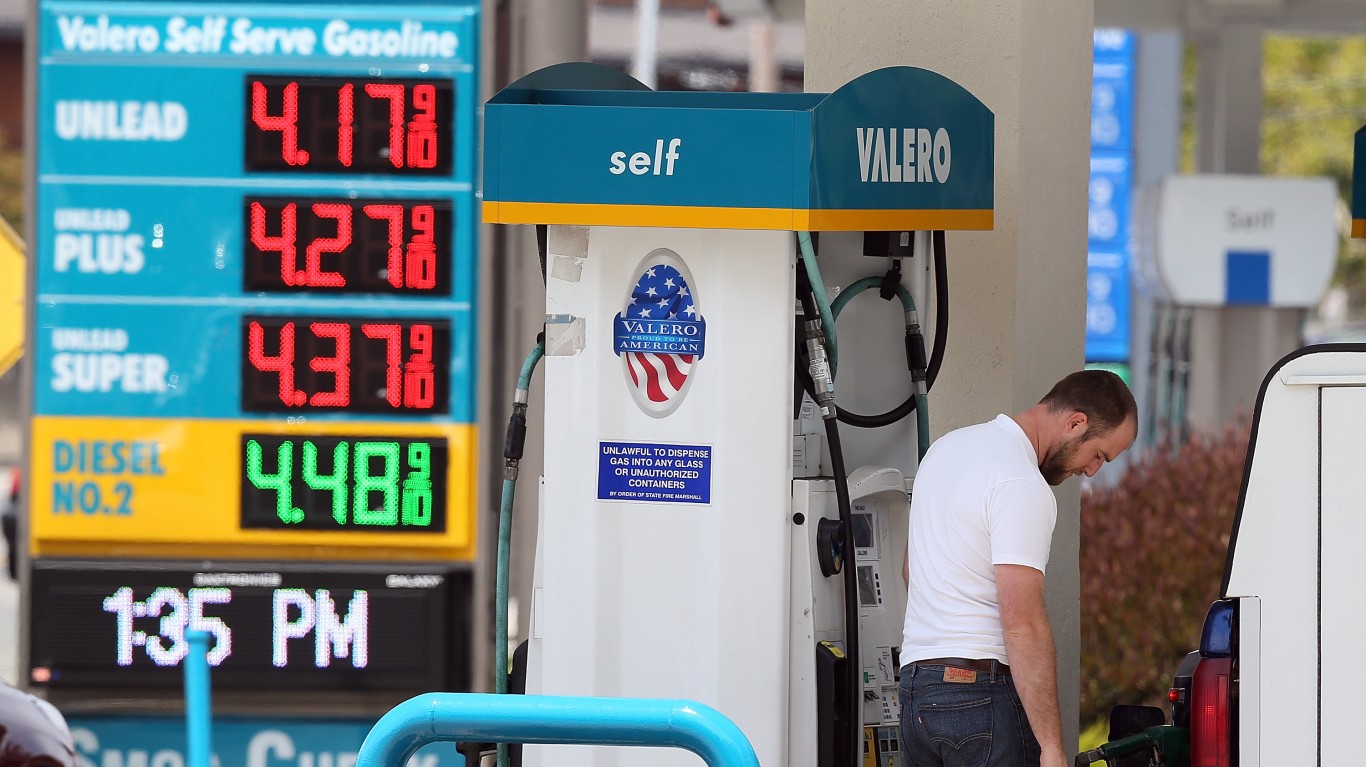
The pass-through to U.S. households is visible on any street corner. West Texas Intermediate crude settled at $97.26 per barrel on September 9, up 16.1% in a month and closing in on the spring peak of $114.58 hit on April 7. It sits at $104.60 today. Regular gasoline now averages $4.33 per gallon, sitting above the $4.00 threshold the indicator flags as “painful for budgets.” Nine months ago, drivers were paying $2.78 per gallon.
Diesel and jet fuel are the choke points. The IEA identifies middle distillates as the constraint driving the demand cut, because those are the products refiners cannot easily backfill when Gulf crude grades disappear. That is why California Governor Gavin Newsom last week publicly pressed the U.S. Energy Secretary to explain the administration’s plan for “Iran war gas and diesel price spikes.”
Consumers Are Already Retreating
Households are behaving as the price signal predicts. Retail sales fell to $763.6 billion in July, down 0.6% from June, the first monthly decline since last fall. University of Michigan consumer sentiment sits at 55.2, below the 60 threshold the survey flags as recessionary. Headline Consumer Price Index climbed to 334.1 in August, a 0.4% monthly gain, with energy the dominant contributor.
What to Watch Next
The signal that matters is the timing of Strait of Hormuz normalization. President Trump said Tuesday the U.S. is “open” to a renewed deal with Iran even as a tanker was hit in the strait, and the IEA now expects the recovery in Gulf flows to slip into next year. Every additional month of disruption widens the 2026 demand loss and locks in higher prices through the winter heating season, when diesel and heating oil inventories are already thin. If flows do not restart before December, the second-worst demand shock in six decades will start looking less like a ceiling and more like a floor.
Contact [email protected] for any questions or corrections.
After two decades of patrolling the dark corners of suburbia as a police officer, Rich Duprey hung up his badge and gun to begin writing full time about stocks and investing. For the past 20 years, he’s been cruising the markets looking for companies to lock up as long-term holdings in a portfolio while writing extensively on the broad sectors of consumer goods, technology, and industrials. Because his experience isn’t from the typical financial analyst track, Rich is able to break down complex topics into understandable and useful action points for the average investor. His writings have appeared on The Motley Fool, InvestorPlace, Yahoo! Finance, Money Morning, and, of course, 24/7 Wall St. He has been featured in both U.S. and international publications, including MarketWatch, Financial Times, Forbes, Fast Company, and USA Today.