3 Stocks That Turned Patient Investors Into Millionaires (and History Says the Pattern Isn’t Done)
A handful of stocks have quietly turned ordinary investors into millionaires over the past decade, and the specific pattern behind each one suggests the compounding window is still open rather than closing.

This post may contain links from our sponsors and affiliates, and Flywheel Publishing may receive compensation for actions taken through them.

Real wealth in equities rarely comes from trading. It comes from owning the same handful of durable businesses for decades and letting the math work. The pattern is consistent: a category-defining moat, decades of compounding revenue and earnings, expanding margins, aggressive shareholder returns through buybacks and dividends, and a credible engine to power the next decade. Miss any one of those and you get a good stock. Get all of them and you get a millionaire-maker.
Three names still fit every part of the framework. Their long-run price records are already extraordinary, and each has a specific next-leg thesis that keeps the compounding story alive rather than closing it out (we studied a batch of recent runners most investors walked past and pulled out the pattern in a free report here). Future compounding is never guaranteed, yet the setups here are unusually clean.
#3. Visa: Toll Booth on Global Commerce
Over the past 10 years, Visa shares returned more than 350%, with a 64% gain over the past five. Visa (NYSE:V | V Price Prediction) prints money the old-fashioned way: taking a small slice of every swipe, tap, and cross-border transaction on the world’s largest payments rail.
Fiscal Q3 2026 net revenue rose 14% year-over-year to $11.6 billion, and payments volume crossed $4 trillion for the first time in Visa’s history. Cross-border volume ex intra-Europe grew 12% constant-dollar, and value-added services revenue expanded 34% year-over-year in constant dollars. Visa returned $6.2 billion to shareholders in the quarter and has $28.4 billion remaining in buyback authorization. The quarterly dividend has stepped up from 0.45 in 2023 to 0.67 in 2026.
The forward engine comes in the form of agentic commerce, stablecoin rails and Visa Direct. CEO Ryan McInerney told investors “Agentic Commerce is a when, not an if,” and Visa has already partnered with OpenAI on secure agent-initiated payments.
Risk: local payment schemes, regulators pushing account-to-account rails, and stablecoin disintermediation all target the same interchange stream. Visa is building on both sides of that transition, but the risk to network economics is real and measurable.
#2. Microsoft: Enterprise AI With a Balance Sheet Fortress
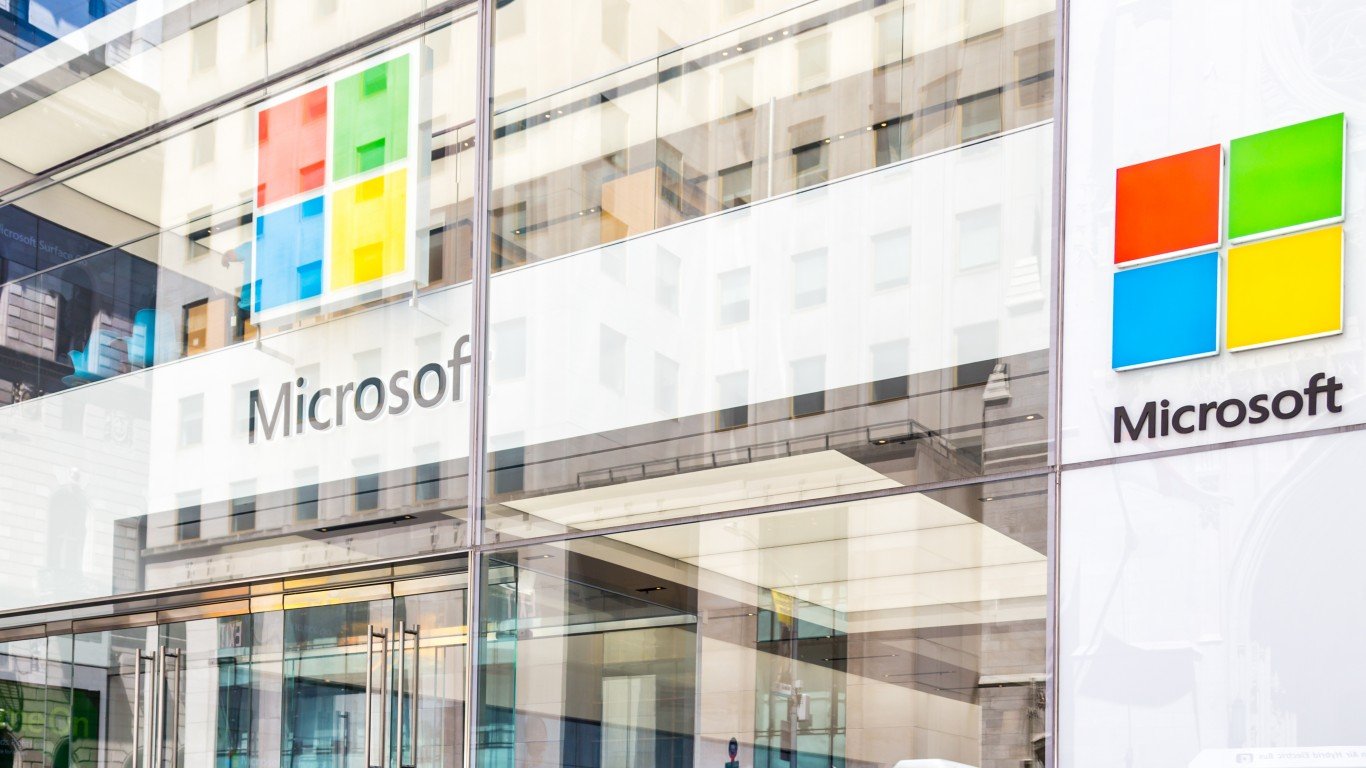
Microsoft (NASDAQ:MSFT) has compounded shareholders at a staggering pace: around 760% over 10 years and more than 66% over five. The stock trades at roughly 27x earnings, and the business now looks less like a software company and more like the world’s most important AI infrastructure operator.
Fiscal Q4 2026 revenue hit $90 billion, up 18%, and Azure revenue surpassed $100 billion in full-year revenue, growing 41%. Commercial RPO surged to $678 billion, up 84%, and Microsoft 365 Copilot passed 30 million paid seats. Full-year FY26 operating income exceeded $155 billion, and Microsoft returned over $43 billion to shareholders. The quarterly dividend has climbed from 0.68 in 2023 to 0.91 in 2026.
Satya Nadella said “Azure revenue surpassed $100 billion for the first time, and Microsoft 365 Copilot reached over 30 million paid seats.” Demand still exceeds supply, and Azure Q1 FY27 guidance is approximately 45% constant-currency growth.
Risk: FY27 capex is guided to roughly $175 billion. If AI demand ever softens, that spending becomes a heavy anchor on returns on capital.
#1. Apple: The Compounding Machine That Refuses to Slow
Apple (NASDAQ:AAPL) is the top of this list because no other mega-cap combines Apple’s installed base, cash generation, and buyback discipline. The 1o-year return is more than 1,100%, the five-year return over 112% and shares are up nearly 34% over the last year alone. Four forward splits since 2000, including the 4-for-1 split in 2020, tell the compounding story visually.
Fiscal Q3 2026 revenue hit $109.42 billion, up 16.4% year-over-year, with EPS of $2.02 versus $1.89 consensus, marking a ninth consecutive EPS beat. iPhone revenue reached $54.3 billion, up 22%, Mac grew 29%, and Services set another record at $30.74 billion. Apple returned $33 billion to shareholders in the quarter, and the board authorized an additional $100B buyback. The dividend has stepped from 0.23 in 2022 to 0.27 in 2026.
Tim Cook told investors “I truly have never been more confident that the best is yet to come.” The forward engine is a reimagined Siri AI unveiled at WWDC26, riding a two and a half billion device install base.
Risk: supply constraints are widening. Apple expects supply constraints to increase significantly next quarter, with Cook citing “a 100-year flood on the memory pricing”. Regulatory pressure on Services in the EU and U.S. is a separate overhang.
Why the Pattern Still Has Room to Run
The premise was simple: durable moats, decades of compounding, margin expansion, giant capital returns, and a credible next-decade engine. Visa dominates payments and is building the rails for agentic commerce. Microsoft owns enterprise AI infrastructure and is monetizing it faster than any peer. Apple sits at the top because it combines the largest installed base in consumer technology with a Services engine growing 12% year-over-year, a fresh Siri AI platform layered on $62.09 billion in nine-month buybacks, and management guiding to 9% to 11% revenue growth into the next quarter. Future compounding is never a certainty. Yet when the same business keeps setting records at a $4.7 trillion market cap, betting against the pattern has historically been the expensive trade.
Contact [email protected] for any questions or corrections.
Joel South covers large-cap stocks, dividend investing, and major market trends, with a focus on earnings analysis, valuation, and turning complex data into actionable insights for investors.
He brings more than 15 years of experience as an investor and financial journalist, including 12 years at The Motley Fool, where he served as an investment analyst, Bureau Chief, and later led the Fool.com investing news desk. He has also co-hosted an investing podcast and appeared across TV and radio discussing market trends.