3 Shaky Consumer Dividend Stocks Flashing Warning Signs
Three consumer brands with yields that look generous on a screen are hiding serious cracks beneath the headline numbers, and at least one of them stopped paying shareholders altogether without most income investors noticing.


Income investors screen for yield, but a dividend is only as durable as the cash flow behind it. Three big consumer brands currently flash warning signs that go beyond a single quarter of weakness: a suspended payout hiding behind stale screen data, a beer giant guiding double-digit earnings declines into its dividend, and a motorcycle icon whose most profitable engine has been permanently downsized. None of the three has told shareholders a cut is coming. All three deserve a hard second look before the headline yield is taken at face value.
A quick working definition: a dividend looks shaky when the company can’t cover it out of earnings and free cash flow on a sustained basis, when leverage is climbing to fund shareholder returns, or when the headline yield has been inflated by a falling share price rather than by payout growth. We cataloged seven of these warning signs in a free dividend trap guide, and all three names below trip at least one of them.
Whirlpool (WHR): A Yield That May Not Exist
Screens still show Whirlpool (NYSE:WHR | WHR Price Prediction) with a dividend yield of roughly 6.87%, which looks like a gift from a household name in appliances. The headline number is stale. Whirlpool disclosed that no dividends were declared on common stock in Q2 2026 ($0 per share) and explicitly listed “common dividend suspension” among the risks tied to its Q1 2026 recapitalization, with management prioritizing deleveraging over the payout.
Whirlpool reported a Q2 2026 ongoing loss of $0.21 per share against a $0.05 estimate, on revenue of $3.517 billion, down 6.81% year over year. Q1 was worse: operating cash flow of negative $827 million and free cash flow of negative $896 million. To clear maturities through 2028, the company issued $2.0 billion in secured bonds and a new $2.0 billion asset-based lending facility, plus mandatory convertible preferred stock that sits above common in liquidation. The equity has responded accordingly, down 48.05% year to date and 59.56% over the past year.
Full-year free cash flow above $300 million and net debt below $5.0 billion at year end, plus a housing and appliance demand recovery, would set the stage for eventual reinstatement. Until then, any yield figure on a Whirlpool screen reflects a data lag.

Molson Coors (TAP): Earnings Guided Down Into the Payout
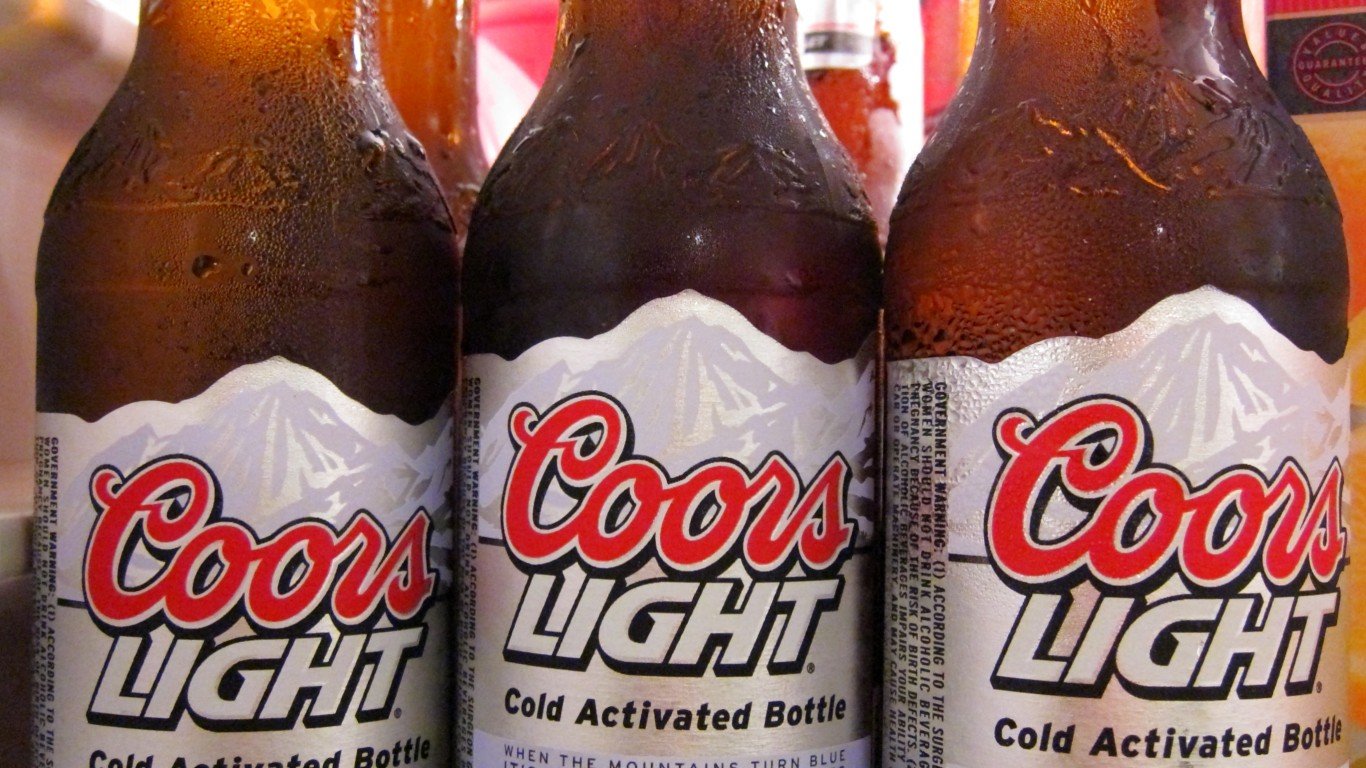
Molson Coors (NYSE:TAP) yields about 4.89%, with a quarterly payout recently raised to $0.48 from $0.47. The brewer has just declared its next dividend, payable September 18, 2026, and management on the Q2 call described the company as “a highly cash-generative business”. That is the bull case, and it is real.
The warning sign is what management guided against that payout. Full-year 2026 underlying pretax income is guided down 15% to 18% and underlying EPS down 11% to 15%, on flat constant-currency sales. Q2 operating income fell 43.13% year over year to $331.9 million, financial volume declined 5.4%, and cost of goods per hectoliter rose 12.1%. Management flagged Midwest Premium aluminum inflation in excess of $130 million for the full year. Leverage is drifting the wrong way: net debt to underlying EBITDA rose to 2.53x from 2.41x, and the company is still spending on capital returns, with $211.0 million of buybacks in the first half of 2026 on top of the dividend. The share price is doing its part to inflate the yield too, down 14.42% year to date and 18.37% over the past year.
US beer volumes stabilizing better than the minus 5% experienced in 2025, delivery of the $450 million three-year cost-savings program, and free cash flow landing near the $1.1 billion guide would give the raised payout room to breathe.

Harley-Davidson (HOG): A Smaller Payout, a Bigger Structural Problem
Harley-Davidson (NYSE:HOG) carries a more modest yield of 2.7% on a quarterly dividend of $0.1875. Trailing EPS of $1.80 against an annualized payout of $0.75 looks comfortable on paper. The trouble is what is happening underneath.
Harley-Davidson Financial Services, historically a major profit contributor, has been permanently downsized: HDFS revenue fell 55% in Q2 and 54% in Q1 following the H2 2025 sale of loan assets to KKR/PIMCO, part of a transition to a capital-light model that lowers that earnings stream for good. Consolidated results reflect it. Q2 operating income fell 32.4% and net income fell 25.81% year over year. Q1 was uglier: operating income down 85.36%, net income down 81.39%, and operating cash flow of negative $228 million versus positive $142 million a year earlier. LiveWire is still guided to an operating loss of $70 million to $80 million for the year. Yet the company spent $158 million buying back 7.9 million shares in the first half, a call management described as “a top priority at Harley-Davidson, especially via share buybacks in this moment”. History matters here: Harley cut the payout from $0.38 in March 2020 to $0.02 by May 2020, so the board has proven willing to move quickly when cash pressure builds.
Delivery of raised full-year HDMC operating income of $10 million to $50 million and HDFS operating income of $55 million to $70 million, plus traction from new Superglide and Deadwood launches, would keep coverage intact even at a permanently lower HDFS run rate.
Takeaway
A dividend cut does not normally happen in a vacuum. It usually takes the share price with it, wiping out years of yield in a single session. Whirlpool has already suspended its common payout, Molson Coors is guiding earnings down double digits into a raised dividend, and Harley-Davidson is funding buybacks while its most reliable profit engine shrinks. None of these companies has told shareholders another cut is imminent. All three are worth watching before assuming the yield you see on a screen is the yield you will actually collect.
Contact [email protected] for any questions or corrections.
Chris Lange is a financial and geopolitical writer with more than a decade of experience covering a myriad of topics. He has published thousands of articles for 24/7 Wall St., with past coverage focused heavily on stocks, IPOs, healthcare, defense, global affairs, and technology.
His work has been quoted, or referenced by a number of outlets including Business Insider, USA Today, Yahoo Finance, MSN, The Motley Fool, and many other publications. A graduate of Southwestern University, he studied business with a focus on investments and has previous experience in banking and startups.
When not reading or writing the news, he is following his passion for Lacrosse, playing chess, or building solar projects with his dad.