AI Agents Are About to Start Spending Your Money. 5 Stocks Sitting in the Line of Fire.
AI agents can already pick your next purchase, but they still can't pull the trigger without your permission. Five companies are quietly building the infrastructure that changes that, and they are not all the obvious names.

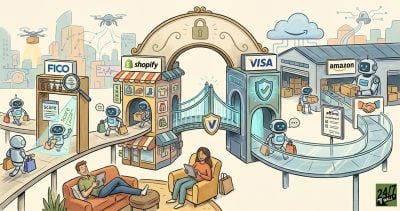
Consumers are already letting AI agents pick their next flight, their next router, their next tube of toothpaste. Almost none of them will let the agent hit “buy.” Visa’s chief executive said in July that “the ultimate thing that’s going to accelerate that adoption is going to be trust, trust that the payment is secure, trust that the agent is authorized, trust that the transaction reflects the consumer’s actual intent, and then the protections exist if something goes wrong.” Whoever closes that trust gap collects a toll on every autonomous transaction that follows. Five U.S.-listed names sit directly in the path of disruption.
1. Fair Isaac: The Invisible Tollbooth on Agentic Credit
Start with the name nobody puts on an agentic-commerce bingo card. Fair Isaac (NYSE:FICO | FICO Price Prediction) owns the score every U.S. lender pulls before extending a dollar of consumer credit. The moment an autonomous agent tries to open a card, apply installment financing, or underwrite a “buy this now” instruction, a FICO Score has to be requested, priced, and returned in milliseconds. FICO Platform, the AI decisioning layer regional and money-center banks are migrating onto, is where those queries get resolved.
The Q3 fiscal 2026 report filed July 29, 2026, showed the tollbooth working. Scores segment revenue hit $458.90 million, up 41%, with B2B Scores up 49%. Platform ARR grew 62% year over year with platform dollar-based net retention of 148%. Management raised full-year revenue guidance to $2.53 billion and non-GAAP EPS to $42.43.
The setup is the sentiment. Fair Isaac shares have shed 41.9% year to date and trade near $955.50, giving investors an entry into the credit rail every agent must eventually query. The next name in the line of fire never had to query anyone. It just had to sit under the checkout button.


2. Shopify: The Checkout Surface Agents Talk To
Shopify (NASDAQ:SHOP) is the plumbing an agent hits when a consumer says “order it.” President Harley Finkelstein said on the Q2 2026 call: “Whether commerce is handled by humans or agents, whether stores are built by people or AI, Shopify runs underneath it all.” Shopify already ships a Universal Commerce Protocol, a billion-product Catalog, and Shop Pay identity that agents can transact against on behalf of returning buyers.
The Q2 2026 numbers show the machine is already ingesting agent traffic. AI-driven orders tripled year over year, AI searches powered by Catalog converted at twice the rate of scraped-data searches, and GMV reached $116 billion, up 32% year over year. Management guided Q3 revenue growth to the low 30s.
| Shopify Q2 2026 Agentic Signals | Value |
|---|---|
| AI-driven orders YoY | 3x |
| Catalog vs. scraped conversion | 2x |
| GMV growth | 32% |
Shares are down 18.9% year to date to $127.53, cheaper than they were when the agent traffic began compounding. The stock in the next slot doesn’t need agent traffic. It authorizes the money that moves regardless of who clicks buy.


3. Visa: The Network Naming “Agentic” a Strategic Pillar
Visa (NYSE:V) has done something the market has not fully priced: it has explicitly built agentic rails into its Visa-as-a-Service stack and told investors it is the trust arbiter. McInerney told analysts, “We are excited to be partnering with OpenAI to enable secure visa payments within agentic commerce” and “Agentic Commerce is a when, not an if.” The Agent Score, Agent Directory, and Token Assurance Framework are the products that answer the trust question the CEO named.
The Q3 fiscal 2026 report shows a network with the capital to weaponize this. Net revenue was $11.6 billion, up 14%, payments volume crossed $4 trillion, and tokenized penetration was nearing 60% of e-commerce transactions globally. Visa returned $6.2 billion to shareholders in the quarter, with $28.4 billion remaining on the buyback.
The stock is one of the few names in this basket in the green. It is up 5.7% year to date at $366.20. That relative strength matters because the next name owns both the agent and the storefront the agent is buying through.


4. Amazon: The Only Company That Owns the Agent, the Store, and the Cloud Under Both
Amazon (NASDAQ:AMZN) is the vertically integrated bet. Alexa+ and Rufus are the agents, Amazon.com is the storefront the agent buys through, Bedrock AgentCore is the framework competitors’ agents run on, and AWS is the compute underneath all of it. Andy Jassy said on the Q2 2026 call, “AWS is booming” and confirmed that AI and Chips businesses each eclipsed run rates of more than $25 billion.
The shopping funnel is already agentic. Over 350 million customers used Alexa for Shopping in the last 12 months, interactions were up over 5x year over year, and customers who use Alexa for Shopping spend over 40% more per order. AWS itself printed $42.2 billion, up 36.7%, its fastest growth in 18 quarters.
Shares are up 11.4% year to date at $252.39 and trade at a P/E of 20. Amazon is the platform play. The last name is the credit product the agent will actually reach for when instructed to buy something without accumulating revolving interest.


5. Affirm: The Credit Primitive an Agent Picks When You Say “Don’t Rack Up Interest”
If an autonomous agent is instructed to buy a $1,400 sofa without hidden fees, the default answer is transparent installment credit with a fixed schedule and no fine print. Affirm (NASDAQ:AFRM) is already embedded at checkout across Shopify, Amazon, Walmart, and now Intuit’s QuickBooks Payments as the exclusive pay-over-time option. Max Levchin’s framing from the Q2 2026 call has solidified into a thesis: “Consumers aren’t avoiding credit. They’re avoiding credit that profits from their confusion.”
The Q3 fiscal 2026 report filed May 7, 2026, shows the flywheel spinning. GMV was $11.60 billion, up 35%, the tenth consecutive quarter of GMV growth above 30%. Affirm Card GMV was $2.10 billion, up 146% with 4.4 million active cardholders. GAAP net income swung to $102.90 million from $2.80 million a year earlier.
| Affirm Q3 FY26 | Value |
|---|---|
| GMV growth | 35% |
| Affirm Card GMV growth | 146% |
| Active merchants | 515 thousand, +44% |
The stock is down 19.8% over the past year at $68.11, and the market cap is roughly $23.0 billion, comparable to Fair Isaac’s. That is the punchline: the agent-native credit rail is being valued in line with the credit-scoring incumbent, right as autonomous checkout begins arriving.


Where the Toll Gets Collected
Consumer trust is the choke point, and every name on this list is spending real capital to be the one that closes it. Fair Isaac collects on the underwrite, Shopify collects on the checkout, Visa collects on the authorization, Amazon collects on all three plus the compute, and Affirm collects on the loan the agent chooses. Agent-initiated GMV has yet to appear as a line item in earnings decks, but that reporting gap is narrowing quarter by quarter.
Contact [email protected] for any questions or corrections.
Trey has been an editor and author at 24/7 Wall St. for more than a decade, where he has published thousands of articles analyzing corporate earnings, dividend stocks, short interest, insider buying, private equity, and market trends. His comprehensive coverage spans the full spectrum of financial markets, from blue-chip stalwarts to emerging growth companies.
Beyond 24/7 Wall St., Trey has created and edited financial content for Benzinga and AOL's BloggingStocks, contributing additional hundreds of articles to the investment community.
Trey's editorial expertise extends across multiple publishing environments. He served as production editor at Dearborn Financial Publishing and development editor at Kaplan, where he helped shape financial education materials. Earlier in his career, he worked as a writer-producer at SVE. His freelance editing portfolio includes work for prestigious clients such as Sage Publications, Rand McNally, the Institute for Supply Management, the American Library Association, Eggplant Literary Productions, and Spiegel.
Outside of financial journalism, Trey writes fiction and has been an active member of the writing community for years, moderating workshop sessions at regional conventions.