Got $10,000? Eli Lilly vs. Nvidia: The Better Buy For 2026
Eli Lilly and Nvidia both just posted stunning quarters riding two of the biggest secular waves in markets today, but a $10,000 bet can only tilt one way. Which secular story holds the sharper edge heading into 2026?


Eli Lilly (NYSE:LLY | LLY Price Prediction) and NVIDIA (NASDAQ:NVDA) just delivered blockbuster quarters that captured two different secular waves.
Lilly is riding the incretin revolution, with Mounjaro and Zepbound reshaping obesity care. NVIDIA is powering the AI factory build-out, shipping Vera Rubin at full tilt. Both stocks now carry mega-cap expectations, and a $10,000 decision between them comes down to which secular story you trust more heading into 2026.
Incretins Carry Lilly. Vera Rubin Carries NVIDIA.
Lilly booked $22.97 billion in Q2 2026 revenue, up 47.7% YoY, with Mounjaro at $9.94 billion (+91%) and Zepbound at $4.93 billion (+46%).
International Mounjaro sales jumped 172% after China’s NRDL listing, and management raised FY2026 revenue guidance to $85B to $87B. CEO Dave Ricks said “Lilly’s momentum continues, as we delivered 48% revenue growth and raised our full-year guidance.” The catch: U.S. prices fell 9% excluding rebate adjustments, so volume is doing all the heavy lifting.

NVIDIA reported $96.22 billion in Q2 FY2027 revenue, up 105.8% YoY, with Data Center hitting $89.02 billion. Q3 guidance points to $108 billion, which excludes any China Data Center compute.
Jensen Huang framed the moment bluntly: “AI has reached its inflection point. It’s doing useful work. Its tokens are productive and profitable.” Supply commitments have swelled to $279 billion, mostly memory tied to the Vera Rubin ramp.

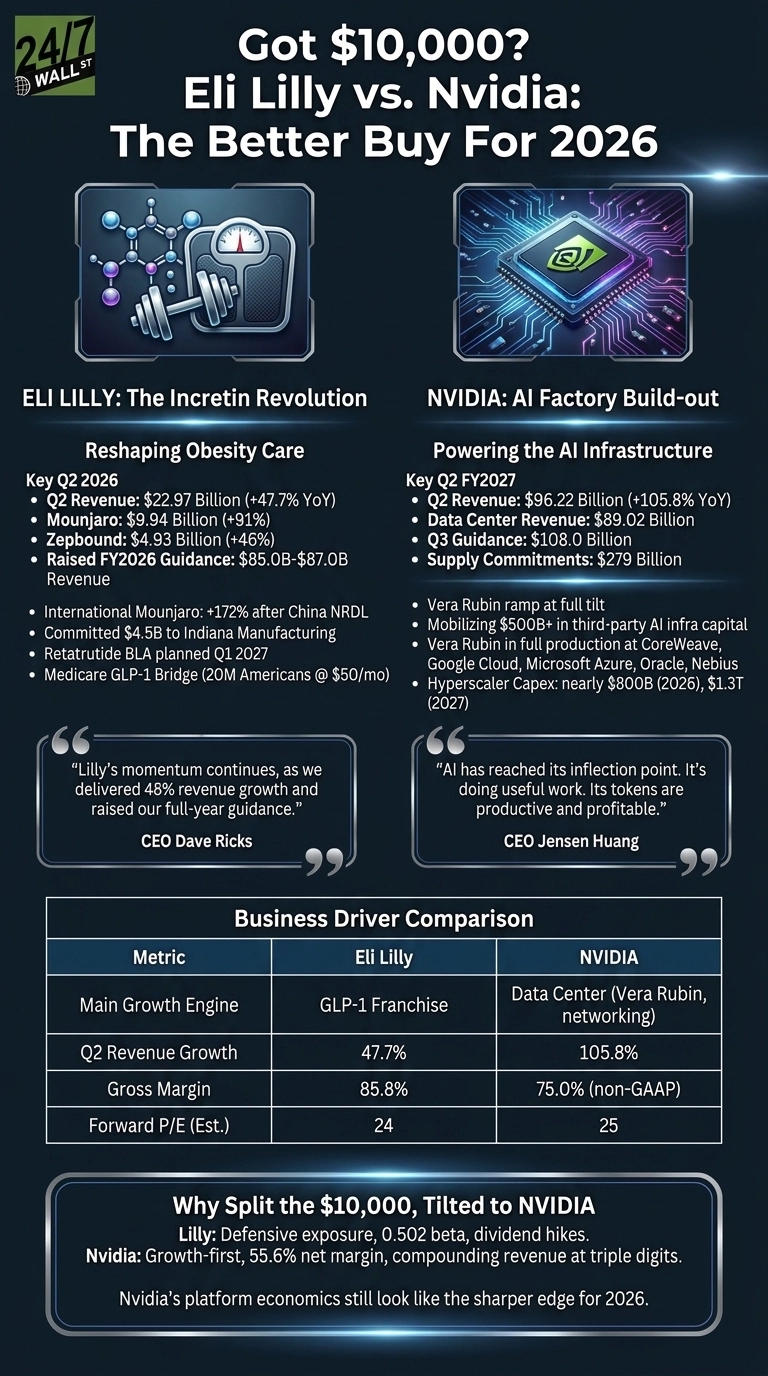
| Business Driver | Eli Lilly | NVIDIA |
| Main growth engine | GLP-1 franchise (Mounjaro, Zepbound) | Data Center (Vera Rubin, networking) |
| Q2 revenue growth | 47.7% | 105.8% |
| Gross margin | 85.8% | 75.0% non-GAAP |
| Management focus | Capacity, pipeline, retatrutide | AI factory ecosystem, neocloud |
Two Very Different Bets on Scale
Lilly is widening its net. It committed another $4.5 billion to Indiana manufacturing, absorbed $2.78 billion in IPR&D charges from acquisitions of Orna, Ajax, Centessa and Kelonia, and lined up a retatrutide BLA filing in Q1 2027 across obesity, sleep apnea and knee OA pain. This is a pharma giant trying to build a portfolio that outlives any single molecule.

NVIDIA is tightening its grip on the AI stack. Vera Rubin is in full production at CoreWeave, Google Cloud, Microsoft Azure, Oracle, and Nebius, and NVIDIA is mobilizing over $500 billion in third-party AI infrastructure capital with Apollo, BlackRock, Blackstone, Brookfield, Goldman Sachs and KKR.
That is a platform strategy at work. The vulnerability is memory pricing, which management warned could pull Q4 gross margins into the 71% to 72% range.

What Decides 2026
For Lilly, I will be watching whether retatrutide’s Phase III data package translates into a smooth BLA, and whether the Medicare GLP-1 Bridge Program (covering 20 million Americans at $50 per month) offsets the pricing drag from broader CVS formulary access. Forward EPS estimates sit at $47.26 for 2027, up from $44.49 ninety days ago, so analysts are still nudging higher.
For NVIDIA, the tell is whether hyperscaler capex, nearly $800 billion in 2026 and $1.3 trillion in 2027 among the top five, actually shows up in supply-constrained bookings.
That spend also flows to the power, cooling, and networking names behind the racks, which we profiled in a free report on seven AI infrastructure suppliers. Fiscal 2028 EPS estimates have jumped to $15.46 from $12.63 ninety days ago.
Why I’d Split the $10,000, Tilted to NVIDIA
If I had to pick one, I lean NVIDIA. A forward P/E of 25 for a business compounding revenue at triple digits, with a 55.6% net margin, is genuinely unusual.
Lilly trades at a forward P/E of 24 on much slower growth and real pricing headwinds. If you want defensive exposure to a demographic megatrend, Lilly’s 0.502 beta and dividend hikes make sense. For growth-first investors, NVIDIA’s platform economics still look like the sharper edge for 2026.
Contact [email protected] for any questions or corrections.
Vandita Jadeja is a financial publisher with over a decade of experience writing about financial topics, including investment, savings, retirement, insurance and banking. Vandita is a Chartered Accountant who loves to debunk financial concepts for readers.
Her work has appeared on sites that include The Motley Fool, InvestorPlace, and Benzinga. She covers investing and focuses on stock picks and price prediction for 24/7 Wall St.
When not looking for the next stock investment opportunity, she can be found traveling, reading, chasing sunsets and enjoying her iced latte.