Robots Everywhere: Goldman Sachs Now Sees 6.5 Million Humanoid Robots by 2035
A major bank just dropped a forecast that reframes the entire robotics industry, and the ripple effects are already moving stock prices across chips, foundries, and factory floors. Here is what the number means for long-term investors.

This post may contain links from our sponsors and affiliates, and Flywheel Publishing may receive compensation for actions taken through them.
One number reframes the entire robotics conversation, and it did not come from a chipmaker or an automaker. It came from a bank.
Goldman’s Big Robot Number
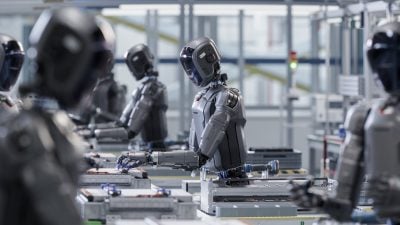
6.5 million humanoid robot units shipped globally by 2035. That is the headline projection in Goldman Sachs‘s (NYSE:GS | GS Price Prediction) new Physical AI research report, and it is a sharp upgrade to what the firm was modeling before. Goldman now sees the ramp arriving in phases: 75,000 units in 2026, 890,000 by 2030 (revised up from a prior estimate of 256,000), and 6.5 million by 2035, representing a $138 billion market opportunity led by logistics, warehousing, and automotive.
What It Means
Read the number operationally. Goldman is modeling a decade of unit shipments large enough to require dedicated production lines, memory allocation, foundry capacity, factory-floor automation, and financing. The $138 billion market figure lands on the same balance sheets that already fund the AI data-center buildout, which is why the read-through cuts across chips, capital equipment, and manufacturing (we profiled seven suppliers powering that same buildout, from electricity to cooling to networking, in a free report you can grab here).
The company that produced the forecast is also a direct beneficiary of the capital cycle it is describing. Goldman reported record Q2 2026 net revenues of $20.3 billion and record EPS of $20.98, with CEO David Solomon telling investors, “We are in the middle of an AI CapEx super cycle where there are demands on financing into every single financing instrument in every region of the world and across every single industry.”
Market Reaction
The listed beneficiaries are trading like the thesis is already in motion. Teradyne (NASDAQ:TER), the semiconductor-test and industrial-robotics name, is up 229.21% over the past year and 96.4% year to date. Taiwan Semiconductor Manufacturing (NYSE:TSM) is up 69.14% over one year. NVIDIA (NASDAQ:NVDA) is up 23.5% over one year. Tesla (NASDAQ:TSLA) is down 18.74% year-to-date, and Intuitive Surgical (NASDAQ:ISRG), the closest listed proxy for scaled robotics commercialization, is down 34.82% year-to-date.
Bull Case
Every layer of the humanoid stack has a listed proxy that is already booking revenue against it. On the compute layer, NVIDIA posted Q2 FY27 revenue of $96.22B, up 105.85% year over year, and guided Q3 to $108.0B. CEO Jensen Huang told investors, “Amazon will also adopt our full physical AI stack, Omniverse, Cosmos, Isaac, and Jetson to power its fleet of warehouse robots.” That is the exact application layer Goldman flags as the entry point for the 6.5 million-unit ramp.
On the foundry layer, TSMC guided Q3 2026 revenue between $44.6 billion and $45.8 billion and expects full-year 2026 revenue growth slightly above 40% year-over-year in U.S. dollar terms. Management said demand runs strong “from this day on all the way to probably 2029, 2030.”
On the test-and-automation layer, Teradyne reported Q2 2026 revenue of $1.329B, up 103.9% year over year, with Robotics revenue of $100 million, up 33% year over year. CEO Greg Smith called out “physical AI applications” as the driver.
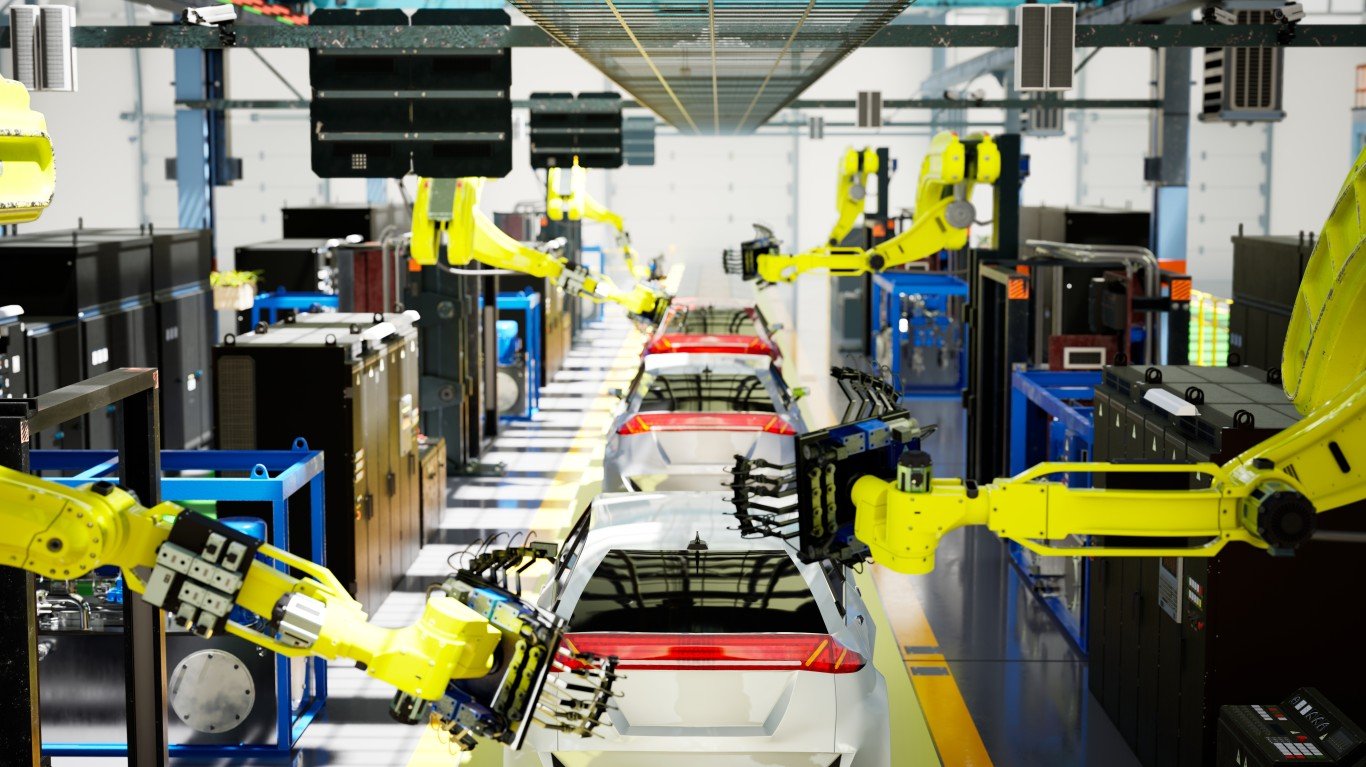
On the humanoid layer itself, Tesla is installing first-generation Optimus production lines at Fremont after decommissioning Model S and X lines, and Elon Musk described an aspirational target of 10 million units a year of Optimus 4 versus a million units a year of Optimus 3. And on the commercialization analog, Intuitive Surgical closed the quarter with almost 13,000 systems installed worldwide, proving that robotics scaling in a regulated, mission-critical setting can compound for a decade.
Bottom Line
For retirement-focused investors, the Goldman forecast is a framing tool for long-term positioning. It sets a scale that lets long-term holders decide which layer of the stack they want to own: the financier writing the checks, the foundry printing the silicon, the test-equipment maker qualifying every chip, or the two companies actually building the robots. Near-term calendar items in the provided data include Teradyne’s dividend date of September 25, 2026 and NVIDIA’s $0.25 quarterly dividend paid October 1, 2026.
The risk sitting alongside the opportunity is a governance one: Anthropic employees have cited a 10% chance AI wipes out humankind within 10 years, CEO Dario Amodei has said developers need to slow down, and OpenAI CEO Sam Altman has floated an agreement among major AI developers to do so. A voluntary pause would slow the very build cycle Goldman is modeling. Until one arrives, the money keeps building for 6.5 million robots.
Contact [email protected] for any questions or corrections.
After two decades of patrolling the dark corners of suburbia as a police officer, Rich Duprey hung up his badge and gun to begin writing full time about stocks and investing. For the past 20 years, he’s been cruising the markets looking for companies to lock up as long-term holdings in a portfolio while writing extensively on the broad sectors of consumer goods, technology, and industrials. Because his experience isn’t from the typical financial analyst track, Rich is able to break down complex topics into understandable and useful action points for the average investor. His writings have appeared on The Motley Fool, InvestorPlace, Yahoo! Finance, Money Morning, and, of course, 24/7 Wall St. He has been featured in both U.S. and international publications, including MarketWatch, Financial Times, Forbes, Fast Company, and USA Today.