The AI Buildout Collision: $1 Trillion in Committed Spending Meets a 3-Year Energy Wall
Hyperscalers have locked in a trillion dollars for AI infrastructure, but three separate warnings from finance, energy, and hardware insiders point to the same crisis forming just ahead of the spending wave.

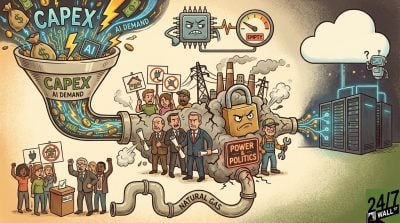
Three financial podcasts on Monday evening identified the same bottleneck from different angles. On All-In, an AI hardware founder said the industry has roughly three years before compute demand outruns available power. On Bloomberg Businessweek, a U.S. natural gas producer executive argued that America is pumping record hydrocarbons while household energy bills climb, because siting and transmission are the real bottleneck. And on CNBC, a major bank chief executive projected hyperscaler AI capital spending could hit $1 trillion next year. The collision: money is committed, electrons are not, and local communities are turning against the sites.
Physics Wall Comes First
The physics case came on All-In with Chamath, Jason, Sacks & Friedberg. “We’re going to run out of energy pretty fast, in like three years or so is my estimate,” the AI hardware founder told the show. Energy binds inference economics: once the chips are paid for, the marginal cost of serving a token is dominated by electricity consumption (kilowatt-hours). His custom inference hardware burns roughly 500 nanojoules per image, while, per the same All-In interview, a GPU sits on the order of millijoules, many orders of magnitude more electricity for the same work. Today’s deployed fleet is nowhere near the theoretical floor. If frontier models keep scaling on current silicon, power supply constraints will become a bottleneck before model scaling does.
Permitting Wall Comes Next
The politics case came on Bloomberg Businessweek. A U.S. natural gas producer executive told the show that “80% of the public is unfavorable towards data centers” and that Americans’ energy bills are up over 40% even as the country produces more oil and natural gas than ever. His diagnosis: political force has blocked market forces. Delivery is the constraint. New York, he argued, effectively vetoes New England pipeline expansion. That’s why Boston pays some of the world’s highest gas prices while Appalachian producers sit on stranded molecules a few hundred miles away. The same logic now applies to electrons and data centers. The EIA projects that in its High Electricity Demand case, data center server load grows fastest in the South Atlantic and West South Central census divisions, home to Virginia and Texas. Those are also the two states where residential rate fights will get loudest first. California just tightened rules on data center energy and water use. In addition, the House passed a bill last week aimed at shielding consumers from data center-driven rate hikes.
Capex Is Already Locked In
The capital case came on CNBC. The $1 trillion hyperscaler capex figure for next year matters precisely because it is not conditional. Land is optioned, accelerators are pre-ordered, power purchase agreements are signed, debt is placed. The buildout does not pause while grid operators clear interconnection queues or while a county board relitigates a substation. (All that committed spending has to be powered, cooled, and wired by somebody, which is the why we put together a free report on seven AI infrastructure suppliers that are not the chipmakers.) Households already feel the second-order effects. National regular gasoline is $4.16 a gallon, above the $4 threshold that shows up in every consumer sentiment survey. Residential electricity is next.
What to Watch
Three signals over the next two quarters will tell the story. First, PJM and Electric Reliability Council of Texas (ERCOT) interconnection queues: are new gigawatts clearing, or piling up? Second, local siting votes in Loudoun County, Virginia, and the Dallas exurbs. Third, residential utility bill increases in the census divisions the U.S. Energy Information Administration (EIA) has flagged as ground zero. The buildout will face political constraints before physical ones. Permitting bottlenecks and public opposition tighten faster than new generation capacity can be built. Wall Street is already starting to price that risk in.
Contact [email protected] for any questions or corrections.
Trey has been an editor and author at 24/7 Wall St. for more than a decade, where he has published thousands of articles analyzing corporate earnings, dividend stocks, short interest, insider buying, private equity, and market trends. His comprehensive coverage spans the full spectrum of financial markets, from blue-chip stalwarts to emerging growth companies.
Beyond 24/7 Wall St., Trey has created and edited financial content for Benzinga and AOL's BloggingStocks, contributing additional hundreds of articles to the investment community.
Trey's editorial expertise extends across multiple publishing environments. He served as production editor at Dearborn Financial Publishing and development editor at Kaplan, where he helped shape financial education materials. Earlier in his career, he worked as a writer-producer at SVE. His freelance editing portfolio includes work for prestigious clients such as Sage Publications, Rand McNally, the Institute for Supply Management, the American Library Association, Eggplant Literary Productions, and Spiegel.
Outside of financial journalism, Trey writes fiction and has been an active member of the writing community for years, moderating workshop sessions at regional conventions.