Oracle Has the Biggest Upside of Any Megacap Right Now: 54%
Oracle's cloud business is growing faster than it has in years, yet the stock has been cut nearly in half. Our model finds a jarring disconnect between what the business is doing and what the market is pricing in.

This post may contain links from our sponsors and affiliates, and Flywheel Publishing may receive compensation for actions taken through them.

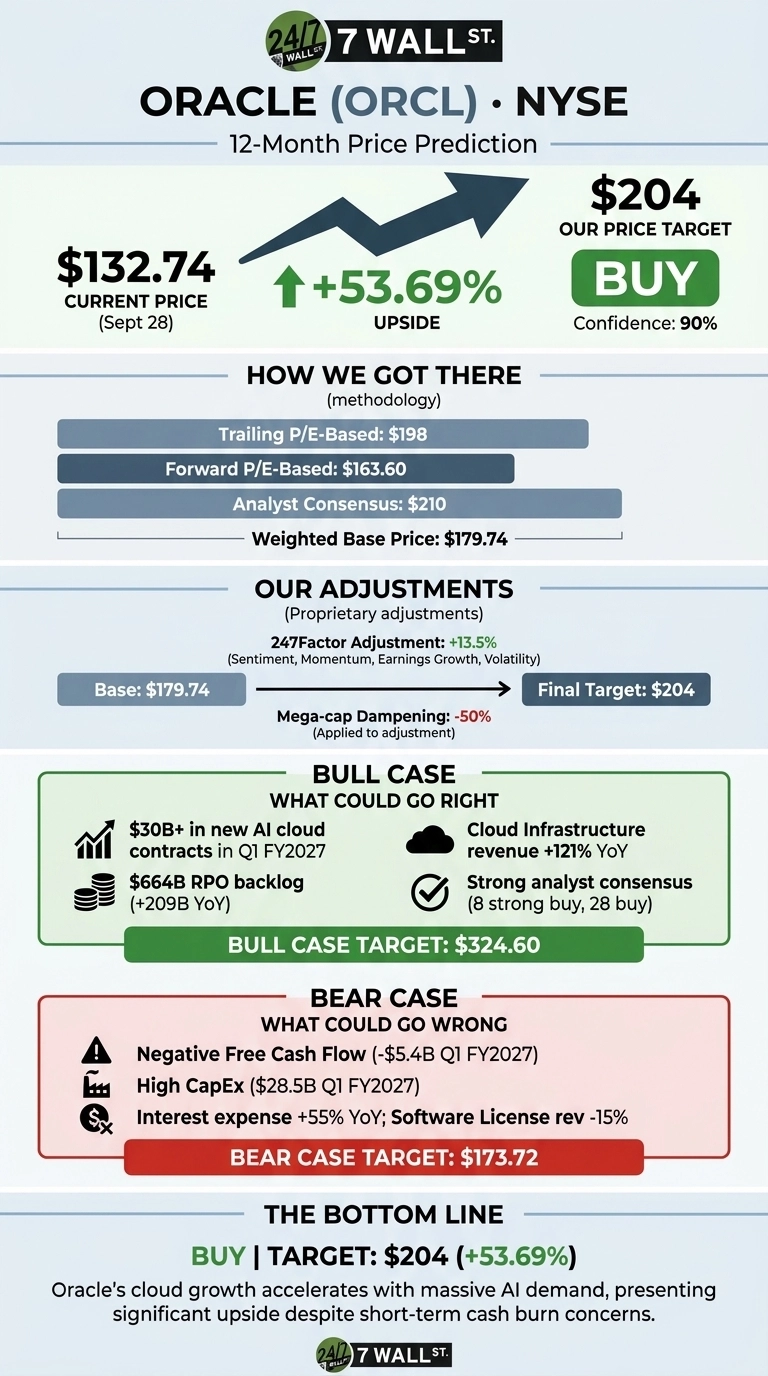
Oracle is growing faster than it has in years, yet its stock is priced as if something has gone very wrong. Based on our proprietary model, the 24/7 Wall St. price target for Oracle (NYSE:ORCL | ORCL Price Prediction) is $204 over the next 12 months. That is 53.69% above the $132.74 close on September 28.
| Metric | Value |
|---|---|
| Model Reference Price | $132.74 |
| 24/7 Wall St. Price Target | $204 |
| Upside | 53.69% |
| Model Rating | BUY |
| Confidence Level | 90% |
The model gives Oracle a buy rating with high confidence. On Tuesday, shares rebounded 5.17% to $139.46, cutting implied upside to roughly 46%, still significant for a megacap.
A 50% Drawdown Even as Cloud Growth Tops 100%
Oracle is down 6.13% over the past week, 7.55% over the past month, 27.75% year to date and 50.24% over the past year. It sits about 56% below its $319.46 52-week high and roughly 22% above its $114.50 low.
The business kept speeding up while the stock fell. In fiscal Q1 2027, non-GAAP EPS of $1.92 beat the $1.74 estimate. Revenue of $19.345 billion grew 29.6% and also came in above expectations. Cloud infrastructure revenue rose 121%.
Remaining performance obligations (RPO), meaning revenue that is already signed but not yet recognized, reached $664 billion. Two days after the report, Larry Ellison called off his plan to sell Oracle stock (September 12). Fortune reported that all the options granted to Ellison and his co-CEOs had ended the fiscal year underwater.

Why Bulls See $324 Within Reach
The bull case reaches $324.60. Oracle delivered 850 megawatts of capacity with more than 300,000 GPUs. GPU utilization was 97.9%, and GPUs up for renewal were renewed or resold at a 20% premium.
Management expects about half of RPO to convert to sales within 36 months. Multicloud database revenue grew 353%. Investor Day and AI World are both in October. Analysts are firmly positive: 8 strong buy and 28 buy ratings against just 1 sell.

Cash Burn Is the Risk Worth Watching
The bear case comes in at $173.72. Q1 free cash flow was -$5.396 billion on $28.499 billion of capex. Management expects full-year capex of $90 to $95 billion and has not said when free cash flow will turn positive. Oracle plans to raise about $40 billion this fiscal year. Interest expense rose 55%, and software license revenue fell 15%.
The capex bill is enormous, and Oracle is only one of several hyperscalers writing checks like this. The suppliers doing the powering, cooling, and networking behind that expansion are a separate trade worth knowing, and we rounded up seven of them here: 7 Stocks Powering the AI Boom (That Aren’t Chipmakers).
Oracle Trades at a Steep Discount to Microsoft and Amazon
| Company | Forward P/E | Quarterly Revenue Growth |
|---|---|---|
| Oracle | 18 | 29.6% |
| Microsoft | 25 | 17.7% |
| Amazon | 24 | 19.6% |
Microsoft (NASDAQ:MSFT) is the closest comparison. Azure competes for the same AI workloads. Microsoft grows more slowly yet carries a higher multiple, in part due to positive free cash flow and a lower beta of 1.108.
Amazon (NASDAQ:AMZN) runs AWS and also hosts Oracle’s multicloud databases. If Oracle’s forward EPS were valued at Amazon’s multiple, the stock would be worth about $209. Against these peers, our target looks conservative.
Oracle Price Prediction 2026-2030
The 24/7 Wall St. price target of $204 carries a buy rating and 90% confidence. Oracle trades at 18x forward earnings while guiding to 34% revenue growth.
Confidence would rise if Q2 cloud growth lands inside the 65% to 71% guidance range and Investor Day outlines a path to positive free cash flow. At current levels, the model sees reward outweighing risk.

| Year | 24/7 Wall St. Price Target |
|---|---|
| 2026 (12-month target) | $204 |
| 2027 | $211.02 |
| 2028 | $277.67 |
| 2029 | $333.12 |
| 2030 | $381.89 |
The projections rest on Oracle continuing to convert RPO into revenue at its current rate. Delays in data center power or permits would drag them down, while faster free cash flow could lift them higher.
Contact [email protected] for any questions or corrections.
Vandita Jadeja is a financial publisher with over a decade of experience writing about financial topics, including investment, savings, retirement, insurance and banking. Vandita is a Chartered Accountant who loves to debunk financial concepts for readers.
Her work has appeared on sites that include The Motley Fool, InvestorPlace, and Benzinga. She covers investing and focuses on stock picks and price prediction for 24/7 Wall St.
When not looking for the next stock investment opportunity, she can be found traveling, reading, chasing sunsets and enjoying her iced latte.