4 Big Oil Dividends Ranked by What Matters When Crude Falls
Four oil giants all pay dividends, but when crude prices drop, their balance sheets tell very different stories about which payouts survive and which ones get cut to the bone.

This post may contain links from our sponsors and affiliates, and Flywheel Publishing may receive compensation for actions taken through them.

Energy dividends are paid out of oil and gas sales, and the companies don’t control the price of either. When crude is high, every payout looks safe. When crude falls, a weak balance sheet shows up fast. Right now prices are working in shareholders’ favor: Brent averaged $103.85 per barrel in the second quarter, and the big producers are using that cash to pay down debt, buy back stock and raise dividends. For an income investor, the real question is which payouts would still hold when oil falls. Below, Exxon Mobil (NYSE:XOM | XOM Price Prediction), Chevron (NYSE:CVX), BP (NYSE:BP) and Occidental Petroleum (NYSE:OXY) are compared on coverage, free cash flow, debt and dividend history, starting with the safest.
Exxon Mobil: 43 Straight Years of Raises Backed by a Fortress Balance Sheet
Exxon yields 2.56%. It is a fully integrated major. It pumps oil and gas in the Permian Basin, Guyana and its LNG projects, then processes that output and turns it into chemicals. Those best assets made up 59% of 2025 production, and total output reached a new high of 4.7M boe/d. Having refining and chemicals helps when crude prices fall, because cheaper oil brings down the cost of their raw material.
Dividend safety: This is the strongest income profile in the group. The forward annual dividend is $4.12 per share, compared with trailing diluted EPS of $7.81. The free cash flow yield of 3.50% is higher than the dividend yield, so the payout is covered by cash the business actually brings in. Exxon generated $26.13B of free cash flow in 2025. Debt is low: the debt-equity ratio is 0.168, net debt to EBITDA is 0.548, and earnings cover interest costs 56.3x. Exxon says it has grown annual dividend per share for 43 consecutive years. The quarterly payout went from $0.95 in 2024 to $0.99 in 2025 and is now $1.03.
Bull case: Exxon has cut $15.6B in structural costs since 2019 and is aiming for $20B by 2030. It also plans $20B of share repurchases this year. Fewer shares outstanding makes each future raise cheaper to fund. The stock trades at 21 and 15 times trailing and forward earnings, respectively. The CEO, Darren Woods, said “ExxonMobil is a fundamentally stronger company than it was just a few years ago,” and called it a “durable platform to grow earnings, cash flow, and shareholder value through 2030 and beyond.”
Risk: Reported earnings can swing a lot. In the first quarter, net income fell to $4.18B after a $3.88B mark-to-market timing charge and $706M in losses from Middle East supply disruptions. The effective tax rate also rose to 40%.
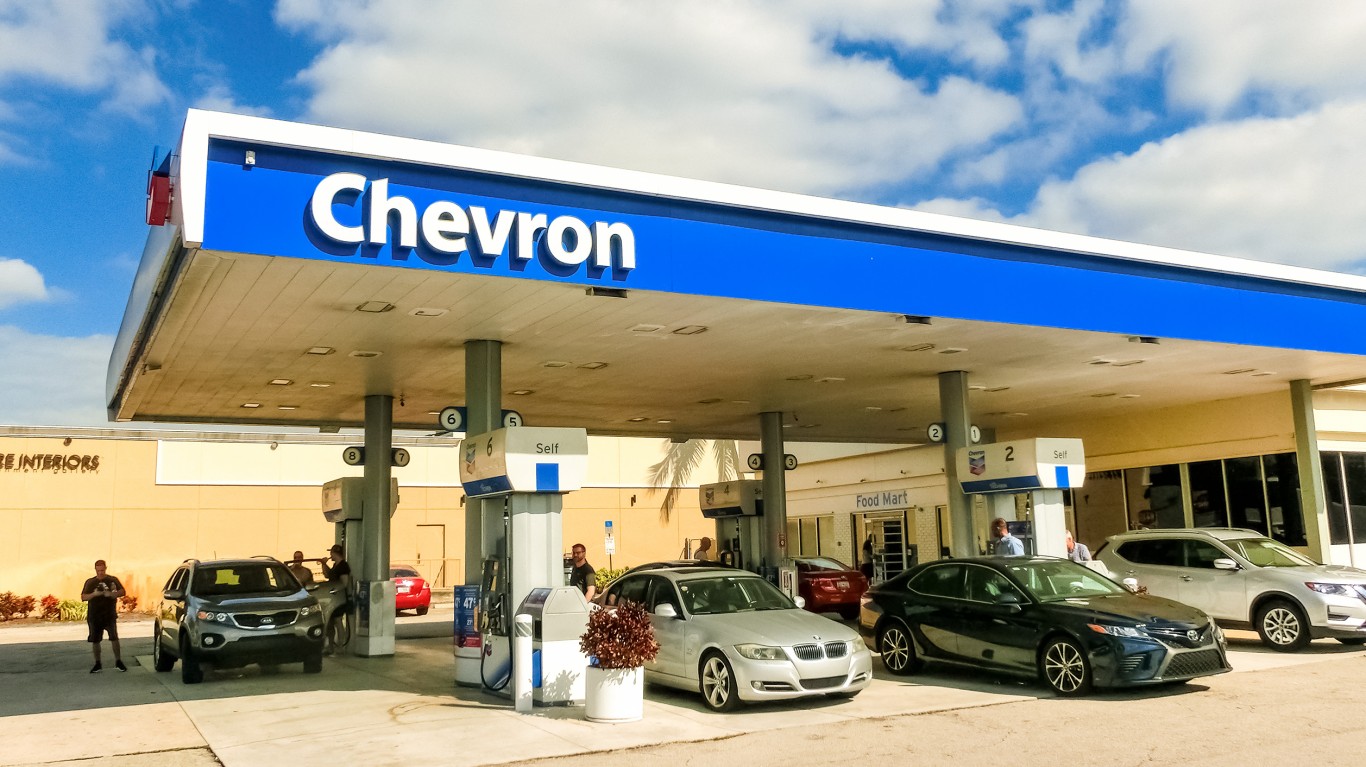
Chevron: Bigger After Hess and Generating Cash Fast
Chevron yields 3.14%, which is the most income of the two US majors. It is also integrated, with production, processes, chemicals and now power generation. After buying Hess, it is much larger: worldwide production grew 20% from a year earlier to 4,070 MBOED in the second quarter, and US refineries ran at 97% utilization.
Dividend safety: The forward annual dividend is $7.12, compared with trailing diluted EPS of $10.38. The free cash flow yield of 4.08% is above the dividend yield. Second-quarter operating cash flow was $22.63B against capex of $4.54B, leaving $18.10B of free cash flow. Chevron used part of that to repay $8.41B of debt. The debt-equity ratio is 0.251 and interest coverage is 13.7x. The dividend has gone up in every year of the recent record: from $1.12 a quarter in 2018 to $1.29 in 2020, $1.71 in 2025 and $1.78 now. That includes a raise during 2020, when oil prices fell.
Bull case: The Hess deal is already paying off. Chevron reached a $3B annual run rate of cost savings six months ahead of plan and captured $1.5B in Hess synergies within a year. It has now returned over $5 billion to shareholders for the 16th consecutive quarter. It also signed a 20-year power deal for a 2.67 GW West Texas AI data center project, which adds a source of income that doesn’t depend on oil prices. The forward P/E is 15.
Risk: Hess added debt. Net debt to EBITDA is 1.08, compared with Exxon’s 0.548. That gives Chevron less of a cushion if a long oil downturn hits while it is still integrating the deal.
BP: The Biggest Yield, With a Turnaround Attached
BP yields 4.59%, the highest in this group. US investors own it through an American Depositary Share (ADS), which trades on the NYSE in dollars and represents a set number of BP’s London-listed ordinary shares. BP announces its dividend in cents per ordinary share and then converts it to a per-ADS amount. The latest payout was 8.660 cents per ordinary share, or $0.5196 per ADS. BP is an integrated major with a large processes business, which helped this year: its refining margin indicator was $29.6/bbl versus $11.9/bbl a year earlier.
Dividend safety: Coverage is fine at current oil prices. Second-quarter operating cash flow was $10.86B against capex of $3.09B. Its finances are weaker. Net debt was $25.3B at the end of the first quarter, up from $22.2B at year end. The dividend history includes a cut: the ADR payout fell from $0.63 to $0.315 in 2020. It has been raised steadily since then and recently went from $0.4992 to $0.5196.
Bull case: On forward earnings, BP is the cheapest stock here at 10 times. Management expects $8 to $9B in divestment proceeds this year, including the roughly $6B Castrol sale, and has raised its cost-cutting target to $6.5 to $7.5B by 2027. The CEO, Meg O’Neill, has been direct about BP’s problems: “Our performance over the past few years has not met our own expectations… we have written off too much value; and our costs and liabilities are not resilient enough in a low price environment.”
Risk: BP carries liabilities its US peers don’t. It still has $6.9B in Gulf of America oil spill provisions on the books, it expects about $1.6B in settlement payments this year, and its UK operations pay an Energy Profits Levy with a 78% headline rate through March 2030.
Occidental Petroleum: A Fast-Growing Dividend Tied Directly to Crude
Occidental yields 1.82%, and it is a different kind of company from the other three. It is classified as an Oil & Gas E&P company, meaning exploration and production. It has no large refining business to absorb a drop in crude, and it has sold its OxyChem chemicals unit. Its cash flow therefore rises and falls almost directly with the price of oil. Its realized crude price was $96.78/bbl in the second quarter.
Dividend safety: The current payout is easy to cover. The forward annual dividend is $1.12, compared with trailing diluted EPS of $3.39, and second-quarter free cash flow was $3.02B. The company is still paying down debt. Principal debt fell to $13.3B in the first quarter and to $11.8B in the second, and the next target is $10.0B. Its dividend record is the weakest of the four. In 2020 the quarterly payout went from $0.79 to $0.01. It has since been rebuilt to $0.28.
Bull case: Dividend growth is the main appeal here. The payout has been increased 8% this year, and the next payment is on October 15. Operations are improving: production of 1,433 Mboed beat guidance, and operating costs fell to $8.70/BOE. Goldman Sachs (NYSE:GS) is getting more positive, with Barron’s reporting a Goldman upgrade this week.
Risk: Occidental has the most to lose if oil prices fall. In its May outlook, the EIA forecast OPEC output recovering from 20.90 million barrels per day in the second quarter of 2026 to 28.28 million in the fourth quarter. More supply would brings down the prices that are currently funding Occidental’s debt paydown.
Where Big Oil Income Lands Now
Exxon Mobil and Chevron are the most reliable income in this group: both cover their dividends with free cash flow, both carry little debt, and both kept raising the payout through the 2020 oil crash. BP offers the highest yield, but that yield depends on its recovery and on paying down debt. Occidental cut its dividend in 2020 and is now growing it quickly, which makes it a payout to keep an eye on in a downturn more than a foundation for an income portfolio. When oil prices fall, the dividends with strong balance sheets behind them are the ones most likely to hold.
Contact [email protected] for any questions or corrections.
Chris Lange is a financial and geopolitical writer with more than a decade of experience covering a myriad of topics. He has published thousands of articles for 24/7 Wall St., with past coverage focused heavily on stocks, IPOs, healthcare, defense, global affairs, and technology.
His work has been quoted, or referenced by a number of outlets including Business Insider, USA Today, Yahoo Finance, MSN, The Motley Fool, and many other publications. A graduate of Southwestern University, he studied business with a focus on investments and has previous experience in banking and startups.
When not reading or writing the news, he is following his passion for Lacrosse, playing chess, or building solar projects with his dad.