58 Analysts, Zero Sells: Amazon’s Price Target Is a Rare Consensus
Fifty-eight analysts cover Amazon and not one rates it a sell, yet the stock still sits well below its 52-week high while free cash flow turns negative and capital spending surges to levels that would make most CFOs flinch.

This post may contain links from our sponsors and affiliates, and Flywheel Publishing may receive compensation for actions taken through them.
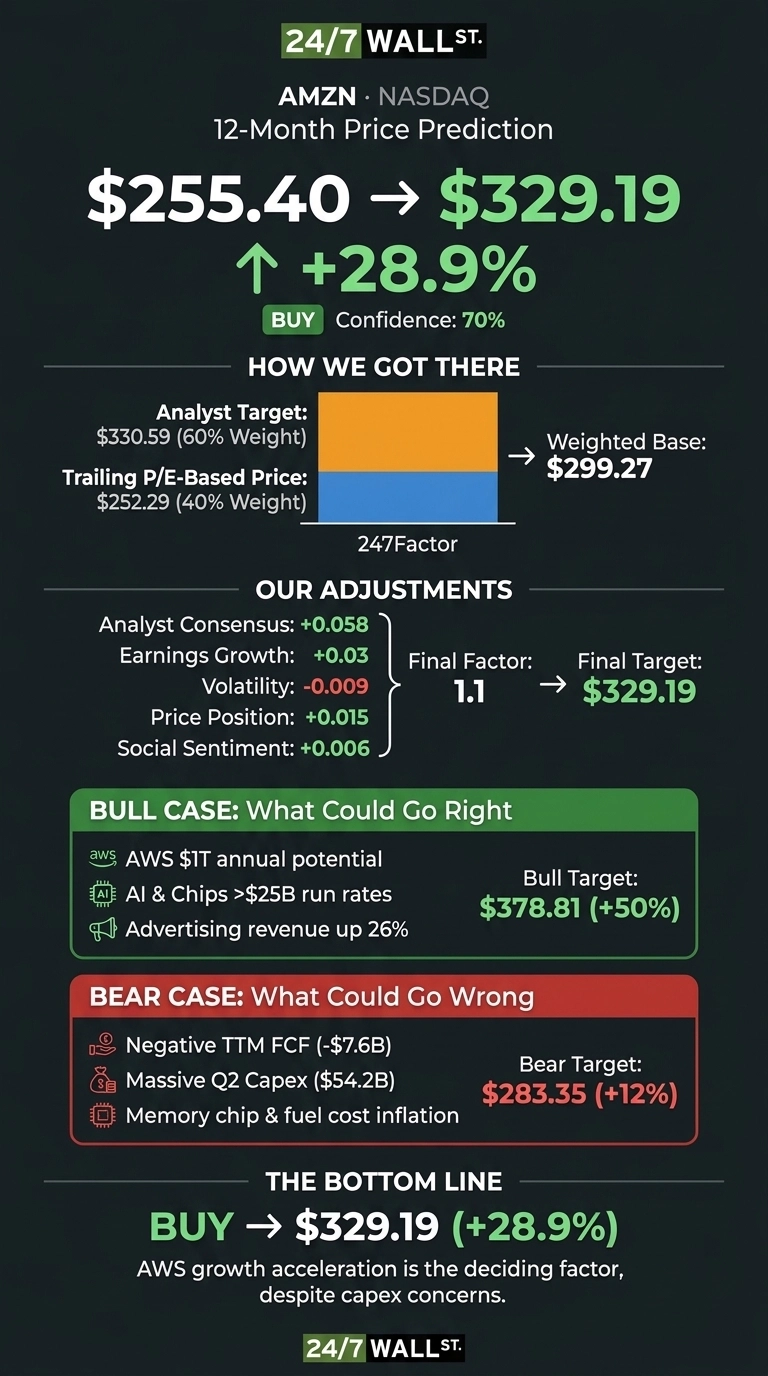
The 24/7 Wall St. price target for Amazon (NASDAQ:AMZN | AMZN Price Prediction) is $329.19. From today’s $255.40, that works out to 28.9% upside. Our model rates the stock a buy with 70% confidence.
| Metric | Value |
|---|---|
| Current Price | $255.40 |
| The Price Target from 24/7 Wall St. | $329.19 |
| Upside | 28.9% |
| Recommendation | BUY |
| Confidence Level | 70% |
Wall Street lines up behind the same view. Analysts list 15 Strong Buy ratings, 43 Buys, 2 Holds and zero Sells. Their consensus target of $330.59 lands within about a dollar of ours. Our model’s confidence fell to 0.7 from 0.9 in recent updates, which shows higher capital spending.

AWS Posts Its Fastest Growth in 18 Quarters as Shares Trail Their High
Amazon is up 3.76% over the past week, down 1.2% over the past month and up 10.65% year to date. The stock trades 11.1% below its $287.20 52-week high and 30.3% above its $196 low.
Q2 revenue came in at $200.61 billion, up 19.62% and ahead of the $196.43 billion estimate. GAAP EPS of $5.75 was inflated by a $53.4 billion Anthropic gain. On a comparable basis, EPS was about $1.88 against a $1.83 estimate. AWS revenue grew 37% to $42.23 billion, and the AWS backlog reached $496 billion.

Why Bulls See $378 and a Trillion-Dollar AWS
AWS now runs at a $169 billion annualized rate. Amazon’s chief executive said it could become “a trillion-dollar annual revenue business for us in time.” The AI and chips businesses each exceeded $25 billion run rates.
OpenAI committed about 2 GW of Trainium capacity starting 2027, and Anthropic up to 5 GW. Advertising rose 26% to $19.8 billion. On CNBC’s Fast Money, Carter Worth argued for a bounce toward $305. Our bull scenario reaches $378.81.

Negative Free Cash Flow Is the Risk Worth Watching
Trailing free cash flow turned negative at -$7.6 billion, and Q2 capex hit $54.2 billion. The consensus EPS estimate for 2027 is $10.5149, below $12.8820 for 2026. Most of that gap shows one-time Anthropic gains in 2026.
Memory chip inflation and higher fuel costs add pressure. Management’s response is that servers break even in a little under three years, and most AI capacity is contracted for terms of at least five years. Even the bear-case estimate of $283.35 sits above today’s price.
Amazon Looks Cheapest Against Microsoft and Alphabet
Through Azure, Microsoft (NASDAQ:MSFT) competes directly with AWS. In both cloud and digital advertising, Alphabet (NASDAQ:GOOGL) competes with Amazon.
| Company | Forward P/E | EV/EBITDA | Revenue Growth (YoY) |
|---|---|---|---|
| Amazon | 24 | 10.98 | 19.6% |
| Microsoft | 25 | 17.72 | 17.7% |
| Alphabet | 23 | 12.74 | 24.2% |
Microsoft trades at a higher EV/EBITDA multiple than Amazon while growing revenue more slowly. Alphabet grows faster but also costs more on EBITDA.
Both carry near-unanimous Buy coverage, with 2 Holds at Microsoft and 5 at Alphabet. Against these two peers, our target looks reasonable, even conservative.
Amazon Price Prediction 2026-2030
The 24/7 Wall St. price target of $329.19 carries a buy rating at 70% confidence. AWS acceleration is the deciding factor.
I’d find Amazon compelling if backlog keeps converting into revenue. I’d grow cautious if capex keeps rising without a recovery in free cash flow.
These are the levels the 24/7 Wall St. price target model projects for Amazon in the coming years, assuming current trends hold.
| Year | The Price Target from 24/7 Wall St. |
|---|---|
| 2026 | $263.96 |
| 2027 | $329.19 |
| 2028 | $385.41 |
| 2029 | $464.01 |
| 2030 | $501.52 |
The projections rest on Amazon continuing to execute its current strategy. Trainium sales to outside customers could add upside.
A slowdown in AI demand that leaves new capacity sitting idle would be the main downside risk. The flip side is the broader expansion feeding AWS: we highlighted seven power, cooling, and networking suppliers riding that same wave in a free report on AI infrastructure stocks.
Contact [email protected] for any questions or corrections.
Vandita Jadeja is a financial publisher with over a decade of experience writing about financial topics, including investment, savings, retirement, insurance and banking. Vandita is a Chartered Accountant who loves to debunk financial concepts for readers.
Her work has appeared on sites that include The Motley Fool, InvestorPlace, and Benzinga. She covers investing and focuses on stock picks and price prediction for 24/7 Wall St.
When not looking for the next stock investment opportunity, she can be found traveling, reading, chasing sunsets and enjoying her iced latte.