Western Digital Lost One Third Its Value Over 3 Months: It’S Ready to Provide 175% Returns Says This Wall Street Pro
Western Digital has beaten earnings five straight times, yet the stock keeps falling as a supply threat from a rival threatens to unravel the entire bullish case that has one Wall Street analyst calling for a massive rebound.


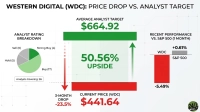
Western Digital (NASDAQ:WDC | WDC Price Prediction) currently trades at $380.71. Wall Street’s average price target is $668.50, which implies 75.6% upside.
Since spinning off its Flash business into Sandisk (NASDAQ:SNDK) in February 2025, Western Digital has made only hard disk drives. Management says “roughly 80% of data stored in a hyperscale data center resides on hard disk drives,” and that figure puts the company at the center of AI storage spending. The Street-high target of $1,050.00 from Melius Research analyst Ben Reitzes implies 175.8% upside.
The stock has fallen more than 30% and the consensus gap is above 40%. Meanwhile the business keeps beating estimates.
A 32% Slide Despite Five Straight Earnings Beats
Supply fears did most of the damage. Nikkei reported that Toshiba plans to invest about ¥60 billion ($380 million) to double hard-disk-drive production capacity by fiscal 2027. That goes straight at the supply discipline that has been driving HDD pricing. A Bloomberg report that Seagate Technology (NASDAQ:STX) and Toshiba are competing for TDK’s magnetic-heads business followed, and WDC fell 6.93% to $411.04 in that session.
The decline started earlier. Western Digital’s fiscal Q4 report showed revenue of $3.75B, up 43.8%, and EPS of $3.56 against estimates of $3.29. Shares still fell roughly 9%–11%, a classic expectations correction. Over three months the stock is down 32.4%, from $563.14. It lost 7.38% in the past week alone, while the S&P 500 slid just 0.13%. With a beta of 2.169, WDC moves harder than the market in both directions.
Analysts Are Focused on Margins and Long-Term Contracts
Gross margin is where the bullish argument begins. It rose from 43.9% to 54.4% across fiscal 2026, and guidance for the current quarter calls for 55–56%. Q1 FY27 guidance also points to revenue of about $4.10B and EPS of $4.00. Price per terabyte rose by a high teens percentage year over year, while cost per terabyte fell approximately 8%.
Visibility is the second pillar. Customer demand for long-term agreements reaches out to 2029, 2030, and 2031. According to the CEO, “Visibility remains very strong.” upcoming drivers include the 40TB ePMR ramp and a 44TB HAMR drive due in the first half of calendar year 2027, along with exabyte growth that management estimates at 25% plus. The next earnings report lands October 22.
Analyst view is skewed: 4 Strong Buys, 17 Buys, 5 Holds and zero Sells. After Q4, firms including Cantor Fitzgerald, Bernstein, Morgan Stanley and BofA raised or maintained their targets. Melius goes furthest. It argues that AI storage demand “will severely outpace supply” and that Wall Street underestimates storage earnings power (we featured seven suppliers riding the same AI data-center buildout, from power to cooling to storage, in a report available here). The weak spot is that Toshiba’s expansion challenges the supply assumption that thesis depends on.
Seagate Sold Off Too, While NetApp Ran Past Its Target
The two big HDD makers fell together. Flash-focused storage moved the other way.
Seagate trades at $747.20, 34.6% below its 52-week high, after losing 9.92% over the past month. Its $1144.35 target implies 53.2% upside. Of 25 analysts, 22 have a Buy or Strong Buy rating, while 1 rates it Strong Sell. The Street sees less upside here than in WDC.
NetApp (NASDAQ:NTAP) rose 20.2% in a month to $239.01, which is above its $211.69 target and implies 11.4% downside. 12 of its 20 analysts rate it Hold, so targets are trailing the rally.
WDC has the largest implied upside in the group, and it also posts the deepest three-month decline.
WDC Is Still Up 121% This Year After Losing Half Its Peak Value
At $380.71, WDC sits 52.4% below its 52-week high of $799.62. The 26 covering analysts set an average target of $668.50, or 75.6% upside. Targets are one data point, and they move after the fact.
Year to date the stock is still up 121.24%, compared with 14.1% for the S&P 500. It trades at a trailing P/E of 14 and a forward P/E of 23.
Supply Discipline Decides Whether This Discount Pays Off
Western Digital’s bullish thesis holds if long-term contract pricing holds, margins clear 55% as guided and the HAMR launch stays on schedule. That path supports a return toward the mid-$600s.
It becomes a value trap if Toshiba’s added capacity floods the market, pricing per terabyte rolls over and concentrated hyperscaler buyers push back. HDDs have a long history of boom-and-bust cycles, and the market is pricing in that memory.
I lean bullish. Five straight beats, contracted visibility and a forward multiple in the low 20s give the consensus target real support. The $1,050 call needs a supply-constrained world that Toshiba is actively working to end.
Contact [email protected] for any questions or corrections.
Alex Sirois is a financial writer with experience spanning both retail and institutional investing. He has written for InvestorPlace and held roles at BNY Mellon and Bernstein, giving him a perspective that bridges Main Street portfolios and Wall Street analysis.
Alex holds an MBA from George Washington University and has built his career across multiple industries, including e-commerce, education, and translation — a breadth of experience that informs how he breaks down complex financial topics for everyday investors. His writing is conversational, actionable, and grounded in long-term, buy-and-hold investing principles.
At 247 Wall St., Alex focuses on delivering analysis that is both accessible and useful, with a clear emphasis on helping readers make more informed decisions with their money.