JNJ Stock Has a New Growth Story, but One Business Needs to Catch Up
Johnson and Johnson just posted a quarter where one business charged ahead while another quietly stalled, and which side wins out will determine whether the stock earns its premium valuation over rivals like Merck and AbbVie.

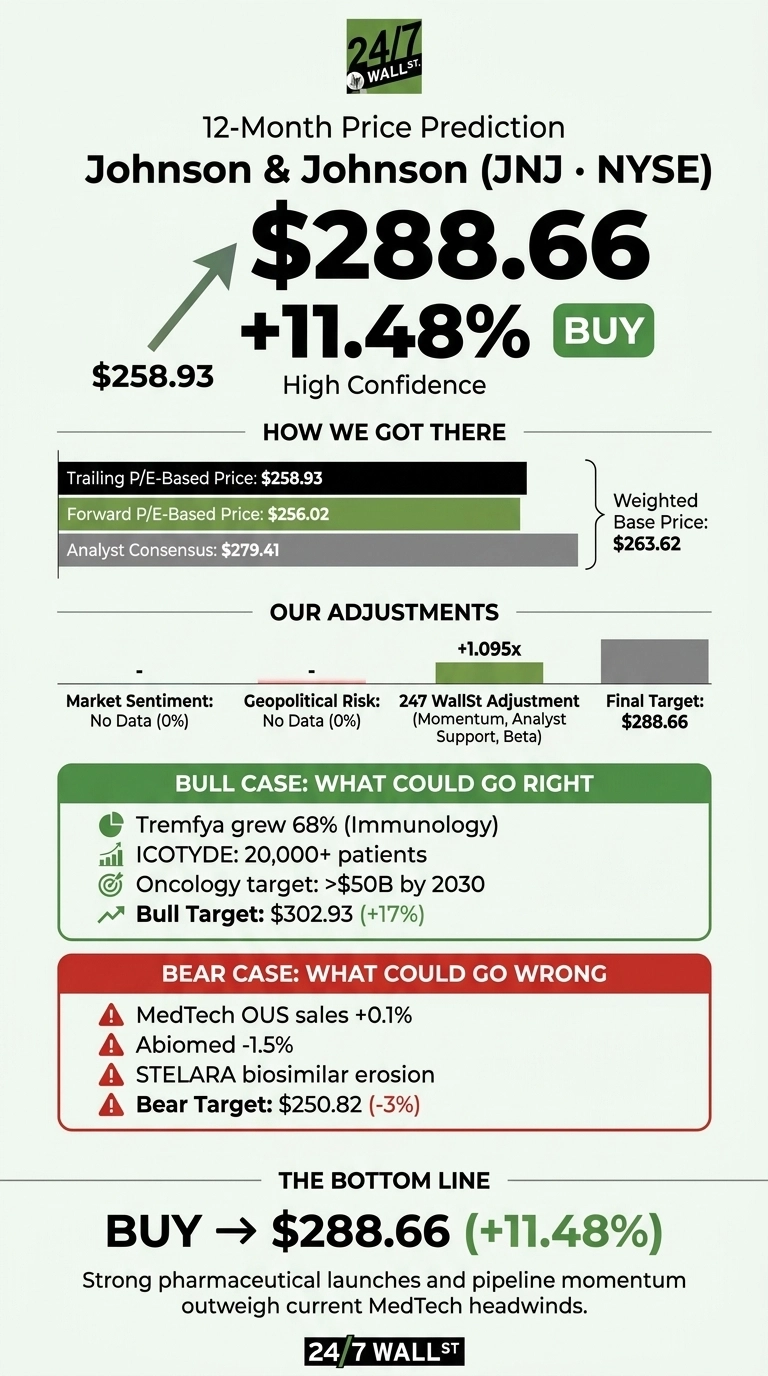
Our 24/7 Wall St. price target for Johnson & Johnson (NYSE:JNJ | JNJ Price Prediction) is $288.66 over the next 12 months. From the $258.93 close on October 20, that works out to 11.48% upside, and our rating is buy.
| Metric | Value |
|---|---|
| Current Price | $258.93 |
| 24/7 Wall St. Price Target | $288.66 |
| Upside/Downside | 11.48% |
| Recommendation | BUY |
| Confidence Level | 90% |

Our confidence in this call is high. Right now the growth comes from pharma. Last quarter Innovative Medicine grew 7.9% and MedTech grew 2.5%. Over the next year, I think the stock depends on whether devices can close that gap. If MedTech steadies, our target is likely too low.
A Talc Charge Hid a Solid Third Quarter
Shares dropped 1.3% to $255.99 at midday. They are up 2.97% for the week, down 5.19% over the past month and up 25.69% year to date. The 52-week range is $180.59 to $281.07.
In the quarter reported October 13, sales came in at $25.4 billion. Adjusted EPS was $2.59, while GAAP EPS fell to $0.09. About $7 billion of charges explain the drop: the proposed talc settlement plus costs tied to the Firefly Bio deal and the Cell BioMedicines partnership.
Management cut adjusted EPS guidance to $11.05 to $11.15. Leave out the $0.64 deal impact and EPS growth would be close to 9%.

Why Bulls See More Than $300
Our bull case reaches $302.93, which is 17% upside. Tremfya grew 68%, and management sees it becoming a $10 billion-plus franchise. New data released October 19 showed durable fistula remission in Crohn’s disease.
The oral psoriasis drug ICOTYDE has more than 20,000 patients on therapy. CAPLYTA reached $1 billion in year-to-date sales. J&J is targeting more than $50 billion in oncology sales by 2030.
Wall Street is supportive too: there are 16 Buy or Strong Buy ratings and a consensus target of $279.41.

MedTech Is the Business That Has to Catch Up
Our bear case is $250.82. MedTech sales outside the U.S. rose just 0.1%. Abiomed fell 1.5% and surgery fell 1%. Timothy Schmid, speaking for MedTech, put it plainly: “Simply put, we can do better, and we absolutely will.”
Two more risks add to the pressure. Firefly Bio and Cell BioMedicines are expected to reduce 2027 EPS by $1.36 per share, and Stelara keeps losing sales to biosimilars.
The other side deserves weight. U.S. MedTech grew 4.8% and Shockwave grew 17.2%. MedTech’s adjusted margin improved to 22.9%, and VARIPULSE Pro is still awaiting U.S. approval. Separating the Orthopaedics business should also sharpen the focus on the device units that remain.

J&J Trades at a Premium to Merck and AbbVie
| Company | Forward P/E | Quarterly Revenue Growth |
|---|---|---|
| Johnson & Johnson | 21 | 5.9% |
| Merck | 15 | 5.1% |
| AbbVie | 16 | 10.2% |
Merck (NYSE:MRK) is a direct oncology competitor with similar growth. Its forward P/E is 15, which suggests investors are paying extra for J&J’s broader set of drug launches.
AbbVie (NYSE:ABBV) has also had to replace sales from a major immunology drug facing biosimilars. It is growing faster at 10.2% and trades at a lower multiple. Against these two peers, our target looks reasonable but leaves little room for MedTech to disappoint.
Pharma Momentum Supports Our BUY Rating
Our 24/7 Wall St. price target is $288.66, with a buy rating and 90% confidence. What tips the call is that strong launches are outrunning Stelara’s decline.
I’d be a buyer if the December 8 Enterprise Business Review shows a credible plan to fix MedTech. I’d stay on the sidelines if device sales outside the U.S. keep stalling into 2027. On balance, I think the drug pipeline earns J&J its premium.
| Year | 24/7 Wall St. Price Target |
|---|---|
| 2026 | $261.98 |
| 2027 | $287.67 |
| 2028 | $314.27 |
| 2029 | $338.34 |
| 2030 | $358.63 |
These projections assume J&J keeps executing on its double-digit growth plan. The biggest swing factors are a faster MedTech recovery on the upside and new litigation costs on the downside.
Contact [email protected] for any questions or corrections.
Vandita Jadeja is a financial publisher with over a decade of experience writing about financial topics, including investment, savings, retirement, insurance and banking. Vandita is a Chartered Accountant who loves to debunk financial concepts for readers.
Her work has appeared on sites that include The Motley Fool, InvestorPlace, and Benzinga. She covers investing and focuses on stock picks and price prediction for 24/7 Wall St.
When not looking for the next stock investment opportunity, she can be found traveling, reading, chasing sunsets and enjoying her iced latte.