CoreWeave Stock: The AI Demand Story Is Strong, but One Risk Could Change Everything
CoreWeave has $104 billion in contracted revenue, a 25% price increase already in effect, and Wall Street calling for triple-digit upside. One number buried in the financials threatens to unravel all of it.


CoreWeave (NASDAQ:CRWV) has a simple pitch. It leases purpose-built GPU capacity to AI labs and enterprises, and its CEO says the company sits “between the models and the silicon, delivering the infrastructure, software, and expertise required to build and run AI at scale.”
Demand backs up that claim, but the stock has not. Shares are down 13.24% year-to-date, down 51.1% over the past year, and off 20.15% in the last week alone. From $62.19, a run to $100 in 2027 would take a 61% gain. Here’s what would have to go right.
Wall Street Sees Even More Upside Than $100
Analysts’ average price target is $138.34, which implies 122% upside. 31 analysts rate the stock a buy or strong buy, while 3 rate it a sell or strong sell. That optimism rests on revenue.
Estimates call for $12.87 billion in 2026 and $26.34 billion in 2027, roughly 105% growth. CoreWeave has topped revenue estimates in five straight quarters, and in Q2 it posted its first EPS beat: -$1.14 against an estimate of -$1.447.
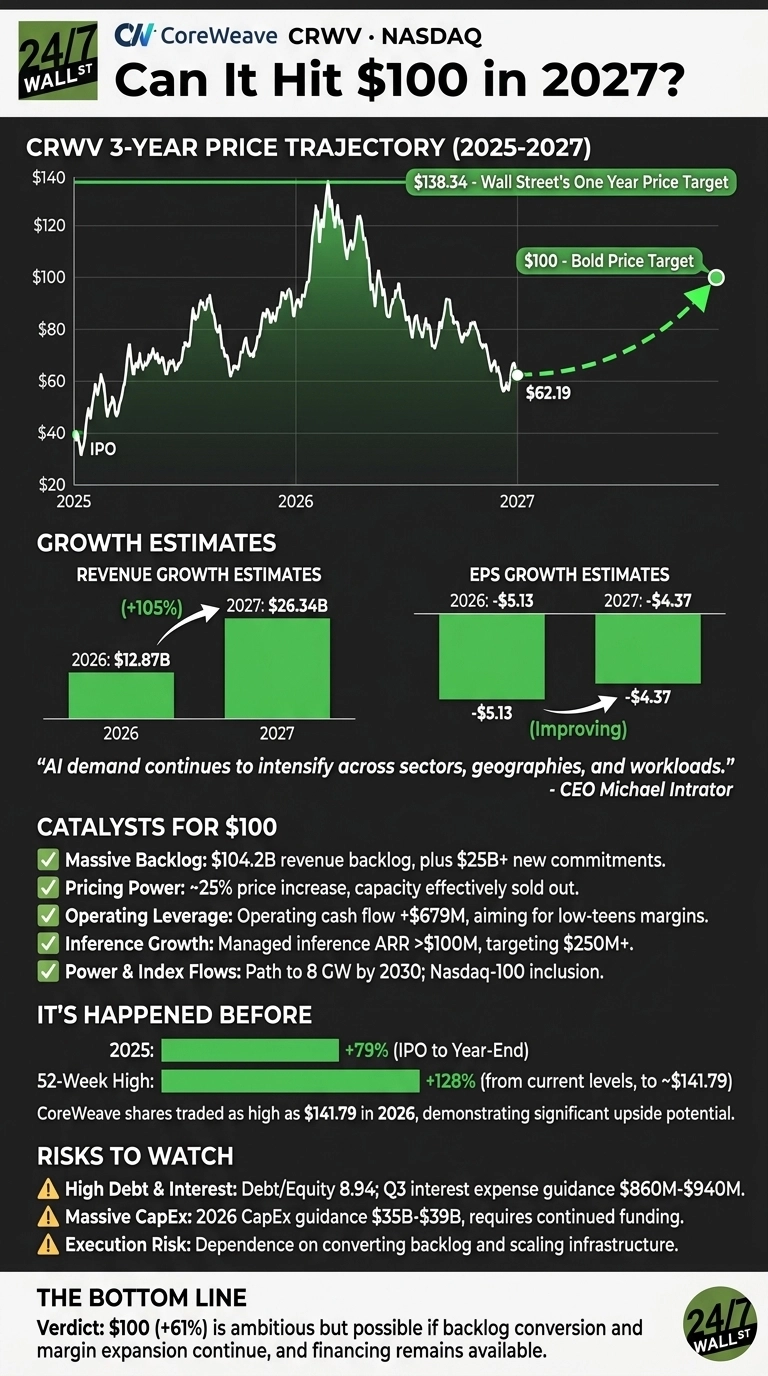
Here’s What It Takes for CoreWeave to Reach $100
CoreWeave is still losing money, so price-to-sales is the right benchmark. Its market cap now equals about 1.1x 2027 revenue estimates. At $100, that would rise to roughly 1.7x, which is modest for a company doubling its sales. The catch is debt: enterprise value runs 12.38x trailing revenue.
A few factors could drive CoreWeave to $100.
- Backlog: Contracted revenue stands at $104.2 billion, and more than $25 billion in new commitments signed early in Q3 isn’t counted yet.
- Pricing power: A July price increase of about 25% went into effect, and management says “our near-term capacity remains effectively sold out.”
- Operating leverage: Operating cash flow reached $679 million, and management expects adjusted operating margins in the “low teens” in Q4.
- Inference: Managed inference ARR passed $100 million, and the company is aiming for at least $250 million by year-end.
- Power and index flows: CoreWeave plans to grow from 1.5 gigawatts of active power to 8 gigawatts by 2030, and its addition to the Nasdaq-100 could bring in index-fund buying.

Financing Is the One Risk That Could Change Everything
All of this growth runs on borrowed money. Interest expense rose to $640 million from $267 million a year earlier, and Q3 guidance calls for $860 million to $940 million. Capex guidance for 2026 is $35 billion to $39 billion, and debt-to-equity is 8.94.
If credit markets tighten, the bull case breaks down. There is some relief: CoreWeave has cut its average cost of debt by almost 300 basis points, which it says saves about $1.1 billion a year in interest.
CoreWeave’s Short History Shows $100 Is Within Reach
CoreWeave went public at $40 and closed 2025 at $71.61, a 79% gain in its first partial year.
Its 52-week high is $141.79, and shares traded at $136.80 around its Q1 report in May. The stock has already traded well above $100 this year.
$100 Is a Stretch, but the Path Is Clear
Reaching $100 would take a 61% gain, which is still below where Wall Street’s consensus target sits. That would require backlog turning into revenue, pricing holding firm, margins expanding as promised, and lenders continuing to fund the expansion.
In the near term, Q3 interest costs and progress on power installations are the numbers to track. Gains of that magnitude won’t happen every year, but this is the model for how CoreWeave could see outsized returns in 2027.
Contact [email protected] for any questions or corrections.
Vandita Jadeja is a financial publisher with over a decade of experience writing about financial topics, including investment, savings, retirement, insurance and banking. Vandita is a Chartered Accountant who loves to debunk financial concepts for readers.
Her work has appeared on sites that include The Motley Fool, InvestorPlace, and Benzinga. She covers investing and focuses on stock picks and price prediction for 24/7 Wall St.
When not looking for the next stock investment opportunity, she can be found traveling, reading, chasing sunsets and enjoying her iced latte.