Why Meta and Alphabet Don’t Care That Q3 Earnings Paints Them as Laggards
Both Meta and Alphabet missed earnings estimates this quarter, yet their management teams are betting billions that the headline numbers completely misrepresent where the real growth is coming from.

Both Meta Platforms (NASDAQ:META | META Price Prediction) and Alphabet (NASDAQ:GOOGL) missed EPS estimates this month because of one-time charges. The company recorded a $9.89 billion legal settlement charge. Alphabet booked an $8.7 billion loss on equity securities. Beyond those charges, both ad giants grew fast and kept spending heavily on AI. This justifies questioning the “laggard” label.
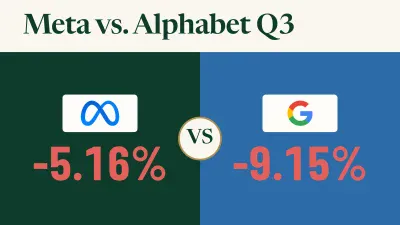
The stock charts tell a weaker story. Meta is down 5.16% year to date, and Alphabet is down 9.15%, including a 12.64% drop on October 29 alone. Sentiment turned quickly.
Ad Pricing Lifts Meta as Cloud Lifts Alphabet
Meta’s revenue came in at $64.60 billion, up 26.1% and ahead of consensus. Ad impressions rose 10% and average price per ad climbed 14%. In other words, advertisers are paying more for placements that convert. Without the charge, EPS would have been $7.40 instead of the reported $3.83, so the miss came from a legal event. CFO Susan Li said AI is “already delivering incremental advertising revenue.”
Alphabet’s growth story sits in Google Cloud. Cloud revenue rose to $30.71 billion, up 103%, and segment operating income reached $11.12 billion, compared with $3.59 billion a year earlier. Cloud now makes real profit. Search grew 12%, but I’m a little skeptical: CNBC called the miss the first real sign that AI is taking a bite out of search.
| Business Driver | Meta | Alphabet |
|---|---|---|
| Main Growth Engine | Family of Apps ads | Google Cloud and TPUs |
| Q3 Capex | $34.91B | $51.36B |
| Free Cash Flow | -$2.12B | -$9.07B |
Both companies posted negative free cash flow. Each management team is bearing that strain to fund the AI data-center expansion, and the picks-and-shovels suppliers behind it keep showing up in our free report on seven AI infrastructure plays that aren’t chipmakers, here: free AI infrastructure report.
Meta Builds a Consumer Agent While Alphabet Sells the Stack
Meta wants its Muse agent to reach billions of people. More than 10 million people set it up in about a month and a half. Over 25% of users shopped through it, and the average purchase exceeded $200. That is an early sign of commerce intent. Zuckerberg plans to charge businesses “a fee based on the transactions that we help facilitate.”
Alphabet makes money from AI by selling it directly. Pichai cited “strong demand for our TPU systems across a wide range of customers.” Funding the expansion took $28.7 billion through debt and at-the-market share sales, which means dilution. Meta is creating a new nonvoting share class that works like a 2-for-1 split, with trading expected in late January 2027.
Muse Revenue and Search Resilience Set the Next Test
The key question is whether Meta delivers on Q4 revenue guidance of $73B-$76B while more youth litigation trials approach. Muse arrives on Meta glasses in November 2026. For Alphabet, search growth matters as R&D expense climbs to $20.64B.
Why I Lean Toward Alphabet’s Clearer AI Payback
To me, Alphabet’s spending has the more visible return. Customers already pay for its TPUs and cloud capacity. Meta’s ad engine looks excellent, but Muse monetization is still a plan. If you can live with wider outcomes and trust Zuckerberg’s record, Meta offers more upside potential. I would change my view if Muse commerce fees show up in 2027 results.
Contact [email protected] for any questions or corrections.
Alex Sirois is a financial writer with experience spanning both retail and institutional investing. He has written for InvestorPlace and held roles at BNY Mellon and Bernstein, giving him a perspective that bridges Main Street portfolios and Wall Street analysis.
Alex holds an MBA from George Washington University and has built his career across multiple industries, including e-commerce, education, and translation — a breadth of experience that informs how he breaks down complex financial topics for everyday investors. His writing is conversational, actionable, and grounded in long-term, buy-and-hold investing principles.
At 247 Wall St., Alex focuses on delivering analysis that is both accessible and useful, with a clear emphasis on helping readers make more informed decisions with their money.