Prediction: This Under-the-Radar AI Stock Could Have a Big 2030 Ahead
Marvell Technology has quietly become one of the purest plays on AI data center buildout, and its CEO is calling the upside in coming years game-changing. But getting to $500 by 2030 demands three very specific things to break exactly…


Marvell Technology (NASDAQ:MRVL | MRVL Price Prediction | MRVL Price Prediction) has become one of the clearest ways to own the build-out of AI data centers. Its Data Center segment brought in $2.1715B last quarter, up 46%, and that segment now makes up 79% of revenue.
CEO Matt Murphy says “AI-related bookings remain exceptionally robust.” The shares are up 194.58% year to date, yet they sit well below their peak. So can Marvell reach $500 by 2030? I think it can, and the math below shows how.

What’s Holding Marvell Back Right Now
The rally has stalled. At $249.92, the stock is 24.2% below its 52-week high of $329.73. It is down 4.57% over the past month, even after rising 3.95% this week. With a beta of 2.26, the stock moves more than twice as hard as the market.
There are real concerns behind the pullback. Management guided Q3 non-GAAP gross margin to 57.5% to 58.5%, which is below Q2’s 58.9%. It also raised its fiscal 2027 operating expense outlook to approximately $2.55 billion. A small group of hyperscalers drive most of the revenue, and the Google warrant could dilute shareholders by up to 7%.
Analysts Are Bullish, but They May Be Underpricing 2030
The Wall Street consensus target of $341.44 implies 36.6% upside. Analyst ratings include 8 Strong Buy recommendations, 32 Buy ratings, 6 Holds, and zero Sell ratings.
The model we built is more conservative. Its base case is $284.80, or 17.23% upside, within a one-year range of $218.43 to $352.54. The model rates its confidence as high.

In my view, 12-month targets miss the bigger story. Analyst sentiment is 87% bullish, but the model’s earnings growth contribution is only 0.03. That looks too low next to management’s forecast of roughly 50% revenue growth in fiscal 2028. Murphy put it plainly: “There is a lot of upside bias in those numbers in fiscal 29 and beyond in custom.”
Here’s What It Takes for Marvell to Reach $500
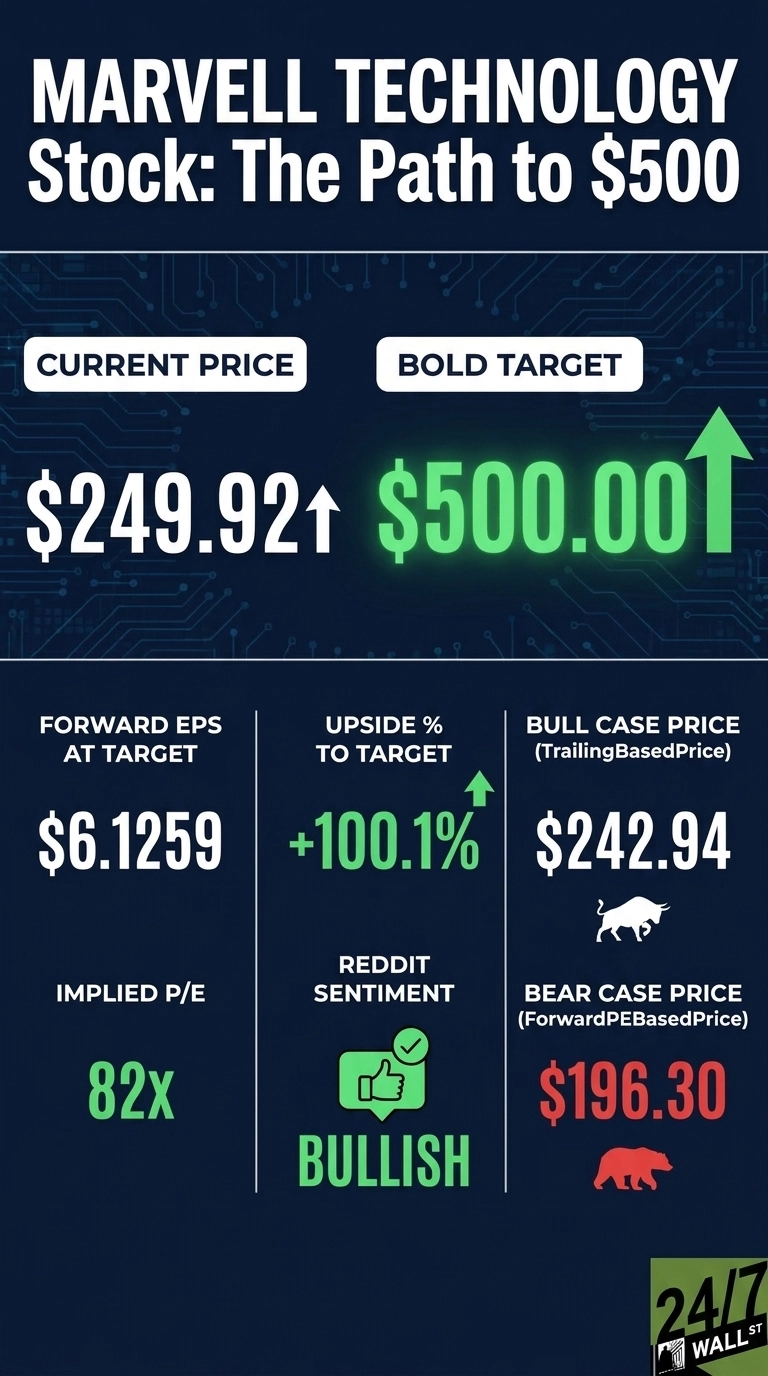
Reaching $500 from today’s price of $249.92 would require a gain of 100.1%.
With forward EPS of $6.1259, a $500 price implies a forward P/E of 82x. The base case of $284.80 already implies 46x, which means the bold target needs 35x of additional multiple expansion on today’s earnings.
That is why the path to $500 depends on earnings growth. If EPS compounds anywhere near that pace through 2030, the multiple at $500 shrinks quickly. Management expects its custom business to “more than double year over year in fiscal 2028” and non-GAAP operating margin to reach the top of its 38 to 40% target range.
Murphy called the full potential of the hyperscaler agreement “game-changing.” Our 2030 bull case reaches $509.10 by October of that year. Hyperscalers cutting capital spending or bringing more chip design in-house presents the biggest risk.
Where Marvell Trades Today vs Its Earnings Power
At today’s price, Marvell trades at 41x forward earnings. That is reasonable for a company guiding to roughly $12 billion in fiscal 2027 revenue.
Over the past 52 weeks the stock has ran from $70.62 to $329.73, and it has returned 1943.93% over 10 years. If earnings keep compounding, today’s multiple leaves room for upside.
$500 Is a Stretch, but Here’s Why It’s Possible
Hitting $500 requires a 100.1% gain. I call that a stretch with a credible path. Three things need to go right: the custom business has to double in fiscal 2028, margins have to reach the high end of the target range, and the Google programs have to ramp in fiscal 2029.
A sharp slowdown in AI infrastructure spending would disrupt the plan. Marvell is one play on that expansion, and we rounded up seven more suppliers behind the data centers, from power to cooling, in a free report you can grab here. Returns at this level shouldn’t be expected every year, but we’ve outlined the path for how Marvell Technology could reach $500 in 2030.
Contact [email protected] for any questions or corrections.
Vandita Jadeja is a financial publisher with over a decade of experience writing about financial topics, including investment, savings, retirement, insurance and banking. Vandita is a Chartered Accountant who loves to debunk financial concepts for readers.
Her work has appeared on sites that include The Motley Fool, InvestorPlace, and Benzinga. She covers investing and focuses on stock picks and price prediction for 24/7 Wall St.
When not looking for the next stock investment opportunity, she can be found traveling, reading, chasing sunsets and enjoying her iced latte.