Forget the 12-Month Squeeze: Microsoft Is Primed for an Explosive AI Payoff
Microsoft's stock barely moved over the past year while its earnings surged, and that widening gap tells a story most investors are misreading entirely.


Microsoft (NASDAQ:MSFT | MSFT Price Prediction) shows a widening gap between its share price and its operating results. The stock rose just 1.6% over the past year. Meanwhile, net income grew 32.01% in the latest quarter. The investment case depends on this gap between share performance and earnings growth.
Why I Keep Coming Back
Corporate AI runs on Microsoft’s plumbing. Companies rent Azure capacity, build agents in Foundry, and pay for Copilot through both seats and usage. Microsoft gets paid at every layer. When a business puts AI to work, the bill usually lands with Microsoft somewhere along the way.
Three Receipts Behind My Conviction
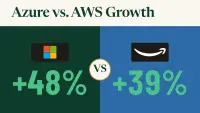
First, growth is speeding up even at a $3.87 trillion market cap. In the quarter ended Sept 30, 2026, revenue reached $92.28B, up 18.8%. Microsoft Cloud brought in $63.9B, up 30%, and Azure grew 48%. Copilot daily users rose over 5x year over year.
Second, the backlog. Commercial remaining performance obligations, meaning revenue customers have already signed contracts for, reached $677B, up 73%. Non-GAAP EPS came in at $4.89 against a $4.72 estimate. That extends a run where every quarter from Q3 25 through Q4 26 also beat estimates.
Third, the valuation remains reasonable relative to profitability. The stock trades at 29 times trailing earnings and 26 times forward earnings, with a 46.78% operating margin and 34.04% return on equity. The yield stands at only 0.68%, but the quarterly dividend just rose to $0.98 from $0.91. Back in 2008 and 2009, it was $0.13. Debt/equity stands at 0.29, and interest coverage at 50.88x.
Why Microsoft Stands Apart From Amazon and Oracle
A strong cloud business anchors Amazon (NASDAQ:AMZN), and AWS grew 39% last quarter. Still, the stock trades at 35 times earnings, pays no dividend, and posted a trailing free cash burn of $42.4 billion as AI spending outran cash generation. Oracle (NYSE:ORCL) grew infrastructure revenue 121%, but its free cash flow came in at negative $5.4 billion last quarter, and interest expense rose 55% to $1.4 billion. Microsoft pays for its expansion with cash it makes, and it still returned $10.2B to shareholders in a single quarter.
What Could Hurt This Position
The spending is the real risk. Cash capex hit $39.37B last quarter, up 102.99%, and management expects calendar-year capex of approximately $170 billion. Fiscal 2026 free cash flow slipped 6.46% to $66.99B. Should AI demand cool before those data centers pay off, returns shrink and the stock could stay stuck for a while. Windows OEM and Devices revenue also fell 22%.
That risk leaves my thesis intact because the cash keeps rolling in. Operating cash flow reached $58.0B, up 28.73%, and free cash flow still came in at $18.6 billion during the biggest spending quarter yet. As CFO, Amy Hood put it simply: “We still have demand that exceeds supply.”
Guidance That Signals More Azure Growth Ahead
Management guided second-quarter Azure growth to 49 to 50% in constant currency and total revenue to $96 to $97.1 billion. CEO Satya Nadella said, “I’ve never been more confident in the long-term returns for our investments.” Over ten years, the shares gained 899.33%. I read the flat past year as a pause while the AI return builds in the income statement. The business has already moved, so keep an eye on whether the stock catches up.
Contact [email protected] for any questions or corrections.
Alex Sirois is a financial writer with experience spanning both retail and institutional investing. He has written for InvestorPlace and held roles at BNY Mellon and Bernstein, giving him a perspective that bridges Main Street portfolios and Wall Street analysis.
Alex holds an MBA from George Washington University and has built his career across multiple industries, including e-commerce, education, and translation — a breadth of experience that informs how he breaks down complex financial topics for everyday investors. His writing is conversational, actionable, and grounded in long-term, buy-and-hold investing principles.
At 247 Wall St., Alex focuses on delivering analysis that is both accessible and useful, with a clear emphasis on helping readers make more informed decisions with their money.