Prediction: This Could Be One of the Best AI Stocks to Own Through 2030
Azure is accelerating, Copilot seats are piling up, and OpenAI just made a commitment that changes the math on Microsoft's cloud business entirely. But one expense line is growing faster than almost anyone expected, and it may decide whether this…


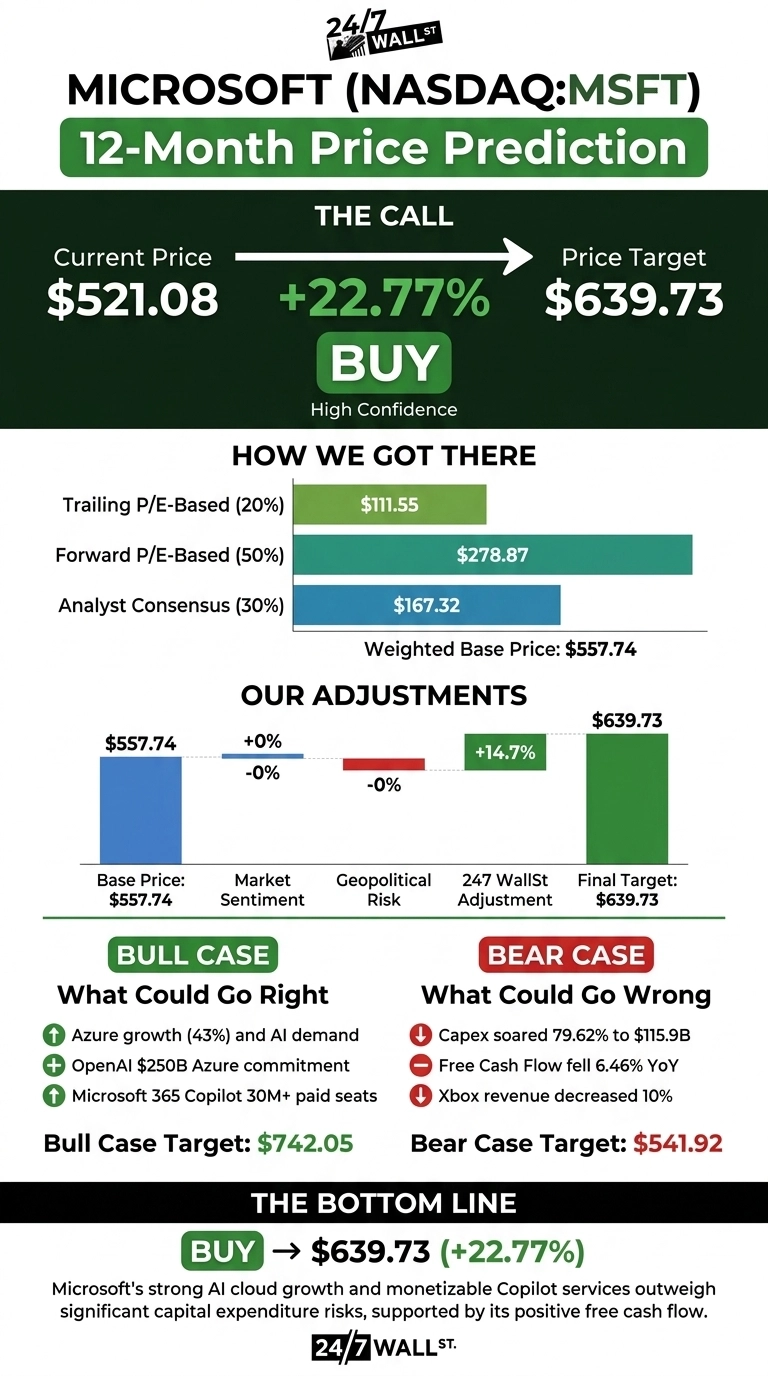
The 24/7 Wall St. price target for Microsoft (NASDAQ:MSFT | MSFT Price Prediction) is $639.73 over the next 12 months. That implies 22.77% upside from Thursday’s close of $521.08. The stock earns a buy rating with high confidence.
| Metric | Value |
|---|---|
| Current Price | $521.08 |
| Price Target from 24/7 Wall St. | $639.73 |
| Upside | 22.77% |
| Recommendation | BUY |
| Confidence Level | 90% |
Azure is growing 43%, the commercial backlog stands at $678 billion, and Microsoft 365 Copilot has more than 30 million paid seats.
Microsoft makes money from AI in both infrastructure and software. Wall Street generally agrees: there are 14 Strong Buy ratings, 39 Buys, 2 Holds and no Sells.

A Summer Rally Brought Shares Back Toward Their Highs
Shares gained 36.82% between July 23 and October 22. They are up 4.1% over the past month and 7.87% year to date, despite a 3.9% drop this past week. The 52-week range runs from $348.54 to $551.15.
In fiscal Q4, revenue of $90.01 billion beat the $87.63 billion estimate. EPS of $4.74 beat the $4.2394 estimate, helped by a $3.20 billion gain on Microsoft’s Anthropic stake. Separately, Microsoft has pushed back against efforts to tokenize its stock as its next earnings report nears.

Why Bulls See $742 Within Reach
Management guided fiscal Q1 Azure growth to about 45% in constant currency. On the last call, the CFO said “Customer demand continues to exceed available capacity.”
Microsoft’s Maia 200 chip delivers 30% better performance per dollar, and OpenAI has committed to buy an additional $250 billion of Azure services. The consensus target is $601.73. The bull case reaches $742.05, a 42.41% return.
Oppenheimer raised the firm’s price target on Microsoft to $625 from $570 and keeps an Outperform rating on the shares ahead of Q1 results while Truist analyst Terry Tillman raised the firm’s price target to $600 from $575 and keeps a Buy rating.

Capex Is the Risk Worth Watching
Capex for fiscal 2026 rose 79.62% to $115.948 billion. Free cash flow fell 6.46% for the year, and Xbox revenue fell 10% last quarter. There is a catch.
Operating cash flow rose 34.35%, and about two-thirds of capex goes to short-lived chips that Microsoft can slow down if demand weakens. In our bear case, shares reach $541.92, still a 4% gain.
Microsoft vs. Alphabet and Amazon
In AI cloud spending, Alphabet (NASDAQ:GOOGL) competes directly. Google Cloud grew 82%, and Alphabet trades at a P/E of 14. That multiple is low partly because earnings included a $99.03 billion equity gain. Alphabet’s quarterly free cash flow was also negative.
The company behind AWS, Amazon (NASDAQ:AMZN), runs Azure’s closest rival, which grew 37%. Amazon’s P/E is higher at 35, and its trailing-12-month free cash flow is -$7.6 billion.
| Company | P/E | Cloud Growth |
|---|---|---|
| Microsoft | 29 | 43% |
| Alphabet | 14 | 82% |
| Amazon | 35 | 37% |
Microsoft sits in the middle on valuation, and it is the only one of the three still producing positive free cash flow. That makes our 24/7 Wall St. price target look reasonable.
Microsoft Earns Its BUY Rating
A buy rating and high confidence go with the 24/7 Wall St. price target of $639.73. Microsoft funds its AI buildout from its own cash flow, which tips the scale.
The case gets stronger if Azure hits its 45% guidance and Copilot seat growth keeps accelerating. I’d turn cautious if capex grows faster than Azure revenue for several quarters.
| Year | Price Target from 24/7 Wall St. |
|---|---|
| 2026 | $543.61 |
| 2027 | $639.73 |
| 2028 | $717.84 |
| 2029 | $805.49 |
| 2030 | $903.84 |
The 2028 and 2029 figures are estimated along our base-case path. Microsoft is assumed to keep executing on its current strategy.
Large swings either way could come from Copilot pricing or from the returns on its AI capex. That capex also lands in the hands of the power, cooling, and networking suppliers behind every data center, and we covered seven of them in a free AI infrastructure report.
Contact [email protected] for any questions or corrections.
Vandita Jadeja is a financial publisher with over a decade of experience writing about financial topics, including investment, savings, retirement, insurance and banking. Vandita is a Chartered Accountant who loves to debunk financial concepts for readers.
Her work has appeared on sites that include The Motley Fool, InvestorPlace, and Benzinga. She covers investing and focuses on stock picks and price prediction for 24/7 Wall St.
When not looking for the next stock investment opportunity, she can be found traveling, reading, chasing sunsets and enjoying her iced latte.