If Microsoft Grows At 10% a Year, Here’s What $1,000 Becomes By 2030
Azure just crossed $100 billion in annual revenue and Microsoft's AI seats are multiplying fast, but the stock has gained barely 2% over the past year. A projection model now puts five-year returns anywhere from modest to life-changing, and the…


A $1,000 stake in Microsoft (NASDAQ:MSFT | MSFT Price Prediction) buys a piece of the company running Azure, the cloud platform that passed $100 billion in annual revenue for the first time. Our forecast model priced the stock at $532.95 in its latest run, and the most recent delayed quote was $525.76.
Microsoft’s AI business is now growing quickly while the company spends record sums on infrastructure, so it is a good time to ask what $1,000 could turn into by 2030.

What $1,000 Could Become: Your Base-Case Answer
If Microsoft compounds at 10% a year for four years, $1,000 grows to $1,464.10 by 2030. That figure is illustrative only. It shows what steady 10% growth would do and is separate from the model’s output.
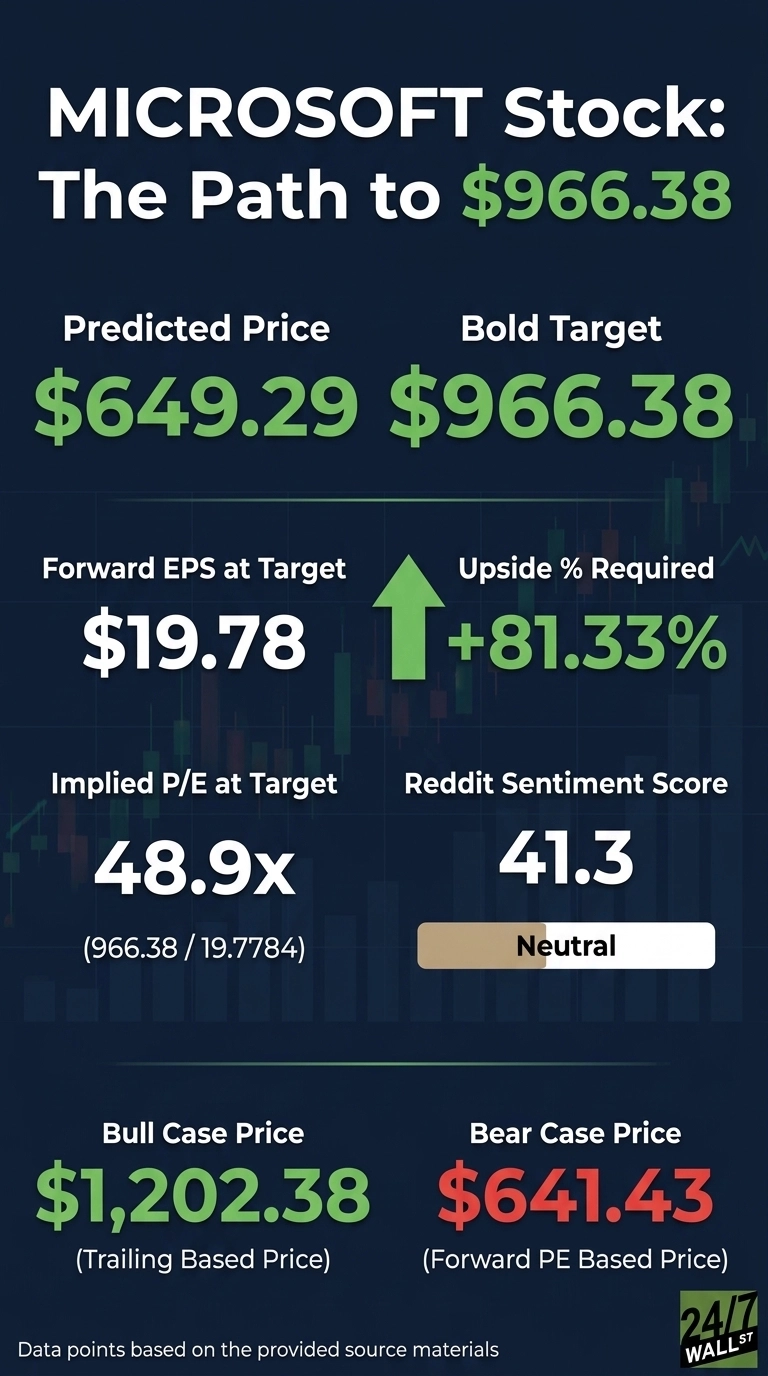
The model creates 1-year and 5-year targets. The closest one to 2030 is the 5-year horizon, which ends October 22, 2031. Under the central scenario, a $1,000 investment could be worth about $1,813.30 by that date, a total return of 81.33%.
It assumes a projected share price of $966.38 and an annualized return of 12.64%, above the 10% in the headline. Along the way, the central projection reaches $889.99 per share in October 2030. Treat that as an illustrative example, since it is not a projected target.
Bull, Base and Bear: The Full Range for Your Stake
| Scenario (5-Year) | Target Price | Total Return | Annualized Return | Value of $1,000 |
|---|---|---|---|---|
| Bull | $1,202.38 | 125.61% | 17.67% | $2,256.10 |
| Base | $966.38 | 81.33% | 12.64% | $1,813.30 |
| Bear | $641.43 | 20.35% | 3.77% | $1,203.50 |
Over the next year, the central projection targets $649.29, a 21.83% return that would turn $1,000 into $1,218.30. Analysts are more conservative, with a consensus target of $600.88.
Even so, 14 rate the stock a strong buy, 39 a buy and 2 a hold, with no sells. Confidence in the model is graded at 0.9 on a scale of 0 to 1.

Three Growth Engines Behind the Target
Azure Demand Is Outrunning Supply
Azure revenue grew 43% in fiscal Q4 2026. Commercial remaining performance obligations, which measure signed future revenue, rose 84% to $678B. Excluding OpenAI, that backlog grew 25%. CFO Amy Hood said on the call, “Demand continues to exceed available supply.”
AI Is Turning Into Revenue
Microsoft 365 Copilot has passed 30 million paid seats, and net paid seat additions more than doubled sequentially. One quarter earlier, the AI business had reached a $37B annualized revenue run rate, up 123% YoY. CEO Satya Nadella said, “I’ve never been more confident in Microsoft’s opportunity to drive durable long-term growth.”
Steady Earnings Beats
Microsoft has beaten EPS estimates for 6 straight quarters. Its most recent result was $4.74, against a $4.24 estimate. Fiscal 2026 revenue reached $331.84B, and management expects “another fiscal year of double-digit revenue and operating income growth.”
The stock trades at about 27x forward earnings, so the projection depends on earnings growth more than on investors paying a higher multiple.

Risks That Could Shrink Your Stake
The biggest swing factor is spending. Capex for the full year reached $115.95B, up 79.62%, and management guided to more than $50 billion next quarter. If enterprise AI demand slows, those data centers could weigh on margins and free cash flow for years.
All of that expansion still has to be powered, cooled, and connected by someone, and we pulled together seven suppliers riding that same wave in a free AI infrastructure report. Microsoft’s gross margin has already slid as the business shifts toward Azure and AI infrastructure.
The consumer side is weaker. More Personal Computing revenue fell 4%, Xbox dropped 10%, and Windows OEM and Devices revenue is expected to fall in the high teens this fiscal year. The company’s filings also list intense competition, cyberattacks, capacity limits and changing regulation as risks.
The stock has been volatile, too. Over the past 52 weeks it has traded as low as $348.54, and its one-year gain is only 2.41%. Microsoft also has an earnings report coming up, which investors are watching closely, so it is worth keeping an eye on the stock as Azure growth guidance comes out.
Your $1,000 Range by the Five-Year Mark
Over the model’s 5-year horizon, a $1,000 stake in Microsoft runs from $1,203.50 in the bear case to $2,256.10 in the bull case, while the base case is $1,813.30.
The headline’s 10%-a-year path to $1,464.10 by 2030 falls between the bear and base outcomes. Every figure here is a scenario. None of them is guaranteed.
This article is a projection for research purposes only.
Contact [email protected] for any questions or corrections.
Vandita Jadeja is a financial publisher with over a decade of experience writing about financial topics, including investment, savings, retirement, insurance and banking. Vandita is a Chartered Accountant who loves to debunk financial concepts for readers.
Her work has appeared on sites that include The Motley Fool, InvestorPlace, and Benzinga. She covers investing and focuses on stock picks and price prediction for 24/7 Wall St.
When not looking for the next stock investment opportunity, she can be found traveling, reading, chasing sunsets and enjoying her iced latte.