Prediction: This Could Be the Best AI Stock You’re Not Talking About
Chip designers dominate AI headlines, but one memory stock already has more than 75% of its future shipments locked in through customer contracts, and Wall Street analysts have barely noticed the discount hiding in plain sight.


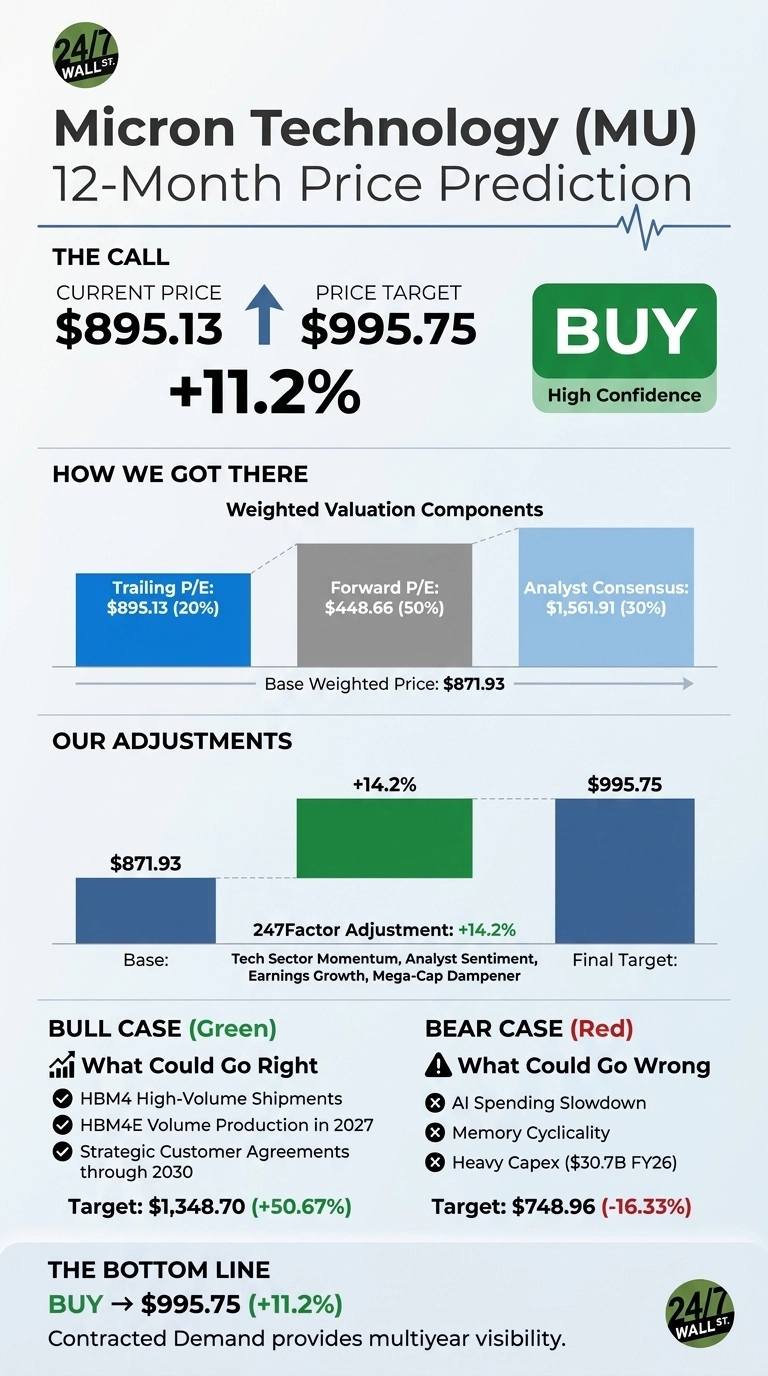
Chip designers get most of the AI attention, but memory goes into every AI accelerator build. The 24/7 Wall St. price target for Micron Technology (NASDAQ:MU | MU Price Prediction) is $995.75. That means 11.24% upside from the current $895.13, and the model rates Micron a buy with high confidence.
24/7 Wall St. Price Target Summary
| Metric | Value |
|---|---|
| Current Price | $895.13 |
| Price Target from 24/7 Wall St. | $995.75 |
| Upside/Downside | 11.24% |
| Recommendation | BUY |
| Confidence Level | 90% |

My confidence comes from how far ahead Micron can see its demand. More than 75% of fiscal 2027 shipments are already committed, and 26 Strategic Customer Agreements run through 2030. That gives Micron multiyear demand visibility in a cyclical industry.
Record Quarter Meets an October Sell-Off
Shares fell 15.97% over the past month and 4.22% today. Samsung’s earnings report showed how high the bar sits for memory stocks. Micron is still up 213.77% year to date and 4.48% over the past week. It trades between a 52-week low of $192.37 and a high of $1,254.61.
Fiscal Q4 revenue reached $54.23B against estimates of $50.97B, up 379.3% YoY. Non-GAAP EPS of $33.42 beat the $31.35 estimate. For fiscal Q1 2027, Micron guided to $61.5B in revenue and EPS of $38.15.
Why Bulls See $1,348.70 Ahead
The bull case reaches $1,348.70, a 50.67% gain. High-bandwidth memory (HBM) drives it. HBM4 is in high-volume shipments to Micron’s lead AI accelerator customer, and HBM4E volume production is expected in calendar 2027. Micron also raised HBM pricing significantly for calendar 2027.
On the September 30 call, President and COO Manish Bhatia called “DRAM the principal constraint versus logic or power to the data center.” Analysts agree: 45 rate the stock a Buy or Strong Buy, with a consensus target of $1,561.91.

Risks That Could Cap the Rally
The bear case falls to $748.96, a 16.33% decline. Memory has always been cyclical, and fiscal 2026 capex of $30.71B could lead to oversupply if AI spending cools. Micron also relies heavily on one lead HBM customer.
Management points out that most construction spending is for clean rooms opening in 2028 and beyond, and that equipment goes in only when demand supports it.

How Micron Compares to Sandisk and Western Digital
Sandisk (NASDAQ:SNDK) is the closest US-listed memory pure play, with the same exposure to AI storage pricing. The stock changes hands at 17 times trailing earnings, compared with Micron’s 13, even though the two are growing at a similar rate.
Western Digital (NASDAQ:WDC) also sells storage to hyperscalers, but its hard-drive business grows more slowly and earns lower margins.
| Company | Latest Quarter Revenue Growth (YoY) | Next-Quarter Non-GAAP Gross Margin Guide |
|---|---|---|
| Micron | 379.3% | ~86.25% |
| Sandisk | 377.95% | 84.5%-85.5% |
| Western Digital | 55.46% | 60%-61% |
Micron has the highest margins of the group and trades at a lower earnings multiple than Sandisk. Next to its peers, the 24/7 Wall St. price target looks conservative.
Our Verdict: Contracted Demand Tips the Scale
The 24/7 Wall St. price target of $995.75 carries a buy rating and 90% confidence. The key factor is contracted demand.
I’d stay bullish if HBM4E ramps on schedule and margins hold in the mid-80s. I’d turn cautious if hyperscalers cut capex or contract pricing resets lower. On the evidence so far, Micron’s contracted demand gives it unusual visibility among AI semiconductor stocks.
| Year | Price Target from 24/7 Wall St. |
|---|---|
| 2026 | $880.66 |
| 2027 | $995.75 |
| 2028 | $1,114.05 |
| 2029 | $1,169.95 |
| 2030 | $1,269.11 |
These projections assume Micron keeps running its current strategy. Large moves in either direction could come from HBM4E pricing or a slowdown in AI infrastructure spending. The chipmakers get the headlines, but the power, cooling, and networking suppliers behind the AI expansion matter just as much, and we rounded up seven of them in a free report here.
Contact [email protected] for any questions or corrections.
Vandita Jadeja is a financial publisher with over a decade of experience writing about financial topics, including investment, savings, retirement, insurance and banking. Vandita is a Chartered Accountant who loves to debunk financial concepts for readers.
Her work has appeared on sites that include The Motley Fool, InvestorPlace, and Benzinga. She covers investing and focuses on stock picks and price prediction for 24/7 Wall St.
When not looking for the next stock investment opportunity, she can be found traveling, reading, chasing sunsets and enjoying her iced latte.