Micron Just Closed Below $800 for the First Time Since July
Record profits, locked-in contracts through 2030 and a stock trading at five times forward earnings, yet Micron just shed billions in a single session. The real threat may come from the customers paying those soaring memory prices.

This post may contain links from our sponsors and affiliates, and Flywheel Publishing may receive compensation for actions taken through them.
Micron Technology (NASDAQ:MU | MU Price Prediction) closed at $795.23, well under Wall Street’s average price target of $1,561.91. That gap implies about 96% upside.
Micron makes the DRAM, NAND and high-bandwidth memory that AI data centers need, and that demand drove the stock’s gains in 2026.
The stock lost $59.87, or 7.00%, from Tuesday’s $855.10 close while the S&P 500 rose 1.58%. It hit $782.00 intraday, finished with a $899.74 billion market value and slipped to $776.00 after hours, a further 2.42% decline.
Micron traded under $800 intraday on July 30 and August 3 but closed above it both days. Its last close below that level came on July 29 at $739.00, and the stock rose 18.36% the next session. That shows how fast this name can reverse, although it guarantees nothing now.
The memory prices squeezing phone and PC makers are the same prices producing Micron’s record profits. This gap likely closes only if those customers keep paying, because the discount reflects worry that margins have topped out.
Micron’s Worst Day Since August Capped a 19.1% Five-Session Slide
It was Micron’s largest one-day percentage drop since August 18, when it fell 7.02%. Over five sessions, from the October 28 close of $983.23, shares lost about 19.1%.
The close is about 34.5% below the June 25 record close of $1,213.56 and about 36.6% under the $1,255.00 intraday record set that day. Shares remain up about 178.6% in 2026 from a $285.41 year-end close.
Micron now trades below its 50-day moving average of $972.18 but above its 200-day average of $753.93. The 200-day line tracks the uptrend that carried the stock all year, so a close beneath it would signal that longer-term holders are leaving.
Election Jitters and Memory Warnings Hit Every Storage Name
Micron has not commented, and no single factor explains the drop. Investors were digesting a Democratic wave in the November 3 midterms, including worry that the Texas governor’s race could lead to a data center moratorium there.
Signs that higher memory prices are hurting hardware demand added pressure. Kioxia issued a conservative December-quarter forecast on November 2, and Apple (NASDAQ:AAPL) chief executive said the company’s memory pricing experience was unprecedented.
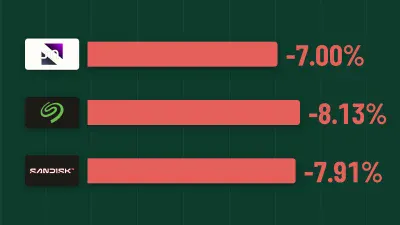
Seagate Technology (NASDAQ:STX) fell 8.13%, SanDisk (NASDAQ:SNDK) dropped 7.91% and Western Digital (NASDAQ:WDC) lost 6.77%, even as the Nasdaq Composite rose 1.44%. SanDisk closed at $1,037.40, still above the $1,000 level it last closed under on April 24.
SanDisk’s $2,023.62 target points to about 95% upside, with Seagate’s $1,044.83 target at about 88%, so Micron’s discount is shared across the group.
Record Results Rest on Prices Customers Now Resist
Fiscal fourth-quarter revenue rose 379.3% to $54.23 billion, with non-GAAP EPS of $33.42 and an 87% gross margin. First-quarter guidance calls for $61.5 billion in revenue.

Over 75% of fiscal 2027 shipments are committed under 26 supply agreements running through 2030. About one-quarter of that agreement revenue moves with market pricing, so a spot-price adjustment would still reach margins.
The bigger danger is demand destruction. If device makers cut memory content to protect their own margins, renewals could reset lower.
Analysts See a Bargain at Five Times Forward Earnings
Of 49 analysts, nine rate Micron Strong Buy, 36 Buy, three Hold, and one Strong Sell. Targets are opinions, and memory stocks often look cheapest near peak earnings.

Micron trades at roughly 5 times forward earnings and holds $73.45 billion in cash and marketable investments against $5.18 billion of debt, about $68.27 billion in net cash.
Its $35.16 billion buyback authorization, including $2.16 billion left from 2018, opens for purchases on December 9. The program has no expiration and does not compel Micron to buy.

What Could Move MU Stock Next
Committed volume through 2030 and a large net cash pile likely give the shares more support than the chart shows.
A return toward $1,561.91 depends on the next report, estimated for December 16 but not yet confirmed. Meeting first-quarter guidance while showing contract pricing holding would reset the debate.
The outlook would weaken if device makers cut orders, spot prices roll over, and the stock closes beneath its 200-day average. A low multiple on peak-margin earnings offers little protection once estimates fall.
SanDisk offers similar implied upside but trades about 55.6% below its record close and pays no dividend, so Micron looks steadier by those measures.
Contact [email protected] for any questions or corrections.
Omor Ibne Ehsan is a writer at 24/7 Wall St. He is a self-taught investor with a focus on growth, cyclical, and dividend equities that have strong fundamentals, value, and long-term potential. He also has an interest in high-risk, high-reward investments such as penny stocks.