Marvell Drops 50% in One Month: This Analyst Stands Pat on 195% Gains Prediction
Marvell's own all-stock acquisition triggered the steepest slide among AI chip peers, yet not a single analyst has issued a Sell. One Wall Street firm sees the selloff as a misread of the deal's structure. Will the integration prove it…

This post may contain links from our sponsors and affiliates, and Flywheel Publishing may receive compensation for actions taken through them.
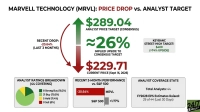
Marvell Technology (NASDAQ:MRVL | MRVL Price Prediction) currently trades at $136.76, while Wall Street’s average price target sits at $313.73. The difference between those figures points to 129.4% upside.
Marvell builds the connective tissue of AI data centers: custom silicon for hyperscalers, optical DSPs for 800G and 1.6T links, and 51.2T Ethernet switches. Data Center revenue reached $2.17B last quarter, 79% of total revenue, and management raised its outlook for both fiscal 2027 and fiscal 2028.
A business that says its growth is accelerating now trades at a forward P/E of 23.
A Lumentum Megadeal Cut Marvell in Half in a Month
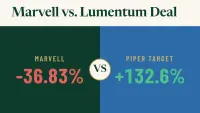
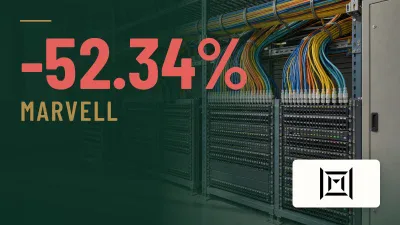
Marvell’s own acquisition did the most damage. The company agreed to buy optical components maker Lumentum (NASDAQ:LITE) in an all-stock transaction, a multibillion-dollar deal that left shareholders facing heavy dilution. The stock fell 52.34% over the past month, from $286.95. That is the steepest monthly decline among its AI chip peers.
The slide started when reports of advanced talks landed alongside a punishing read-across from a hyperscaler’s third-quarter earnings miss. Post-midterm volatility then hit the whole market. Marvell dropped 14.42% most recently while the S&P 500 fell 4.22%.
Operating results remained strong. The last earnings report topped estimates on revenue of $2.739B and EPS of $0.94, with third-quarter guidance of $3.15B.
Piper Sandler Holds $400 While No Analyst Says Sell
Piper Sandler’s David O’Connor raised Marvell to Overweight with a $400.00 target, suggesting 192.5% upside. After the deal news, he argued that optical components and lasers are becoming an unavoidable bottleneck for next-gen hyperscale AI clusters, even as equity issuance and integration risks weigh. He made no change for election volatility and treats the selloff as an overreaction to deal structure.
The broader Street agrees. Marvell carries 9 Strong Buy ratings, 34 Buys, 4 Holds and 0 Sells.
Specific milestones support the optimistic view. Management expects fiscal 2028 revenue of approximately $18 billion, custom revenue that will more than double, and non-GAAP operating margin entering a 38% to 40% range by the fourth quarter. The expanded hyperscaler warrant should contribute much more significantly in fiscal 2029. CEO Matt Murphy put it simply: “Even as our revenue base becomes significantly larger, our growth rate is accelerating.”
Most targets precede the Lumentum share issuance, which changes per-share math. Price targets are one data point and carry no guarantee.
Every AI Chip Leader Fell, but Marvell Fell Hardest
The whole group sold off together. Marvell’s decline was simply deeper than any peer’s.
Broadcom (NASDAQ:AVGO) lost 21.62% in a month to $294.55, against a $526.81 target, or 78.9% upside. With 49 Buy-or-better ratings, 2 Holds and no Sells, it is heavily favored but offers less upside than Marvell.
NVIDIA (NASDAQ:NVDA) dropped 23.97% to $181.90. Its $327.14 target suggesting 79.8% upside, with 10 Strong Buys, 49 Buys, 2 Holds and 1 Sell.
Advanced Micro Devices (NASDAQ:AMD) fell 36.47% to $412.59, versus a $648.24 target and 57.1% upside. Its 11 Holds make it the least loved of the group.
Marvell holds the largest analyst-implied upside across all four names. A deal-specific discount is being applied on top of the sector correction.
A 61% Gain This Year Survived a 52% Monthly Collapse
At $136.76, Marvell trades with 129.4% implied upside to the $313.73 consensus target set by 47 analysts. The stock lost 37.36% in the past week alone.
Even so, shares remain up 61.2% year to date, while the S&P 500 is up 7.71%. A beta of 2.327 explains the swings in both directions.
Lumentum Integration Will Decide Whether Marvell Closes the Gap
Optimism grows if management delivers the roughly $18 billion fiscal 2028 revenue plan and Lumentum’s lasers make Marvell the default end-to-end optical supplier for scale-up AI clusters. Concerns mount if integration stumbles, hyperscaler spending cools after that earnings miss, or customer concentration bites as big buyers move silicon in-house.
The path to $313.73 requires the deal to look accretive within a few quarters. Keep an eye on margin progress toward that 38% to 40% range. At a forward P/E of 23, the valuation looks reasonable, though dilution keeps Piper’s $400 call a long-range target.
Contact [email protected] for any questions or corrections.
Alex Sirois is a financial writer with experience spanning both retail and institutional investing. He has written for InvestorPlace and held roles at BNY Mellon and Bernstein, giving him a perspective that bridges Main Street portfolios and Wall Street analysis.
Alex holds an MBA from George Washington University and has built his career across multiple industries, including e-commerce, education, and translation — a breadth of experience that informs how he breaks down complex financial topics for everyday investors. His writing is conversational, actionable, and grounded in long-term, buy-and-hold investing principles.
At 247 Wall St., Alex focuses on delivering analysis that is both accessible and useful, with a clear emphasis on helping readers make more informed decisions with their money.