State Pension Funds Have at Least $578 Billion Riding on Tumbling AI Stocks
A nonprofit just tallied how much teachers, firefighters, and other public retirees have riding on AI, and the next day the market flinched. Who ends up covering the gap if the bet goes wrong?

This post may contain links from our sponsors and affiliates, and Flywheel Publishing may receive compensation for actions taken through them.
On Wednesday, November 4, 2026, the Equable Institute, a bipartisan nonprofit, estimated that U.S. state and local pension funds held at least $578.1 billion in AI-related companies as of June 30, 2026. Its upper estimate reached $706.6 billion.
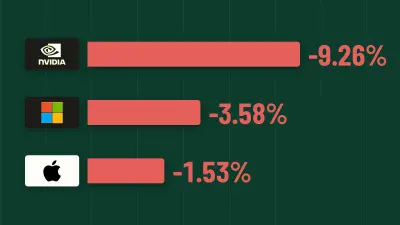
AI stocks and the Nasdaq-100 fell sharply the next day. NVIDIA (NASDAQ:NVDA | NVDA Price Prediction) dropped 9.26% on November 5 to close at $181.60, and the Nasdaq-100 lost about 6.3%.

The sell-off came after Democratic midterm wins raised concerns of data center moratoriums. Microsoft (NASDAQ:MSFT) fell 3.58%, while Apple (NASDAQ:AAPL) slid 1.53%.
Equable’s figures come from before the sell-off, and funds may have traded since, so they reflect holdings as of June 30. They also show that public employees, retirees, and taxpayers carry AI exposure even if they never bought an AI stock.
What Equable’s Estimate Counts
Equable tracked 51 large AI-related companies, which made up 35.1% of all public equity that state and local funds reported. The Magnificent Seven accounted for 63.3% of the public AI holdings.
The range is 9% to 11% of $6.42 trillion in total assets. The upper estimate includes about $396 billion reported directly by 24 of the 25 largest funds, about $180 billion in public stock not reported in detail, and about $130 billion in private equity and corporate debt. Because disclosure is incomplete, both totals are estimates.
NVIDIA was the largest single holding at $47.3 billion, followed by Apple at $42.5 billion and Microsoft at $28.2 billion. That exposure built up automatically. Market-cap-weighted mandates buy each company in proportion to its stock market value, so pension exposure to AI grew as these shares rose.
Taxpayers Carry the Downside
Most public pensions are defined-benefit plans, which promise a set retirement payment. When assets fall short of those promises, employers, taxpayers, and sometimes workers make up the gap through higher contributions.
That makes market concentration a budget issue for states and cities. Private holdings are valued less often than public stock, so any decline there shows up on pension books later.
Anthony Randazzo, Equable’s executive director, said a good AI outcome could do a lot to stabilize pensions, but a bursting bubble could cause very large losses (riding a mania is fine as long as the exit is planned, which is the whole subject of our free bubble survivor’s handbook). He urged every public fund to audit its AI exposure and publish the results.
Three Stocks Moving on Different Fundamentals
NVIDIA sells the chips at the center of AI spending, and it fell hardest. It closed at $200.09 on June 30, $206.69 on November 3 and $200.13 on November 4, then traded at $183.88 after hours on November 5.
That close sits about 9.2% below the June 30 level and about 25% below a 52-week high of $243.37, which may have been an intraday high.
Microsoft’s capital spending of $39.37 billion in its latest quarter ties it to the same data center policy risk. Apple’s business leans more on consumer devices, and its stock held up better.
The Nasdaq Composite fell 5.52%, and the S&P 500 fell about 4.4%, and bans would likely weigh most on the companies whose growth depends on new capacity.
What Supports the Bull Case for AI Stocks
NVIDIA’s fundamentals carry the most weight in the bull case. Its fiscal second-quarter revenue rose 105.85% to $96.22 billion, and it guided to $108.0 billion for the current quarter.

Microsoft’s commercial remaining performance obligation, meaning signed revenue it has not yet booked, reached $677 billion. That backlog supports AI spending for years even if new permits slow.
NVIDIA trades at about 37 times earnings, and bans or slower demand would hurt any stock priced for growth.
NVIDIA is expected to report after the close on November 17. If it confirms the $108.0 billion outlook, the November 5 drop will look like a reaction to policy concerns, and if it cuts guidance, the bears will have the stronger argument.
Contact [email protected] for any questions or corrections.
Omor Ibne Ehsan is a writer at 24/7 Wall St. He is a self-taught investor with a focus on growth, cyclical, and dividend equities that have strong fundamentals, value, and long-term potential. He also has an interest in high-risk, high-reward investments such as penny stocks.