Banks Pulled Back From Lending to Mid-Sized Companies. These 3 Stocks Stepped In, and $105,000 Pays $12,137 a Year
When banks stopped lending to mid-sized companies, a handful of publicly traded lenders moved in and started paying out the interest. Each of these three carries a warning sign worth checking before you chase the income.

Banks have pulled back from lending to mid-sized businesses, in part because tighter capital rules made those loans less attractive to hold. A group of publicly traded lenders stepped in to fill the gap, and they pass most of the interest they collect through to shareholders.
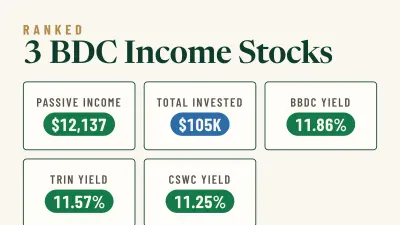
Three of these lenders each received a $35,000 stake, for a total investment of $105,000. At prices as of November 5, 2026, that would yield $12,040 in passive income each year, above the $12,000 target.
All three are business development companies, or BDCs. A BDC is a publicly traded lender to private businesses. BDCs are taxed as regulated investment companies, and keeping that status requires paying out at least 90% of investment company taxable income as dividends (26 U.S.C. § 852(a)(1)(A)). What they distribute largely skips corporate tax, so most of the interest ends up with shareholders.
Each yield below uses a different basis. For Capital Southwest (NASDAQ:CSWC), the calculation annualizes its current regular and supplemental dividends. Trinity Capital (NYSE:TRIN) uses its current monthly dividend, and Barings BDC (NYSE:BBDC) uses its last four quarterly payments.
Capital Southwest
- Stock #3
- Capital Southwest (NASDAQ:CSWC)
- Yield: 11.25%
- Shares for $35,000: 1,502.15
- Annual Passive Income: ~$3,937
Capital Southwest is based in Dallas and lends to lower middle market companies earning $3 million to $25 million in EBITDA (cash profit before interest, taxes, and noncash costs). First-lien debt gets repaid first if a borrower fails, and it makes up 99% of its credit portfolio. The portfolio’s weighted average yield was 10.9%, and the company pays regular dividends monthly plus a supplemental dividend each quarter.
For the quarter ended September 30, 2026, pre-tax net investment income (NII), meaning the interest and fees left after expenses, was $0.58 per share. That covered the $0.58 regular dividend, paid as $0.1934 a month. Behind the $0.06 December supplemental sits $0.92 per share of retained taxable income, which is income already earned but not yet paid out.
Credit quality is the primary concern here. Non-accruals, which are loans that have stopped paying interest, rose to 1.4% of the portfolio at fair value from 1.1%.
Trinity Capital
- Stock #2
- Trinity Capital (NYSE:TRIN)
- Yield: 11.57%
- Shares for $35,000: 1,985.25
- Annual Passive Income: ~$4,050
Trinity Capital lends to growth-stage companies, many of them venture-backed, and runs a large equipment financing business alongside tech lending and three other segments. Its 198-company portfolio includes $470.7 million in equipment financings, and its effective yield on debt investments reached 15.2%.
Third-quarter NII came in at $0.52 per share versus a $0.51 quarterly distribution, for 103% coverage. The $0.17 monthly dividend held steady through every month of 2026. On top of that, the company has $0.69 per share of retained taxable income set aside.
Leverage is the main thing to track. Net debt-to-equity was at 117%, and $75.0 million of unsecured notes mature in December 2026.
Barings BDC
- Stock #1
- Barings BDC (NYSE:BBDC)
- Yield: 11.86%
- Shares for $35,000: 3,990.88
- Annual Passive Income: ~$4,151
Barings BDC is externally managed by Barings, a MassMutual subsidiary, and makes mostly senior secured loans to middle-market companies. Its portfolio was valued at about $2.46 billion as of June 30, 2026.
Third-quarter NII came in at $0.26 per share, down from $0.28 in the previous quarter. That exactly covered the $0.26 quarterly dividend, leaving no cushion for current earnings. Spillover income held in reserve stood at approximately $0.80 per share.
The company previously paid $0.31 quarterly in March, June, and September 2025, combining its $0.26 regular dividend with a $0.05 special payment. The regular $0.26 quarterly dividend remains unchanged.
Net asset value per share slipped to $10.94 from $11.02 after reductions on a few watch-list loans. On October 30, Barings priced a $396 million CLO financing and plans to use the proceeds, along with credit facility borrowings, to repay its $350 million in notes due November 23, 2026.
Income Snapshot at $35,000 per Position
| Name | Yield | Annual Dividend Income |
|---|---|---|
| Capital Southwest | 11.25% | $3,937 |
| Trinity Capital | 11.57% | $4,050 |
| Barings BDC | 11.86% | $4,151 |
| Total | 11.56% | $12,137 |
Together, these three positions generate $12,137 in annual passive income on a $105,000 investment, a combined yield of 11.56%. Capital Southwest contributes $3,937, Trinity Capital adds $4,050, and Barings BDC rounds out the group with $4,151.
Listed BDC shares can be sold on any trading day, which offers more flexibility than a private loan fund that may limit withdrawals. Most of their loans carry floating rates, so this income can shrink if short-term rates fall.
In a taxable account, BDC dividends are mostly taxed as ordinary income. Only the portion a fund reports as qualified dividend income gets the lower rate (26 U.S.C. § 854(b)(1)(B)), and payouts built on interest income rarely qualify.
Contact [email protected] for any questions or corrections.
David Beren has been a Flywheel Publishing contributor since 2022. Writing for 24/7 Wall St. since 2023, David loves to write about topics of all shapes and sizes. As a technology expert, David focuses heavily on consumer electronics brands, automobiles, and general technology. He has previously written for LifeWire, formerly About.com. As a part-time freelance writer, David’s “day job” has been working on and leading social media for multiple Fortune 100 brands. David loves the flexibility of this field and its ability to reach customers exactly where they like to spend their time. Additionally, David previously published his own blog, TmoNews.com, which reached 3 million readers in its first year. In addition to freelance and social media work, David loves to spend time with his family and children and relive the glory days of video game consoles by playing any retro game console he can get his hands on.