Americans Fill Prescriptions Every Month, and $90,000 Across These 3 Drugmakers Pays $3,650 a Year

This post may contain links from our sponsors and affiliates, and Flywheel Publishing may receive compensation for actions taken through them.

Pharmacy counters stay busy in every kind of market. Blood thinners, cancer drugs, and vaccines get refilled on schedule, and the companies that make them return part of those sales to shareholders as dividends. For retirees, that steady demand can become a steady paycheck.
There’s a catch, and it’s called a patent cliff. A patent cliff hits when a best-selling drug loses patent protection, cheaper generic copies enter the market, and sales of the original can fall fast. All three drugmakers below face one, and that risk helps explain their yields.
Here’s what a $30,000 stake in these drugmakers would return. That’s $90,000 invested in total, making $3,650 a year. A prior review of five pharma dividend stocks covered a wider group, and this piece narrows the focus to the income math for three names. The Nov. 10, 2026 close provided the prices.
Merck
- Stock #3: Merck (NYSE:MRK | MRK Price Prediction)
- Forward Yield: 2.3%
- Nov. 10 Close: $148.05
- Shares for $30,000: 202.6
- Annual Passive Income: ~$689
Merck is best known for Keytruda, a cancer immunotherapy that helps the immune system attack tumors, and Gardasil, the HPV vaccine. The Keytruda family, including the under-the-skin version Keytruda Qlex, brought in $8.60 billion in the third quarter.
Merck has the lowest yield of the three and adds the least income, but its dividend keeps growing. The quarterly payout rose to $0.85 from $0.81 with the Jan. 8, 2026 payment, or $3.40 a year. Guided 2026 non-GAAP EPS of $2.77 to $2.82 trails that on paper because it includes one-time deal charges of $3.62 per share for Cidara and $2.31 for Terns. The CFO said Merck remains “committed to the dividend, with the goal of increasing it over time.”
Its biggest patent risk is Keytruda, whose key patents begin expiring in 2028.
Bristol Myers Squibb
- Stock #2: Bristol Myers Squibb (NYSE:BMY)
- Forward Yield: 4.01%
- Nov. 10 Close: $62.80
- Shares for $30,000: 477.7
- Annual Passive Income: ~$1,204
Bristol Myers sells Eliquis, a blood thinner that helps prevent strokes and clots, and Opdivo, a cancer immunotherapy. Eliquis sales rose 25% to $4.69 billion in the third quarter.
Its yield reflects drugs already going over the cliff. Revlimid fell 47% and Pomalyst 81% in the quarter as generics entered the market, and the CFO expects an Eliquis revenue step-down of $1.5 billion to $2 billion in 2027. The quarterly dividend rose to $0.63 from $0.62 with the Jan. 2, 2026 ex-dividend date, or $2.52 a year, covered by 2026 non-GAAP EPS guidance of $6.35 to $6.55.
Pfizer
- Stock #1: Pfizer (NYSE:PFE)
- Forward Yield: 5.86%
- Nov. 10 Close: $29.36
- Shares for $30,000: 1,021.8
- Annual Passive Income: ~$1,757
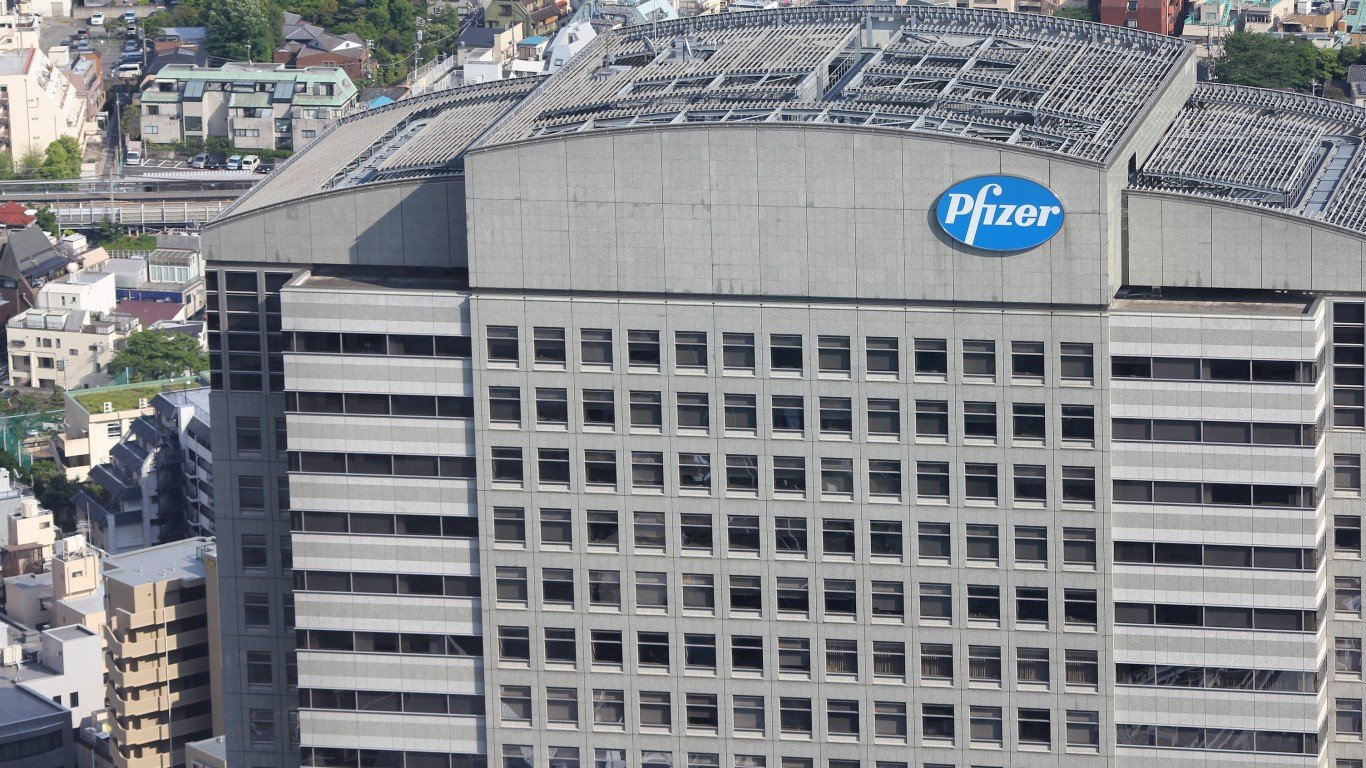
Pfizer co-markets Eliquis with Bristol Myers, sells the Prevnar pneumonia vaccine and has Padcev, a bladder cancer drug whose sales rose 55% to $720 million in the third quarter. Its yield is the highest here because COVID revenue shrank, with Paxlovid down 63%, and because the CFO noted U.S. patent losses for Ibrance and Xtandi in 2027, plus Eliquis internationally at the end of 2026.
Pfizer has held its quarterly dividend flat at $0.43 since early 2025, or $1.72 a year, after raising it each year from $0.38 in 2020 to $0.42 in 2024. Raised 2026 adjusted EPS guidance from $2.95 to $3.05 covers it, and Pfizer is skipping buybacks in 2026 to pay down debt. The CFO said Pfizer can “continue to invest and maintain the dividend” through the patent-loss period.
| Name | Forward Yield | Annual Dividend Income |
|---|---|---|
| Merck | 2.3% | $689 |
| Bristol Myers Squibb | 4.01% | $1,204 |
| Pfizer | 5.86% | $1,757 |
| Total | 4.06% | $3,650 |
Combined, these three stakes make $3,650 of yearly income on a $90,000 investment, a blended yield of 4.06%. Pfizer contributes $1,757, Bristol Myers Squibb adds $1,204, and Merck accounts for $689.
The key thing to watch is each company’s pipeline of new drugs that could replace the ones losing patent protection. Pfizer is working toward first approvals for its obesity drug, berobenatide, in 2028; Bristol Myers has an FDA decision date for mezigdomide on May 13, 2027; and Merck is expanding sac-TMT into more cancers. None of these dividends is guaranteed, and a weak pipeline would change the math.
Dividend payments come every quarter, no matter where the share price sits that day, giving retirees a predictable stream to set against regular bills. Reinvesting those payments buys more shares, and each new share raises the next payment. Scale the same math up, and a mid six-figure balance can throw off a lot more than people expect, which is the exercise we walked through in a free income guide here.
Contact [email protected] for any questions or corrections.
David Beren has been a Flywheel Publishing contributor since 2022. Writing for 24/7 Wall St. since 2023, David loves to write about topics of all shapes and sizes. As a technology expert, David focuses heavily on consumer electronics brands, automobiles, and general technology. He has previously written for LifeWire, formerly About.com. As a part-time freelance writer, David’s “day job” has been working on and leading social media for multiple Fortune 100 brands. David loves the flexibility of this field and its ability to reach customers exactly where they like to spend their time. Additionally, David previously published his own blog, TmoNews.com, which reached 3 million readers in its first year. In addition to freelance and social media work, David loves to spend time with his family and children and relive the glory days of video game consoles by playing any retro game console he can get his hands on.