Two REITs Just Switched to Monthly Paychecks, and $90,000 Across Them and a Longtime Monthly Payer Pays $4,934 a Year

This post may contain links from our sponsors and affiliates, and Flywheel Publishing may receive compensation for actions taken through them.

In 2026, two REITs moved their dividends from quarterly to monthly, and a third has paid monthly for well over a decade. That schedule matches the way bills arrive for someone budgeting month to month. A REIT is a company that owns income-producing property. In exchange for paying little or no corporate tax, it must pay out at least 90% of its taxable income to shareholders, so REIT yields usually sit well above the broader market.
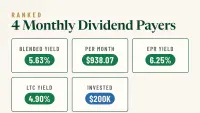
Here is what a $30,000 stake in these three names would produce, assuming a $90,000 investment that generates $4,934 in yearly dividend income at the Nov. 11, 2026 close. Moving to monthly pay leaves the yearly total the same. The annual dividend simply arrives in 12 smaller pieces. Companies make the switch to appeal to income buyers, and retirees like it because it smooths out the gaps between checks. We’ve covered longtime monthly payers in earlier pieces. This group is built around the switch.
Readers who like this schedule tend to want more of it. We rounded up seven of our favorite monthly payers in a free report you can grab here. On taxes, a REIT dividend counts as a qualified dividend only to the extent the REIT designates it as one, under 26 U.S.C. § 857(c)(2). As a result, most of the payout is generally taxed as ordinary income.
UDR
- Stock #3: UDR (NYSE:UDR)
- Yield: 4.76% (forward, at the $36.56 close)
- Shares for $30,000: 820.57
- Annual Passive Income: ~$1,428
UDR is an S&P 500 apartment landlord. It owned or held stakes in 60,617 apartment homes as of Sept. 30, 2026, in markets from Seattle and Boston to Dallas and Tampa. The board declared its first monthly dividends on April 29, 2026, and the first $0.145 check was paid on July 31. At the time, the chief executive said: “Following 50+ years of dividend growth and stability totaling $9 billion of payments, we look forward to paying our first monthly dividend this week.”
Payout safety for a REIT is measured with funds from operations (FFO), a cash-earnings figure that adds back depreciation. UDR’s adjusted version, FFOA, has full-year 2026 guidance of $2.54 to $2.56 per share after the year’s second raise. That compares with a $1.74 annual dividend. The main risk is apartment supply. New buildings compete for tenants, and rents on new leases fell 1.2% in the third quarter even as renewal rents rose 4.1%.
LTC Properties
- Stock #2: LTC Properties (NYSE:LTC)
- Yield: 5.2% (forward, at the $43.88 close)
- Shares for $30,000: 683.68
- Annual Passive Income: ~$1,559
LTC owns assisted living, independent living, memory care, and skilled nursing properties, about 168 of them across 28 states. LTC is the old hand of the group. Its dividend history shows monthly payments going back to at least 2008, and the $0.19 monthly rate has held since October 2016.
The company reaffirmed 2026 Core FFO guidance of $2.76 to $2.78 per share, which sits above the $2.28 annual dividend. The risk lies with operators. LTC is growing a portfolio of communities it runs through hired managers, so it keeps the operating profit and also pays the operating costs. Margin in that portfolio was 28.0% in the third quarter.
Four Corners Property Trust
- Stock #1: Four Corners Property Trust (NYSE:FCPT)
- Yield: 6.49% (forward, at the $23.39 close)
- Shares for $30,000: 1,282.60
- Annual Passive Income: ~$1,947
Four Corners was spun off from Darden Restaurants (NYSE:DRI | DRI Price Prediction) in 2015. It owns more than 1,300 small properties leased to Olive Garden, LongHorn Steakhouse, auto service shops, and veterinary clinics. Its triple-net leases make tenants pay property taxes, insurance, and maintenance. The company’s first monthly dividend of $0.1222 went to shareholders of record on July 31, 2026. The monthly rate has since risen to $0.1265, which makes Four Corners the highest-yielding pick here.
Adjusted FFO (AFFO), which also strips out non-cash items, was $0.45 per share in the second quarter, against a final quarterly dividend of $0.3665. The main risk is tenant health. Darden still accounts for about 41% of base rent, so a slowdown in restaurant spending would show up in this portfolio.
How the $90,000 Breaks Down
| Name | Yield | Annual Dividend Income |
|---|---|---|
| UDR | 4.76% | $1,428 |
| LTC Properties | 5.2% | $1,559 |
| Four Corners Property Trust | 6.49% | $1,947 |
| Total | 5.48% | $4,934 |
Together, these three positions generate $4,934 in annual passive income on a $90,000 investment, a blended yield of 5.48%. Four Corners contributes $1,947, LTC adds $1,559, and UDR provides $1,428.
Monthly pay is a convenience. It changes when the money arrives, but the yearly total stays the same. Boards set these dividends one period at a time, so none of them is guaranteed. Higher interest rates can raise borrowing costs and pull income buyers toward bonds, while tenant problems and new apartment supply can squeeze cash flow. What the schedule does offer is steady timing: with all three paying monthly, a check would arrive in every month of the year.
Contact [email protected] for any questions or corrections.
David Beren has been a Flywheel Publishing contributor since 2022. Writing for 24/7 Wall St. since 2023, David loves to write about topics of all shapes and sizes. As a technology expert, David focuses heavily on consumer electronics brands, automobiles, and general technology. He has previously written for LifeWire, formerly About.com. As a part-time freelance writer, David’s “day job” has been working on and leading social media for multiple Fortune 100 brands. David loves the flexibility of this field and its ability to reach customers exactly where they like to spend their time. Additionally, David previously published his own blog, TmoNews.com, which reached 3 million readers in its first year. In addition to freelance and social media work, David loves to spend time with his family and children and relive the glory days of video game consoles by playing any retro game console he can get his hands on.