3 Food and Beverage Dividend Stocks to Buy in December for Reliable Income

This post may contain links from our sponsors and affiliates, and Flywheel Publishing may receive compensation for actions taken through them.
Retirees hunting for reliable income have a rare setup in the grocery sector this month. Three of the most recognizable names in packaged food and drinks are paying cash backed by brands shoppers buy every week, and one has delivered uninterrupted dividends for 127 consecutive years. Across all three, brand-driven free cash flow is still funding shareholder payouts even as volumes cool after years of inflation-fueled price hikes. Here is how the dividend safety stacks up at each one.
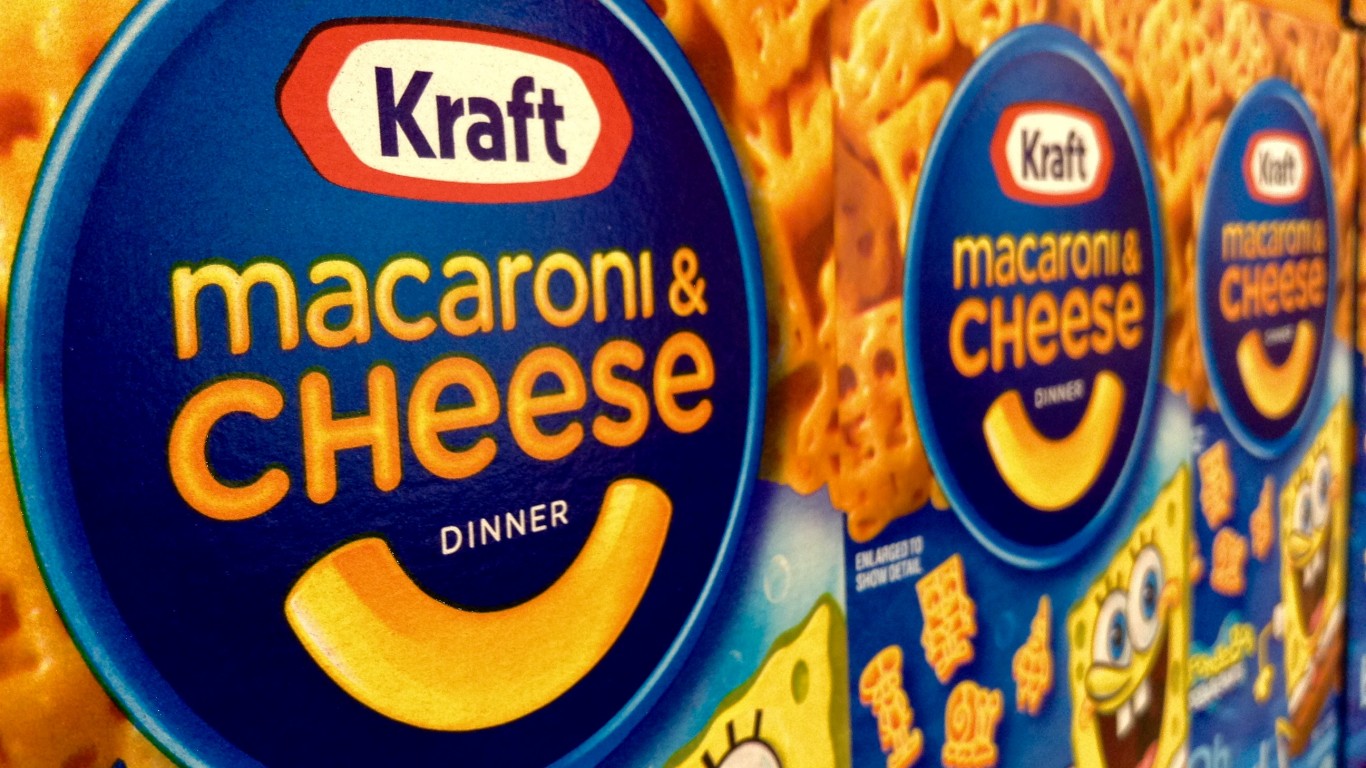
Kraft Heinz: A Well-Covered Payout That Has Been Frozen Since 2019
Kraft Heinz (NASDAQ:KHC | KHC Price Prediction) pays $0.40 per share each quarter, or $1.60 annualized. With shares trading around $25.54, that works out to a yield of about 6.3%. The next payment lands December 23, 2026, to holders of record on December 4, 2026.
Dividend safety: Kraft Heinz cut its quarterly dividend from $0.625 to $0.40 in early 2019 and has held it flat at that level ever since. For a retiree, a flat payout means every year of inflation shrinks what that check buys. The upside of the freeze is coverage. Full-year 2026 adjusted EPS guidance was raised to $2.07 to $2.13[1], so the dividend takes roughly 77% of earnings even at the low end. With free cash flow conversion guided at about 110%[1], the payout uses roughly 70% of implied free cash flow per share. Debt is moving the right way, with $3.982 billion of long-term debt repaid year to date through the third quarter.
Bull case: Heinz, Kraft, Philadelphia, and Lunchables still generate heavy cash, and the business is beating expectations. Third-quarter adjusted EPS of $0.53[1] exceeded the $0.4235 estimate, the company’s sixth consecutive EPS beat. Emerging Markets revenue grew 13.8%[1], and management said the “$700 million”[2] of brand investment this year “is sufficient to turn around the business and deliver sustainable volume-led growth.” Shares are up 10.69% year to date.
Risk: Shifting consumer tastes. Management admitted Philadelphia cream cheese is losing consumption as shoppers move toward cottage cheese and protein-forward products, and it expects inflation slightly above 5%[2] next year. CEO Steve Cahillane said on the November 4, 2026[2] call that “price is likely to have to be taken in ’27 for sure,” which is a tough ask with a weak consumer and private-label rivals waiting.
General Mills: 127 Years of Checks and the Biggest Yield of the Group
General Mills (NYSE:GIS) pays $0.61 per quarter, or $2.44 annualized. With shares at $34.87, the yield is about 7.0%. That yield is elevated partly because the stock is down 19.87% year to date.
Dividend safety: No company in this group can match its payout history. The company paid its 127th consecutive year[3] of uninterrupted dividends, and the quarterly rate has risen from $0.54 in 2022 to $0.59, then $0.60, and most recently to $0.61 in 2025. The board held that rate at its July 2026 declaration, and on November 16, 2026, it declared the next $0.61 payment, payable February 1, 2027, to holders of record on January 11, 2027. Coverage is lower than at Kraft Heinz. Against fiscal 2027 adjusted EPS guidance of $3.00 to $3.20[4], the dividend takes about 81% of earnings at the low end, and with free cash flow conversion guided at roughly 95%, it uses about 86% of implied free cash flow. Fiscal 2026 free cash flow of $1.6263 billion[3] still exceeded the roughly $1.32 billion annual run rate implied by the $330.5 million[4] paid out in the first quarter. Management also cut buybacks to $500 million[3] in fiscal 2026 from $1.2 billion, which leaves more cash for the dividend.
Bull case: Cheerios, Pillsbury, Blue Buffalo and Old El Paso give General Mills scale, and its July annual report targeted at least $750 million[3] of cost savings in fiscal 2027 toward $3 billion by fiscal 2030. First-quarter adjusted EPS of $0.75[4] beat the $0.7178 estimate, and management said cereal share losses narrowed significantly from a year earlier.
Risk: Input costs and leverage. Management expects fourth-quarter inflation near 6%[5], and net debt sits “just a touch” over four times EBITDA. Getting back to its three-times target will take “at least a couple years,”[5] so dividend growth is likely to stay modest until then.
Keurig Dr Pepper: The Lowest Yield With the Most Room to Grow
Keurig Dr Pepper (NASDAQ:KDP) pays $0.23 per quarter, or $0.92 annualized. At $35.01 per share, the yield is about 2.6%, the smallest of the three, after a 28.94% year-to-date run.
Dividend safety: Earnings coverage is the strongest in the group. The $0.69 paid over the first nine months of 2026 represents about 42% of nine-month adjusted EPS of $1.65. Using the company’s assumption of about 1.37 billion[6] diluted shares, the dividend costs roughly $1.26 billion a year, about 50% of the $2.5 billion full-year free cash flow target. The most recent raise came in 2024, when the quarterly payout rose from $0.215 to $0.23, extending a climb from $0.15 in 2019 and 2020. The weak spot is debt. Pro forma leverage stood at 4.1x[6] after the JDE Peet’s acquisition, and the company recently priced a stock offering to cut debt ahead of its split, Reuters reported. CFO Anthony DiSilvestro said the near-term focus is “maintaining our current dividend, and paying down debt,”[6] which signals a hold on raises for now.
Bull case: Soda is on a tear. U.S. Refreshment Beverages net sales grew 10.9%[6] in the third quarter, Dr Pepper Zero Sugar passed $1 billion on an annualized basis, and third-quarter free cash flow reached $1.010 billion, up 91.65%.
Risk: A separation into a beverage company and Global Coffee Co. is planned for early 2027. Management said capital-allocation policies for the two future companies are still being worked out, so shareholders do not yet know how to split the current $0.92 annual payout between them. Lower K-Cup pricing and private-label pods add pressure on the coffee side.
Which Food Stock Has the Strongest Income Case
General Mills offers the strongest income profile of the three on yield and payment history. It offers the highest yield of the three at about 7.0%, a 127-year payment record, and a next check already declared into 2027 (that kind of multi-decade run is exactly what we screened for in our free Dividend Kings report). Kraft Heinz has the better coverage buffer but a frozen payout that loses ground to inflation every year, while Keurig Dr Pepper is the dividend-growth option once its split and debt paydown are finished.
Contact [email protected] for any questions or corrections.
Chris Lange is a financial and geopolitical writer with more than a decade of experience covering a myriad of topics. He has published thousands of articles for 24/7 Wall St., with past coverage focused heavily on stocks, IPOs, healthcare, defense, global affairs, and technology.
His work has been quoted, or referenced by a number of outlets including Business Insider, USA Today, Yahoo Finance, MSN, The Motley Fool, and many other publications. A graduate of Southwestern University, he studied business with a focus on investments and has previous experience in banking and startups.
When not reading or writing the news, he is following his passion for Lacrosse, playing chess, or building solar projects with his dad.