How To Structure Rocket Lab and Planet Labs as a Space Play Flywheel in a $40 Billion Addressable Market

This post may contain links from our sponsors and affiliates, and Flywheel Publishing may receive compensation for actions taken through them.
Rocket Lab (NASDAQ:RKLB | RKLB Price Prediction) and Planet Labs (NYSE:PL) sit at opposite ends of one space supply chain. Rocket Lab builds and launches spacecraft. Planet flies satellites and sells what they see. Rocket Lab’s November 9 report showed record hardware demand. Planet’s September 3 report showed adjusted profitability. Together they frame a $40 billion addressable market.
Spacecraft Lift Rocket Lab as Defense Data Lifts Planet
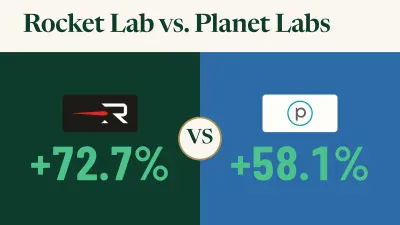
Rocket Lab’s Q3 revenue reached $267.83 million, up 72.7%[1], and product revenue nearly doubled to $197.49 million. Spacecraft drove the gain. Twelve[1] Rocket Lab-built satellites launched, including eight Globalstar direct-to-device platforms. A record $3.57 billion[1] backlog shows that demand has staying power. GAAP EPS of -$0.12[1] missed expectations, largely because of a $27.26 million debt extinguishment loss and $21.34 million in Iridium costs. That miss looks like deal noise.
Planet’s record $116.05 million[2] in revenue grew 58.1%, led by defense and intelligence sales that rose more than 90%[3]. Recurring ACV of 98%[2] means most of the business renews the way a software subscription does. CEO Will Marshall described the plan: “Our strategy pairs AI-enabled analytics with sovereign satellite services.”[2]
| Driver | Rocket Lab | Planet |
|---|---|---|
| Growth Engine | Spacecraft and launch contracts | Defense data and sovereign satellites |
| Non-GAAP Gross Margin | 38.4%[1] | 59%[2] |
| Pricing Lever | Neutron base price of $70M[1] | Sole-source daily-scan awards |
That margin gap is the core of the pairing. Rocket Lab makes manufacturing margins, and Planet makes data margins.
Launch Scarcity Meets an Archive Rivals Cannot Copy
Rocket Lab called launch capacity “incredibly constrained”[4] and turned down lower-priced Neutron commitments. The first 16 Neutron launches are booked[4], and the next open slots fall in the 2030s.
Planet’s moat is its history. “Even if someone had a daily scan suddenly today, they wouldn’t have the archive,”[3] Marshall said. A sole-source $8 million[3] NGA award supports that claim, and Planet counts over $4 billion in satellite services opportunities.
Owned together, the two cover the full loop. Rocket Lab brings down the cost of building and launching constellations, and Planet turns satellites in orbit into multi-year defense and enterprise subscriptions. I am skeptical of the direct link, though. Planet launches on SpaceX rideshares and signed a deal with Isar Aerospace. Contracting rideshare supply could still push small operators toward Electron.
Neutron’s 2027 Debut Will Decide the Next Leg
Neutron’s first flight slipped to 2027[4] after voids turned up in a propellant tank dome. Management expects adjusted EBITDA to turn positive within six months[4] of a successful first flight, so test updates matter most. For Planet, I will be watching fiscal Q3 revenue against its $101 million to $105 million[2] guidance. The early Swedish satellite handover pulled some of that revenue into Q2.
Why I Would Split the Flywheel 50/50
Rocket Lab fell 12.21% over the past week, and Planet fell 12.47%. Planet now trades at $12.49, down 36.66% year to date and well below the $31.95[2] average price of its recent ATM raise. That discount looks steep to me.
For me, an even split works because the two companies face different risks. Rocket Lab carries Neutron execution and Iridium integration risk. Planet carries government termination clauses and $448.3 million in convertible notes. I would rethink the pairing if Neutron slips past 2027 or if Planet’s sovereign pipeline stops turning into signed contracts.
Contact [email protected] for any questions or corrections.
Alex Sirois is a financial writer with experience spanning both retail and institutional investing. He has written for InvestorPlace and held roles at BNY Mellon and Bernstein, giving him a perspective that bridges Main Street portfolios and Wall Street analysis.
Alex holds an MBA from George Washington University and has built his career across multiple industries, including e-commerce, education, and translation — a breadth of experience that informs how he breaks down complex financial topics for everyday investors. His writing is conversational, actionable, and grounded in long-term, buy-and-hold investing principles.
At 247 Wall St., Alex focuses on delivering analysis that is both accessible and useful, with a clear emphasis on helping readers make more informed decisions with their money.