Charlie Bilello Flags the Nasdaq 100’s First Bear Market Since April 2025

This post may contain links from our sponsors and affiliates, and Flywheel Publishing may receive compensation for actions taken through them.
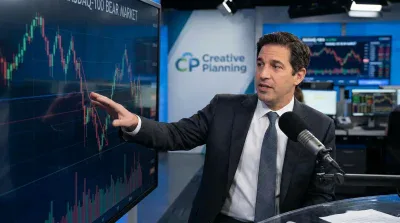
Creative Planning Chief Market Strategist Charlie Bilello wrote on X that the Nasdaq 100 “crossed into bear market territory today for the first time since April 2025.” The milestone came after a Friday selloff in tech stocks, with concerns about AI spending spreading across the market (BBC, The New York Times). If you are retired or close to it, the useful question is how much of your money sits in this index and what a drop like this has meant in the past.
How Close the Index Came to the 20% Line.
A bear market usually means a fall of 20% or more from a recent high. Invesco QQQ Trust (NASDAQ:QQQ), which tracks the Nasdaq 100, posted its record close of $759.66 on October 6, 2026. On November 20, it traded as low as $606.23, or 20.2% below that close. It ended the day at $608.45, down 5.67% and 19.9% below the record. The index closed 19.84% below its record, and its session low sat 20.2% below. So the index crossed the line during trading and closed just above it. The ETF lost 10.51% in one week and 16.1% in one month.
Why Tech-Heavy Indexes Fall Harder
On the same day, SPDR S&P 500 ETF Trust (NYSEARCA:SPY) fell 3.64%. Over the month, it dropped 10.77%. The Nasdaq 100 includes only non-financial companies, and the fund’s prospectus says no single stock can exceed 24% of the index. It also lists significant exposure to the information technology sector. As of June 30, 2026[1], the three largest holdings were NVIDIA (NASDAQ:NVDA | NVDA Price Prediction) at 7.6%, Apple (NASDAQ:AAPL) at 6.67%, and Micron Technology (NASDAQ:MU) at 5.64%. When chip and AI stocks drop together, few holdings in the index move the other way to soften the blow.
What Past Bear Markets Meant for Patient Investors
The most recent bear market close came on April 8, 2025, during the tariff selloff, and it was short. Even after this fall, QQQ is up 3.89% over one year, 50.61% over five years, and 411.73% over ten years. Those periods include the 2022 bear market and the 2025 tariff drop. Bilello made a related point this week. He noted that the S&P 500’s forward P/E had fallen to 17, its lowest in over three years, and he called sharp down days the cost investors pay to earn higher long-run returns from stocks than from bonds or cash.
Your Retirement Portfolio Likely Owns These Stocks Already
The same megacaps also rank among the largest weights in S&P 500 index funds and in many target-date funds. A retired person who has no Nasdaq fund at all can still have a large share of their stock money in the same handful of chip and software companies. The QQQ fact sheet and the fact sheets for your own funds show the top holdings, so you can measure how much the funds overlap.
A Practical Framework Before You React
- Review your target allocation. After years of profits, stocks may make up more of your portfolio than you planned. A set target gives you rules for when to cut and when to add.
- Check your cash cushion. Cash or short-term bonds set aside for upcoming withdrawals reduce the need to sell stocks after a drop.
- Understand what selling locks in. Selling after a 20% drop turns a paper loss into a realized one. The April 2025 fall reversed quickly, and each recovery has followed its own timeline.
- Check concentration. Add up your exposure to the largest tech stocks across all your funds.
Signals to Watch in the Coming Weeks
A measure of expected volatility, the VIX, hit 28.44 on November 19[2], up 9.74 from a week earlier. Markets close November 26 for Thanksgiving, and the Fed meets December 8-9. A bear market headline is a good time to review your allocation, cash reserves, and tech overlap.
Contact [email protected] for any questions or corrections.
Chris Lange is a financial and geopolitical writer with more than a decade of experience covering a myriad of topics. He has published thousands of articles for 24/7 Wall St., with past coverage focused heavily on stocks, IPOs, healthcare, defense, global affairs, and technology.
His work has been quoted, or referenced by a number of outlets including Business Insider, USA Today, Yahoo Finance, MSN, The Motley Fool, and many other publications. A graduate of Southwestern University, he studied business with a focus on investments and has previous experience in banking and startups.
When not reading or writing the news, he is following his passion for Lacrosse, playing chess, or building solar projects with his dad.