GE Vernova Dropped Another 11% This Month: It Will Gain 95% Within 12 Months Predicts One Wall Street Pro

This post may contain links from our sponsors and affiliates, and Flywheel Publishing may receive compensation for actions taken through them.

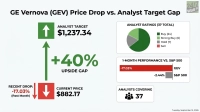
GE Vernova (NYSE:GEV | GEV Price Prediction) currently trades at $714.64, and the average Wall Street price target is $1,148.46. That leaves a gap of 60.7% between the share price and where analysts think the stock belongs.
GE Vernova builds gas turbines, grid equipment and wind turbines. That mix has made it one of the market’s preferred ways to own the electricity demand boom driven by data centers. Backlog reached $197B[1] last quarter, and management expects it to exceed $200B in Q4.
The gap matters because the business is speeding up while the stock is falling. Guggenheim’s Joseph Osha holds the highest target on the Street at $1,400.00, which implies 95.9% upside.
A 40% Slide From the Highs Despite a Record Quarter
GE Vernova sits 40.2% below its 52-week high of $1,195.24, a decline well past 30% for a company that just raised guidance. November did most of the damage. Shares have dropped 16.65% since the end of October, including 7.41% in the past week.
The selling hit the entire AI power trade. Rising inflation pushed borrowing costs higher, and investors grew nervous about how hyperscalers and their partners will pay for expensive data center projects according to The Motley Fool. Then SoftBank booked a loss on power equipment it had ordered for U.S. data centers, and GE Vernova shares fell that same day per Energy News.
The quarterly numbers held up: GAAP EPS came in at $4.81[1] against a $4.01 consensus, and orders reached $29.3B, +96% organic. The market is wondering how long data center demand holds up and is marking down multiples across the group. Wind remains a drag, with guided EBITDA losses of $400-$500M for the year.
32 of 38 Analysts Still Rate GE Vernova a Buy
Analyst support has held firm. Six analysts rate the stock Strong Buy, 26 rate it Buy and six say Hold. None rate it a Sell. Recent changes have been limited to small target cuts. JPMorgan, TD Cowen, Citi and Argus each trimmed targets slightly, and Osha trimmed his from $1,450.00. Other high targets include Morgan Stanley at $1,350.00 and Bernstein at $1,298.00.
It starts with gas turbine pricing. Management expects 2026 gas order pricing to be up directionally 50%[2] from 2025, and those better-priced units are just starting to ship. CEO Scott Strazik said “the second half of this year is the beginning of us starting to ship our better-priced equipment shipments.”[2] Power’s EBITDA margin already reached 21.4%[1].
Cash flow and estimates back up the thesis. Free cash flow guidance jumped to $16-17B[1] from $11.5-12.5B, and the buyback authorization doubled to $20B. Over the past 30 days, analysts made 19 upward revisions to 2027 EPS estimates and four cuts. A price target is one data point, though, and most of these targets frame a 12-month view that depends on valuations recovering across the group.
Vertiv and Eaton Fell With GE Vernova While Quanta Held Up
Most of the peer group sold off together, with one exception.
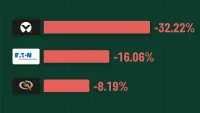
Eaton (NYSE:ETN) has fallen 14.28% in a month to $317.44. Its $465.67 target implies 46.7% upside, which is smaller than GE Vernova’s. 23 analysts rate it Buy or Strong Buy, four say Hold and one says Strong Sell.
Quanta Services (NYSE:PWR) gained 0.27% over the month and trades at $565.58. Its $769.78 target implies 36.1% upside, the smallest in the group. 25 analysts rate it Buy or better, against four Holds and one Strong Sell.
Vertiv (NYSE:VRT) has dropped 13.17% in a month to $173.34. Its $326.89 target implies 88.6% upside, with 26 Buy-or-better ratings and four Holds.
Vertiv has the largest consensus upside. GE Vernova ranks second, so its setup is strong, though Vertiv’s is stronger.
GE Vernova Still Beats the S&P 500 This Year
At $714.64, GE Vernova would need to rise 60.7% to reach the $1,148.46 consensus target set by 38 analysts. It also trades below its 50-day moving average of $888.10 and its 200-day average of $951.40.
Shares are up 9.66% year to date, compared with 5.1% for the S&P 500. Over the past month, GE Vernova fell 16.34% while the index dropped 6.36%. The stock trades at a forward P/E of 29.
Why GE Vernova’s Setup Below $720 Hinges on Turbine Pricing
The investment story gets stronger if higher-priced turbine shipments keep lifting Power margins and the backlog moves past $200B as promised. GE Vernova is one of several non-chip suppliers riding the data center expansion (we covered seven of them, from power to cooling, in a free report on the AI infrastructure trade). The thesis weakens if more data center customers follow SoftBank in cutting orders, because that would undercut the reservation pipeline the bulls depend on.
Analysts need margin expansion to continue into 2027 and cash flow to hit the raised guidance. The market is pricing in a financing crunch for AI infrastructure, and analysts may be underweighting that risk. Even so, about 80%[2] of gas demand comes from traditional customers, which limits GE Vernova’s dependence on hyperscalers. Considering it all, the fundamentals are improving faster than the multiple is falling, though Osha’s $1,400 target requires a full re-rating that could take longer than 12 months.
Contact [email protected] for any questions or corrections.
Alex Sirois is a financial writer with experience spanning both retail and institutional investing. He has written for InvestorPlace and held roles at BNY Mellon and Bernstein, giving him a perspective that bridges Main Street portfolios and Wall Street analysis.
Alex holds an MBA from George Washington University and has built his career across multiple industries, including e-commerce, education, and translation — a breadth of experience that informs how he breaks down complex financial topics for everyday investors. His writing is conversational, actionable, and grounded in long-term, buy-and-hold investing principles.
At 247 Wall St., Alex focuses on delivering analysis that is both accessible and useful, with a clear emphasis on helping readers make more informed decisions with their money.