Vertiv Suffered a Near 40% Drop Over 6 Months: 80% Returns Will Materialize According to This Wall Street Team
Vertiv posted a record quarter, raised guidance, and still watched its stock crater when Washington turned hostile to data centers. Analysts say the market is pricing in a threat that hasn't touched orders yet, but one risk could change that.

This post may contain links from our sponsors and affiliates, and Flywheel Publishing may receive compensation for actions taken through them.
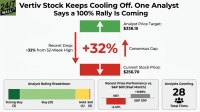
Vertiv (NYSE:VRT | VRT Price Prediction) is trading at $205.57. The average analyst price target is $339.07, implying 64.9% upside.
Vertiv sells the power systems, thermal management gear, racks and services that keep data centers running. That makes it a direct supplier to the AI hyperscaler expansion. Executive Chairman David Cote put it plainly on the latest earnings call: “No data centers, no digital age. And Vertiv supplies the picks and shovels.” Vertiv is one of several suppliers riding that expansion, and we covered seven of them, from power to cooling, in a free report you can grab here.
The gap stands out because the business is speeding up while the stock moves in the opposite direction.
A Record Quarter Could Not Hold Off the Washington Selloff
The sharpest drop came in a single session. Vertiv fell 12.88% after a Democratic congressional sweep raised fears of a policy backlash against data centers. That drop extended a six-month decline of 39.7%, which passes the 30% threshold that separates a violent selloff from a routine pullback. The stock has a 52-week high of $379.76.
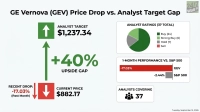
The whole sector took the hit. GE Vernova (NYSE:GEV) closed down about 9% in the same session, per Barron’s. Even so, Vertiv’s slide began well before the election. Third-quarter adjusted EPS came in at $2.21 against a $1.82 consensus, and revenue of $4.31 billion grew 61.2%. Shares reached $245.92 the day after that report, then gave it all back.
Doubts about the company itself added to the pressure. On the call, analysts asked about compressor failures and UPS overheating. Management also said $100 million to $150 million of revenue that slipped out of the second quarter was recovered in Q3, which points to execution problems during the capacity increase.
Bernstein’s $376 Target Implies an 83% Rebound
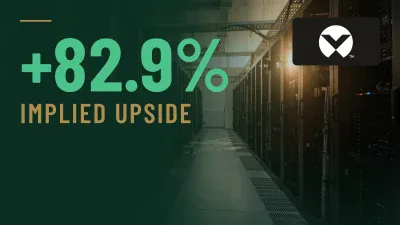
Bernstein holds the Street-high target of $376.00, raised from $368 with an Outperform rating. That target implies 82.9% upside from here. Piper Sandler and Evercore ISI sit close behind at $375.00, and Citi raised its target to $362 while keeping a Buy rating. After the earnings report, the revisions went up.
The bull case rests on order momentum. Organic orders grew more than 100% year over year. Management raised full-year adjusted EPS guidance to $7.10 to $7.20 and free cash flow guidance to $2.60 billion to $2.80 billion. It also expects “continued significant above-market organic sales growth in 2027.”
Analysts also point to new products. Native 800-volt DC power begins customer validation in 2027, with broader deployment expected in 2028. Backlog covers roughly 12 to 18 months of revenue.
All of these targets were set before the election shock, and price targets are estimates that can change.
AI Power Peers Fell Together, but Vertiv Fell Hardest
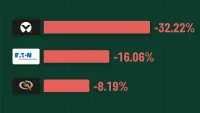
The entire AI power sector sold off, and Vertiv took the largest cut. Eaton (NYSE:ETN) trades at $353.08 after a one-month decline of 18.38%. Its $485.47 target implies 37.5% upside. Of its 28 analysts, 23 give it a Buy or better, 4 rate it Hold and 1 rates it Strong Sell.
GE Vernova is at $832.83, down 15.88% over a month. Its $1,187.07 target implies 42.5% upside, and none of its 38 analysts rates it Sell.
Quanta Services (NYSE:PWR) trades at $580.44 after a 15.07% monthly decline. Its $765.87 target implies 31.9% upside, the lowest in the group.
Vertiv carries the largest analyst-implied upside of the four. That means Wall Street sees its selloff as the most overdone.
Still Ahead of the S&P 500 This Year Despite the Collapse
Despite the drawdown, Vertiv is up 26.98% year to date. The S&P 500 has gained 12.45% over the same stretch. Over the past month, Vertiv lost 18.95% while the index slid 1.04%.
Thirty analysts cover the stock:
- Strong Buy: 3
- Buy: 23
- Hold: 4
- Sell: 0
Shares trade at roughly 23 times forward earnings. With a beta of 2.108, the stock tends to move about twice as much as the market in either direction.
Vertiv’s Fundamentals Look Stronger Than Its Chart
I’d lean bullish on Vertiv here if hyperscaler spending holds through 2027 and the order jump turns into revenue on schedule. If both happen, the guidance points to strong EPS growth this year, and a forward multiple near 23 looks cheap for that. But I’d stay cautious if a Democratic Congress turns local resistance to data centers into permitting or power restrictions, or if quality problems slow the capacity increase.
On balance, I lean bullish. The market is pricing in a political risk that hasn’t impacted the order book yet, while backlog and raised guidance give real visibility into next year. In the coming quarters, watch order growth and any signs of policy-driven project delays.
Contact [email protected] for any questions or corrections.
Alex Sirois is a financial writer with experience spanning both retail and institutional investing. He has written for InvestorPlace and held roles at BNY Mellon and Bernstein, giving him a perspective that bridges Main Street portfolios and Wall Street analysis.
Alex holds an MBA from George Washington University and has built his career across multiple industries, including e-commerce, education, and translation — a breadth of experience that informs how he breaks down complex financial topics for everyday investors. His writing is conversational, actionable, and grounded in long-term, buy-and-hold investing principles.
At 247 Wall St., Alex focuses on delivering analysis that is both accessible and useful, with a clear emphasis on helping readers make more informed decisions with their money.