Invest in the Turkey, Soybeans and Corn Behind Your Holiday Table for Passive Income: $90,000 Across These 3 Farm Processors Pays More Than $2,800 a Year

This post may contain links from our sponsors and affiliates, and Flywheel Publishing may receive compensation for actions taken through them.
Many retirees build their budgets around cash that arrives on a schedule, whatever the market does. Dividends from large food processors fit that pattern well. People keep buying protein, cooking oil, sweeteners, and animal feed through most economic cycles. The companies that turn poultry, soybeans and corn into what ends up on a holiday table also pay quarterly dividends, and each has a long payment record.
The plan here is a $90,000 investment split equally across three farm processors, with $30,000 in each. At current yields, the three positions together would pay out $2,851 per year in passive income, which tops the $2,800 mark. The stocks are listed from lowest yield to highest. All yields are based on each company’s forward annualized dividend and its Nov. 27, 2026 closing price.
Archer-Daniels-Midland
- Stock #3: Archer-Daniels-Midland (NYSE:ADM | ADM Price Prediction)
- Yield: 3.06%
- Shares for $30,000: 442.02
- Annual Passive Income: ~$919
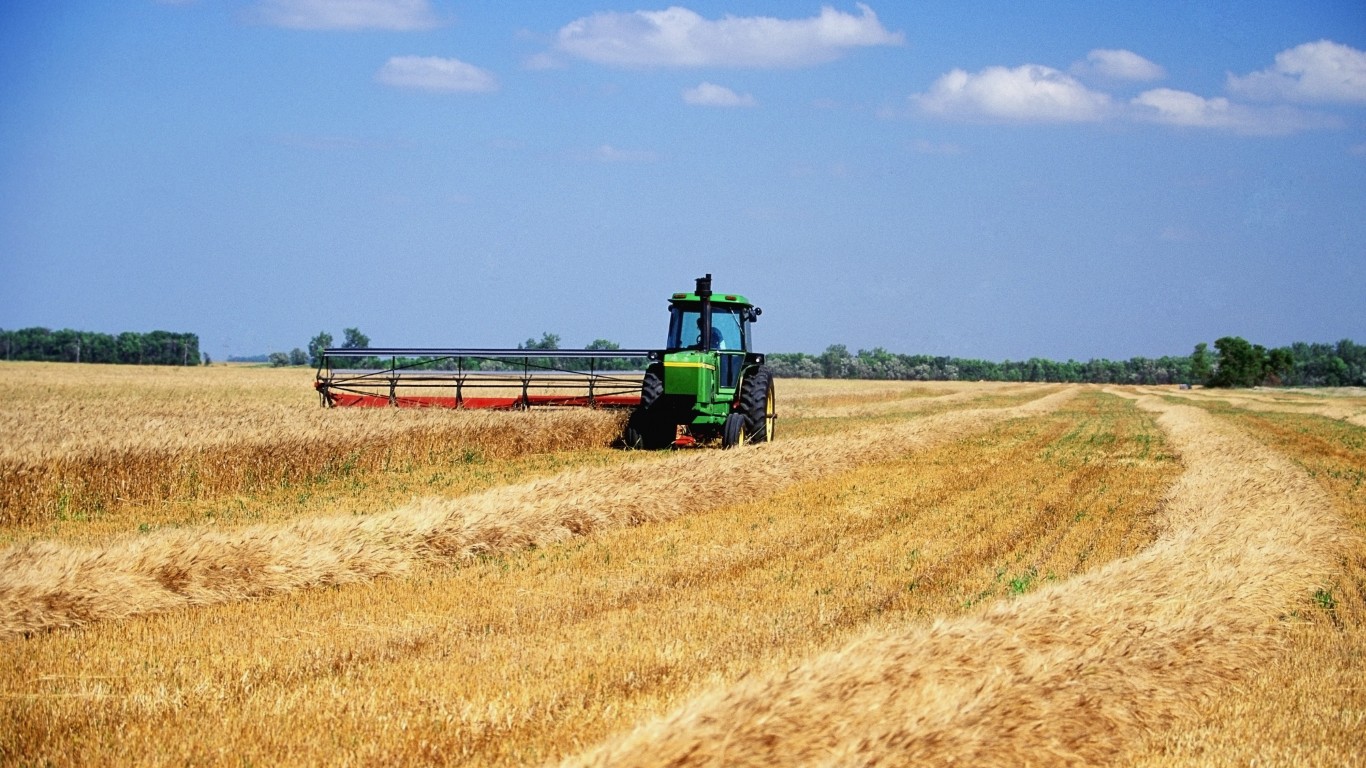
Archer-Daniels-Midland buys, stores, ships, and processes crops into food, feed, fuel, and industrial products. It reports three segments: Ag Services and Oilseeds, Carbohydrate Solutions, and Nutrition. Its yield comes from a mature, cyclical business that pays out part of its processing earnings every quarter. The quarterly dividend is $0.52 per share, or $2.08 a year. The company has paid quarterly dividends without a break since at least 1999, with regular increases along the way.
ADM’s earnings cover the dividend: the company reported third-quarter adjusted EPS of $1.77[1] and then raised its 2026 adjusted EPS guidance to $5.50-$5.80. At the low end of that range, the dividend uses about 38% of earnings. Crushing operating profit rose to $311 million[1] after the Renewable Volume Obligation policy was finalized in March 2026. The same policy link is also a risk, since ADM depends heavily on biofuel policy and ethanol margins, and if either weakens, its processing margins would shrink.
Bunge Global
- Stock #2: Bunge Global (NYSE:BG)
- Yield: 3.15%
- Shares for $30,000: 328.23
- Annual Passive Income: ~$945
Bunge buys, processes, and refines farm commodities in more than 50 countries. Soybean Processing and Refining is its largest segment, and the completed combination with Viterra gave it more grain-sourcing scale. The quarterly dividend is $0.72 per share, or $2.88 a year, up from $0.70 earlier in 2026.
Third-quarter adjusted EPS came in at $2.56[2], and management kept its 2026 adjusted EPS guidance at $9.25 to $9.75. At the low end, the dividend uses about 31% of earnings. Bunge also finished a $2B share repurchase linked to the Viterra deal. On cash flow, rising working capital meant operations used $2.302B of cash over nine months. Trade policy is a live risk as well: geopolitical trade shocks drove Tropical Oils EBIT down to $13M[2].
Tyson Foods
- Stock #1: Tyson Foods (NYSE:TSN)
- Yield: 3.29%
- Shares for $30,000: 474.31
- Annual Passive Income: ~$987
Tyson Foods processes chicken, beef, and pork. It also sells branded foods under names including Tyson, Jimmy Dean, Hillshire Farm and Ball Park. The company reports five segments, and its branded and value-added business makes the highest margins. On Nov. 13, 2026[3], Tyson raised its quarterly dividend to $0.52[3] per Class A share. That sets the annual rate at $2.08[3], a 2% increase.
Tyson makes adjusted EPS of $3.44[3] in fiscal 2026, so the dividend uses about 60% of earnings. Free cash flow for the year was $1.663B[3], up 41.3%, and the company bought back 7.8M shares for $427M. In the Beef segment, mean cattle supplies widened its fourth-quarter adjusted loss to $(171)M[3], and fiscal 2027 guidance allows for a Beef loss of up to $300 million. Free cash flow guidance for fiscal 2027 is $0.8 to $1.3B[3].
Income From $90,000 Across Three Farm Processors
| Name | Yield | Annual Dividend Income |
|---|---|---|
| Archer-Daniels-Midland | 3.06% | $919 |
| Bunge Global | 3.15% | $945 |
| Tyson Foods | 3.29% | $987 |
| Total | 3.17% | $2,851 |
Together, these three positions generate $2,851 in annual passive income on a $90,000 investment, a combined yield of 3.17%. Tyson Foods contributes $987, Bunge $945, and Archer-Daniels-Midland $919 of the total.
All three companies pay quarterly, so reinvested dividends buy more shares four times a year, and each new share contributes to the next payment. Because the dividends cover only part of each company’s earnings, there is room for future increases, which would speed up that compounding over a long holding period.
Contact [email protected] for any questions or corrections.
David Beren has been a Flywheel Publishing contributor since 2022. Writing for 24/7 Wall St. since 2023, David loves to write about topics of all shapes and sizes. As a technology expert, David focuses heavily on consumer electronics brands, automobiles, and general technology. He has previously written for LifeWire, formerly About.com. As a part-time freelance writer, David’s “day job” has been working on and leading social media for multiple Fortune 100 brands. David loves the flexibility of this field and its ability to reach customers exactly where they like to spend their time. Additionally, David previously published his own blog, TmoNews.com, which reached 3 million readers in its first year. In addition to freelance and social media work, David loves to spend time with his family and children and relive the glory days of video game consoles by playing any retro game console he can get his hands on.