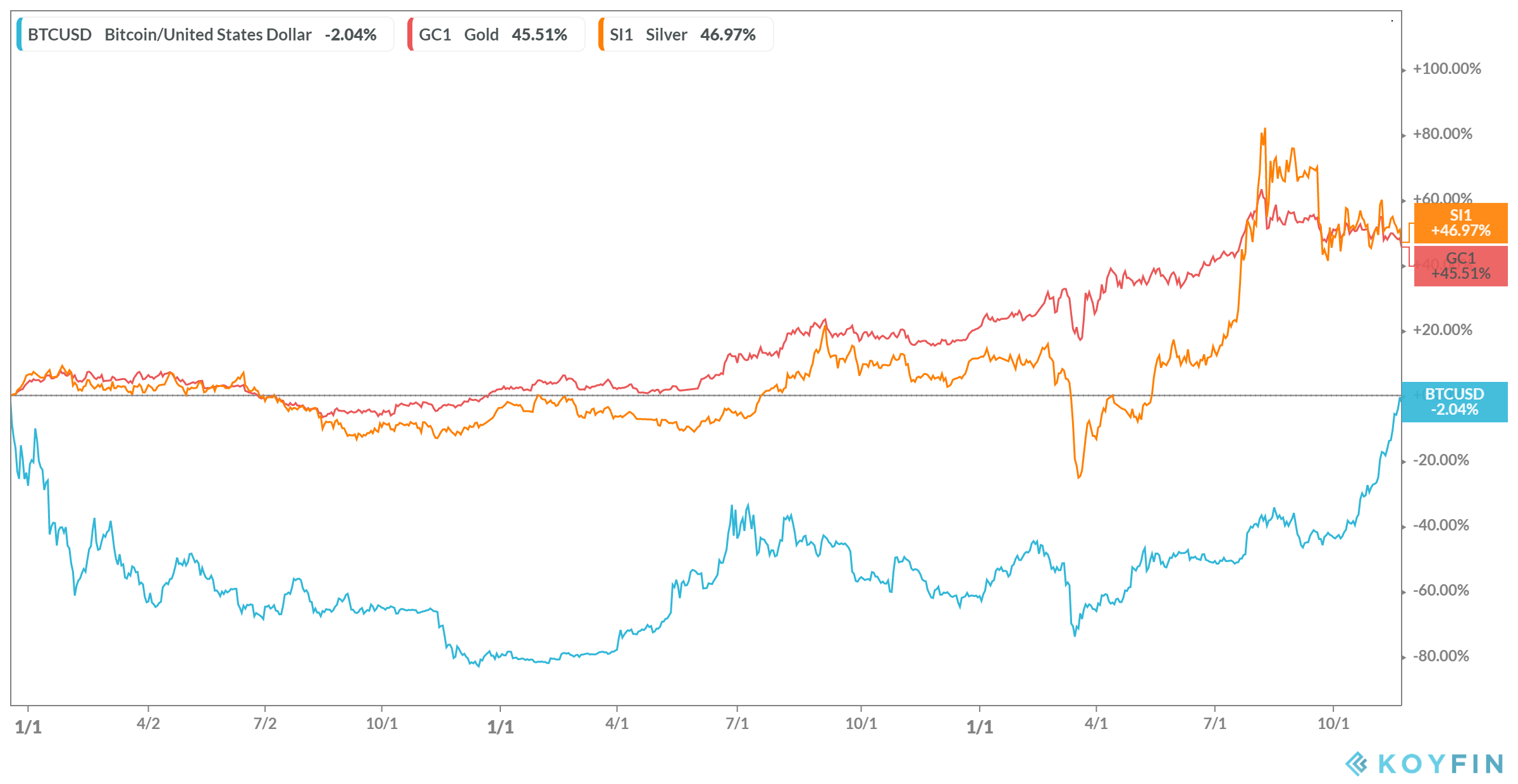
XRP Held Flat This Week While Bitcoin, Ethereum and Solana Fell. Is It Breaking Away From Bitcoin?
XRP barely budged this week while Bitcoin, Ethereum, and Solana tumbled, sparking talk of a long-awaited decoupling. But the correlation data, the ETF flows, and a brutal 30-day track record tell a more complicated story.

This post may contain links from our sponsors and affiliates, and Flywheel Publishing may receive compensation for actions taken through them.
XRP (CRYPTO: XRP) fell just 0.1%, making it one of the most stable major cryptocurrencies. By comparison, Bitcoin (CRYPTO: BTC) fell 2%, Ethereum (CRYPTO: ETH) fell 3.4%, and Solana (CRYPTO: SOL) fell 2.8%. With XRP at $1.30 and Bitcoin near $80,268, some XRP holders speculate the token may be starting to decouple from Bitcoin.
Despite its flat performance over the week, the XRP-Bitcoin correlation suggests otherwise. In fact, XRP’s daily returns over the past seven days showed a strong correlation of 0.97 with Bitcoin’s movements, indicating they moved almost identically during this period. Over longer periods, the correlation remains strong: 0.91 over 30 days, 0.89 over 90 days, and 0.85 historically.
This suggests that while XRP appeared stable over the week, it has closely followed Bitcoin’s trends rather than showing separation. Is the perceived independence real, or is XRP simply falling less than Bitcoin?
What XRP’s 0.97 Correlation With Bitcoin Shows
Correlation measures how closely two assets move together based on their daily returns—the percentage change from one day’s closing price to the next. A correlation of 1 means the two assets rise and fall together, while a value near zero indicates no significant relationship.
Correlation primarily tracks directional movements rather than the magnitude of price changes. So, if XRP fell only half as much as Bitcoin on certain days, it could still show a high correlation because both assets move together.
Traders monitor these correlations as a falling number can signal that two assets are starting to diverge. Unfortunately for XRP, the data shows it moved closer to Bitcoin in the week ending. Its relative stability was more about not falling as much during the same downtrend than about establishing any clear independence.
XRP’s Flat Week Hides a Much Weaker Month
While XRP’s minimal weekly change seems promising, its performance over the last month tells a different story. Over the past 30 days, XRP has dropped 18.8%, compared with Bitcoin’s relatively mild 5% decline. Year-to-date, XRP is down 29.1%, while Bitcoin is down just 7.7%.
Over the past year, XRP has lost 49.8%, while Bitcoin has decreased by 27.7%. This pattern suggests XRP tends to follow Bitcoin, but often more sharply, suffering more during price drops.
A flat performance after a month of steep losses could suggest easing selling pressure. However, it could also signal declining trading activity. For example, spot XRP ETFs traded only $18.8 million on October 23, down from over $102 million on October 2.
The only sign of a potential break came in the 24 hours leading up to October 25, when XRP rose 1.4% while Bitcoin fell 0.4%. Yet, such a single-day movement does little to affect the broader 30-day correlation.
ETF Flows, Swell and Short Sellers Could Pull XRP Away From Bitcoin

One key factor that could push XRP away from Bitcoin is the flow of funds into spot XRP ETFs, which directly hold XRP. From October 19 to October 23, these funds saw a net inflow of about $4.3 million, including significant inflows of around $709,000 on October 21 and $3.5 million on October 22.
However, these ETFs’ net assets shrank from $1.77 billion on September 25 to $1.48 billion on October 23, indicating that price declines outweighed the inflows. A few million dollars per day is clearly insufficient to steer XRP away from Bitcoin’s influence.
Additionally, the upcoming Ripple Swell conference from October 27 to 29 in New York, combined with XRPL Apex, Ripple’s developer conference, could matter. While past conferences haven’t led to long-lasting rallies for XRP, any agreements related to payments or tokenized assets on the XRP Ledger could generate demand independent of Bitcoin.
Short selling also presents another possibility. Reports indicated a rise in XRP margin shorts on Bitfinex, increasing from approximately 148,850 to around 300,000 in under two weeks. While these figures are unconfirmed, if XRP begins to rise, short sellers may be forced to buy back coins, creating a short squeeze that drives up demand for XRP.
Is XRP Breaking Away from Bitcoin?
In conclusion, XRP has not broken away from Bitcoin. During the week ending October 25, it fell less than Bitcoin while still closely tracking its movements, resulting in a correlation of 0.97. This relationship shows that XRP continues to follow Bitcoin’s lead rather than forge its own path. One week is too short to suggest separation, especially given a month in which XRP plummeted 18.8% while Bitcoin lost only 5%.
However, two potential shifts could change this narrative. First, spot XRP ETFs need consistent daily inflows near the $22.6 million they saw on September 25, rather than days with no inflow, as seen in October. Additionally, XRP must close above its 50-day average around $1.41 on days when Bitcoin declines, as this would strengthen its potential to break free from Bitcoin’s grasp.
Contact [email protected] for any questions or corrections.
Sam Daodu is a crypto analyst and the editor of 24/7 Wall St.'s Crypto Desk, where he covers Bitcoin, XRP, Ethereum, Solana and the altcoins investors search for most. His work focuses on price levels, spot ETF flows, on-chain data and the regulatory decisions that move crypto markets, written so a first-time buyer and a seasoned trader can both use it.
Sam has written about crypto professionally since 2019 and has published more than 2,000 articles. Before joining 24/7 Wall St., he wrote for crypto media outlets and Web3 companies and ghostwrote for crypto founders and token launches. His analysis is syndicated on Yahoo Finance, MSN and AOL and has been cited by other crypto news sites. He also founded MacLabs Marketing, a content and personal branding agency for crypto founders and executives.
When he isn't reading charts, Sam is usually at the gym or watching One Piece, a series he maintains has better tokenomics than most altcoins.