The S&P 100 ETF Just Dumped Nike and Colgate for 4 AI Stocks. Here’s What That Means for Your Portfolio
The iShares S&P 100 ETF just swapped out a toothpaste giant and a mall REIT for four AI infrastructure plays, and the move reveals something uncomfortable about what this so-called blue-chip fund has quietly become.

This post may contain links from our sponsors and affiliates, and Flywheel Publishing may receive compensation for actions taken through them.
The iShares S&P 100 ETF (NYSEARCA:OEF) is marketed as a clean way to own America’s largest blue chips, but the index it tracks has quietly been rebuilding around one theme. The coming S&P 100 reshuffle drops Nike (NYSE:NKE | NKE Price Prediction), Colgate-Palmolive (NYSE:CL), Simon Property Group (NYSE:SPG) and Honeywell (NASDAQ:HON) and adds four technology names tied to AI capital spending: Dell Technologies (NYSE:DELL), Palo Alto Networks (NASDAQ:PANW), Arista Networks (NYSE:ANET) and SanDisk (NASDAQ:SNDK).
A mall REIT, a toothpaste maker, a sneaker brand, and an aerospace industrial are swapped for AI servers, AI security, AI networking, and AI memory. The index committee is following market capitalization, ratifying a shift the market already made. The question OEF investors should ask is whether a fund sold as diversified mega-cap exposure still does that job, or whether it has become a slightly cheaper, slightly diluted cousin of Invesco QQQ Trust (NASDAQ:QQQ) at a 0.20% expense ratio.
What the Reshuffle Actually Signals
S&P Global weights S&P 100 constituents by float-adjusted market capitalization, so additions enter near the bottom of the ladder rather than as equal slugs, according to S&P Global. Dell, Palo Alto, Arista and SanDisk will not remake OEF overnight.
They arrive because their market values demanded it. SanDisk trades near $1,740 after a 633% year-to-date run, Dell is up 320.24% year-to-date, and Palo Alto and Arista have gained 80.92% and 47.89%. The committee is ratifying a move that already happened in prices.
The removals tell the same story from the other side. Nike sat at just 0.11% of OEF at the June snapshot, and Colgate-Palmolive at 0.16%. They were already rounding errors.
OEF Was Already a Tech Fund
The AI tilt did not start with this reshuffle. As of June 30, NVIDIA (NASDAQ:NVDA) was 10.47% of OEF, Apple (NASDAQ:AAPL) 9.18%, Microsoft (NASDAQ:MSFT) 5.99%, Amazon (NASDAQ:AMZN) 5.04%, and Broadcom (NASDAQ:AVGO) 3.86%.
Micron’s weight jumped from 0.94% in March to 2.81% by June, while AMD’s weight rose from 0.82% to 2.05%. The AI capital-spending trade was reshaping OEF’s top holdings quarter by quarter before any committee vote.
Total fund assets grew to $20.04 billion at the end of June from $17.84 billion in March, and most of that gain came from technology weight expansion rather than from new consumer or industrial constituents.
OEF vs. QQQ vs. VOO
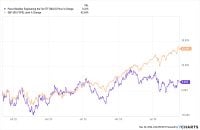
Performance shows what the AI tilt has and has not delivered. OEF returned 11.97% year-to-date and 19.56% over one year through September 4, 2026.
QQQ returned 17.04% year to date and 24.99% over one year. Vanguard S&P 500 ETF (NYSEARCA:VOO) returned 13.59% and 20.08% over the same windows at a lower expense ratio.
OEF sits between the two and beats neither. You get more concentration than VOO without the full tech exposure of QQQ, at four times VOO’s typical fee. Over five years, OEF’s 94.06% return edges QQQ’s 88.42% and VOO’s 82.41%, but the gap is narrower than the marketing implies.
What the AI Additions Actually Own
Dell booked $60.90 billion in AI server orders in a single quarter with a $95 billion backlog, and CEO Jeff Clarke said: “We booked $60.9 billion of AI orders in this quarter, the most in our history.” This is no longer a PC company.
Palo Alto’s Next-Generation Security ARR reached $9.10 billion, growing 63%. Arista posted its first $3 billion quarter with a 49.9% non-GAAP operating margin. SanDisk’s data center revenue grew 437% in the fiscal year, driven by AI memory demand.
Each fits the AI infrastructure thesis beyond the chipmakers everyone already owns (we profiled seven of these picks-and-shovels suppliers in a free report on the AI buildout), but each also carries the cyclicality that comes with it. SanDisk’s business is still NAND pricing, and Dell’s negative shareholders’ equity of -$1.427 billion reflects heavy buybacks funded by leverage.
Is OEF ETF a Buy?
OEF is a concentrated bet that the largest U.S. companies keep winning and that AI capital spending continues to compound through mega-cap balance sheets. If you already own VOO or an S&P 500 fund, OEF is largely redundant and comes with a higher fee. If you want the AI theme cleanly, QQQ does it better with more semiconductor and software depth.
The reshuffle confirms OEF drifted toward tech years ago. For investors who already hold OEF as a core sleeve, the fund still delivers mega-cap exposure; for those building a portfolio today, VOO offers a cheaper broad-market option, and QQQ offers deeper tech conviction. The blue-chip label no longer accurately describes the product.
Contact [email protected] for any questions or corrections.
Omor Ibne Ehsan is a writer at 24/7 Wall St. He is a self-taught investor with a focus on growth, cyclical, and dividend equities that have strong fundamentals, value, and long-term potential. He also has an interest in high-risk, high-reward investments such as penny stocks.