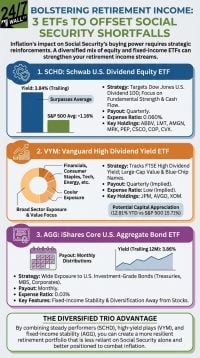
A Dividend Portfolio That Beats the Median Household Income in 47 of the 50 States on $1.1 Million Invested
The U.S. median household income sits near $80,610, and a $1.1 million dividend portfolio generating a blended 7% yield would produce roughly $77,000 a year in cash flow. That level of income exceeds the median household income in most of…

This post may contain links from our sponsors and affiliates, and Flywheel Publishing may receive compensation for actions taken through them.
The U.S. median household income sits near $80,610, and a $1.1 million dividend portfolio generating a blended 7% yield would produce roughly $77,000 a year in cash flow. That level of income exceeds the median household income in most of the country, which helps explain why geography can dramatically change the retirement equation. The same dividend checks arrive whether an investor lives in Jackson, Mississippi, or Jackson Hole, Wyoming.
BEA per capita income data highlights just how far that $77,000 can stretch in lower-cost states. Per capita personal income stands at about $51,948 in Mississippi, $55,432 in West Virginia, and $57,251 in Alabama. Even California, one of the country’s highest-cost states, posts per capita income around $86,378, which is roughly where the math starts to feel tighter for dividend-funded retirees.
The Three Yield Tiers
The capital needed to replicate $77,000 changes dramatically with the yield you accept.
Conservative (3% to 4%). Blue-chip dividend growers, broad equity income funds, and quality dividend ETFs cluster here. $77,000 divided by 0.035 equals roughly $2.2 million. Coca-Cola (NYSE:KO | KO Price Prediction) pays about 2.6% after raising the dividend for 63 straight years, and Johnson & Johnson (NYSE:JNJ) yields around 2.3% with 64 consecutive years of increases. The income looks small today; the growth rate is what carries the next 20 years.
Moderate (5% to 7%). Net lease REITs, preferred share ETFs, high-dividend equity funds, and investment-grade-tilted high-yield strategies sit in this range. $77,000 divided by 0.06 equals roughly $1.28 million. Realty Income (NYSE:O) anchors this tier with a 5.2% yield, 670 consecutive monthly dividends, and 114 quarterly increases. Portfolio occupancy is 98.9% and 2026 AFFO guidance is $4.41 to $4.44 per share.
Aggressive (8% to 14%). Business development companies, mortgage REITs, leveraged covered call funds, and CLO equity funds. $77,000 divided by 0.10 equals $770,000. The income is real, but principal erosion and distribution cuts are common. The investor is harvesting the asset.
How $1.1 Million Gets to $77,000
A realistic blended portfolio looks like this: 30% covered-call ETFs at 8.0% ($26,400), 25% preferred stock ETFs at 8.7% ($23,925), 20% high-yield bond ETFs at 7.0% ($15,400), 15% REITs at 5.5% ($9,075), and 10% dividend aristocrats at 2.5% ($2,750). Total: roughly $77,550.
The Trap Most Income Investors Walk Into
A 10% yield with flat distributions pays $110,000 on a $1.1 million portfolio in year one and roughly the same amount in year ten. A 2.5% yielder growing its dividend at a high single-digit rate looks unimpressive today but can dominate over a decade or longer.
The Coca-Cola Company illustrates the point clearly. Its quarterly dividend climbed from $0.42 in 2021 to $0.53 in 2026. Johnson & Johnson increased its quarterly payout from $1.06 in 2021 to $1.34 in 2026. Realty Income Corporation compounds more slowly but pays dividends monthly, helping smooth cash flow for retirees whose bills arrive every month.
That is why many income investors use a blended strategy instead of relying on a single type of holding. The high-yield sleeve helps fund expenses today, while the dividend-growth sleeve helps protect purchasing power in 2036 and beyond.
What To Do With This
- Replace spending rather than salary. Pull your last two years of actual outflows. The number is often well below the household median, which means the capital target is smaller than you think.
- Run the tax math by state. Texas, Florida, Washington, and a handful of others levy no state income tax, so $77,000 of qualified dividends nets meaningfully more than the same gross in California or New York. Cost of living indexes compound the effect.
- Compare 10-year total return against headline yield. Pull a 3.5% dividend grower and a 10% covered-call fund side by side. The shape of the curves answers the tier question better than any pitch.
Contact [email protected] for any questions or corrections.
Drew Wood has edited or ghostwritten nine books and published more than 1,500 articles on investing, business, politics, travel, world cultures, wildlife, and earth science. He holds a doctorate and four master's degrees and has nearly 30 years of college teaching experience. His travels have taken him to 25 countries, including three years living in Ukraine.