High Earners Cannot Contribute to a Roth IRA Directly. Here’s the Legal Workaround
The IRS draws a hard income line around Roth IRA contributions, but a gap buried in the tax code since 2010 lets high earners sidestep it entirely through a two-step move most accountants never mention at tax time.

This post may contain links from our sponsors and affiliates, and Flywheel Publishing may receive compensation for actions taken through them.
If your income has climbed past the Roth IRA cutoff, the IRS has already told you no. You cannot make a direct Roth IRA contribution once your modified adjusted gross income clears the annual phase-out.
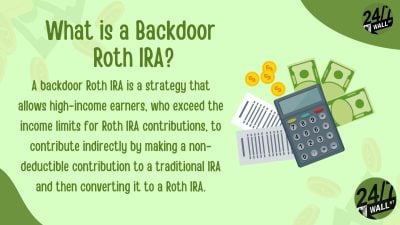
The workaround, known as the backdoor Roth IRA, is a two-step process the tax code permits: a nondeductible contribution to a traditional IRA, followed by a conversion to a Roth IRA. High earners have been running it for years, and many of them are parking the resulting Roth balance in high-growth names like NVIDIA (NASDAQ:NVDA | NVDA Price Prediction) precisely because qualified withdrawals come out tax-free.
Buried Rule Hiding in Plain Sight
The IRS caps who can put money straight into a Roth based on income. The IRS caps nothing about who can convert. Congress removed the income ceiling on Roth conversions back in 2010, and it never came back. That gap is the entire play. You fund a Traditional IRA with after-tax dollars, take no deduction, then convert those dollars to a Roth. Because you already paid tax on the contribution, only growth that occurs between contribution and conversion is taxable, and if you convert quickly, that number is usually near zero.
Where the Rule Actually Lives
The mechanics sit across a few citations you can look up yourself. Nondeductible contributions are governed by IRC \u00a7408(o) and reported on IRS Form 8606. The aggregation and pro-rata rule that determines the taxable share of any conversion is IRC \u00a7408(d)(2), reinforced by IRS Notice 2014-54 for basis allocation. The Tax Cuts and Jobs Act shut off Roth conversion recharacterizations starting in 2018, meaning once you convert, you cannot undo it. For the 2026 numbers, the IRS published Revenue Procedure 2025-32 in October 2025 with the full inflation adjustments, including the Roth IRA phase-out ranges for single, head of household, and married filing jointly.
Who This Actually Fits
The backdoor Roth is built for earners above the direct-contribution phase-out. It is also useful for anyone who wants Roth exposure and does not qualify to contribute directly. It is not a fit if you carry meaningful pretax balances in Traditional, SEP, or SIMPLE IRAs. Under \u00a7408(d)(2), the IRS aggregates every one of those accounts when computing the taxable share of your conversion. Workplace 401(k) balances are excluded from that aggregation, which is why some high earners roll old IRAs into their current 401(k) first to clear the runway.
Steps to Run It Cleanly
- Open a Traditional IRA and a Roth IRA at the same custodian.
- Contribute the 2026 IRA contribution limit in after-tax dollars to the traditional IRA. The limit is $7,500 if you are under 50 and $8,600 if you are 50 or older.
- Do not take a deduction. File Form 8606 with your return to record the basis.
- Convert the balance to your Roth IRA, ideally within days, so almost nothing has grown.
- Invest inside the Roth. Qualified distributions require the account to be at least five years old and the owner to be 59\u00bd or older.
Why NVIDIA Keeps Showing Up Inside These Accounts
The Roth wrapper punishes dividends least and rewards compounding most, which is why high-growth, low-yield names dominate the strategy. NVIDIA is the poster child. The stock carries a dividend yield of roughly 0.13% and posted Q2 FY2027 revenue of $96.22 billion, up 105.8% year over year, with Data Center revenue of $89.02 billion. Its 10-year cumulative price return through Sept. 18 is over 14,000%. In a taxable brokerage, a gain like that owes capital gains tax on every rebalance. In a Roth, a qualified withdrawal owes nothing.

Trap That Wrecks the Strategy
The pro-rata rule is the killer. If you have $93,000 sitting in an old rollover IRA and drop $7,500 of new nondeductible money in, the IRS does not let you convert only the $7,500. It treats every dollar across all your IRAs as one pool and taxes your conversion proportionally. Combined with the no-recharacterization rule, a botched conversion is permanent. Clear the pretax IRA balances first, or the backdoor closes on you.
Contact [email protected] for any questions or corrections.
Joel South covers large-cap stocks, dividend investing, and major market trends, with a focus on earnings analysis, valuation, and turning complex data into actionable insights for investors.
He brings more than 15 years of experience as an investor and financial journalist, including 12 years at The Motley Fool, where he served as an investment analyst, Bureau Chief, and later led the Fool.com investing news desk. He has also co-hosted an investing podcast and appeared across TV and radio discussing market trends.