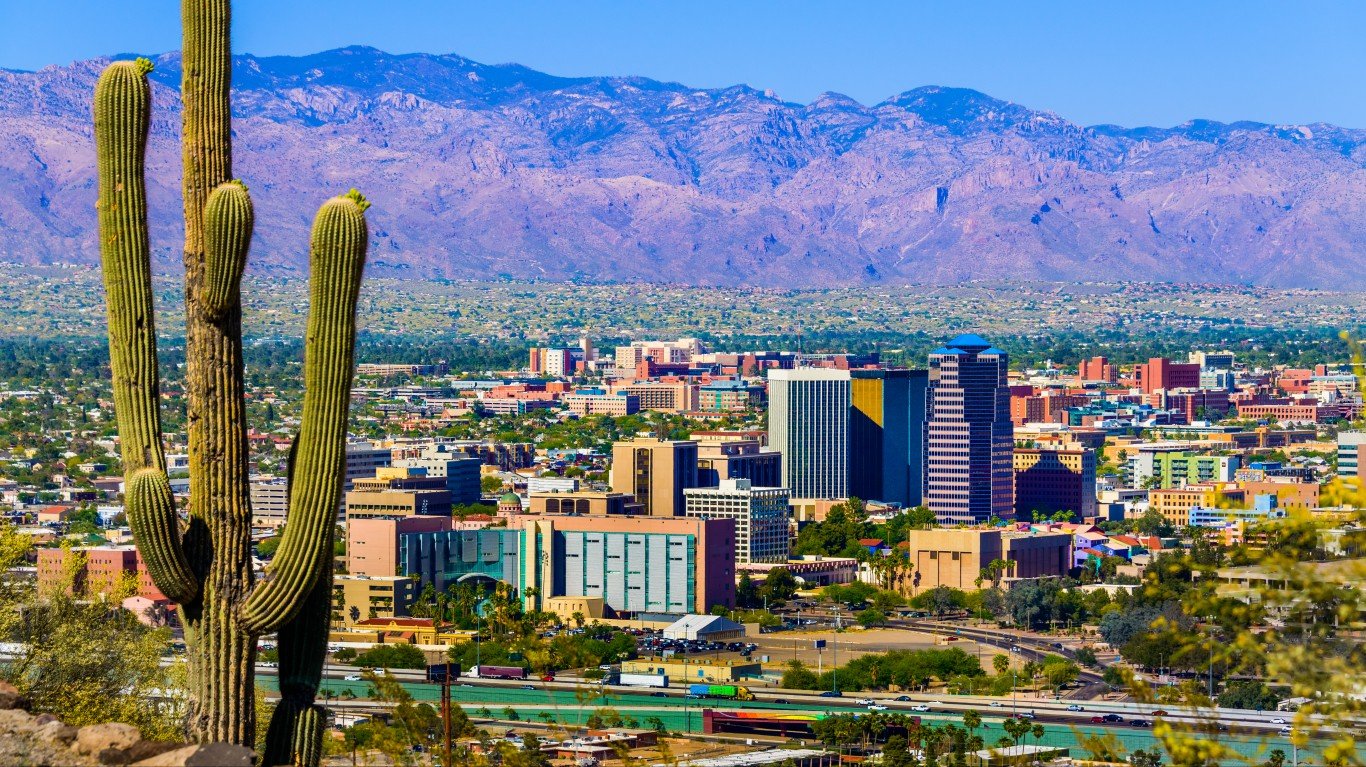
Plenty of Retirees Pick Arizona for the Winters. The Question Nobody Asks the Builder Is Where the Water Comes From
Most Arizona home buyers tour the kitchen, check the HOA fees, and ask about school ratings. Almost none of them ask the one question that could quietly drain thousands of dollars a year from a retirement budget before the first…

This post may contain links from our sponsors and affiliates, and Flywheel Publishing may receive compensation for actions taken through them.
Retirees buying homes in Arizona face a water supply risk that could affect their water bills, resale value, and household budgets, since Colorado River cuts and state water rules are reshaping what it costs to live there even as Arizona continues to draw new residents.
IRS migration data show a net gain of 27,127 individuals in 2022-2023, with California as the largest source at 47,885. Buyers may not always ask where the tap water comes from. In Arizona, that question has a documented answer, and it can affect water bills, resale value, and, in a few places, whether a house has reliable water at all.
Where Arizona’s Water Comes From, and Why the Supply Is Shrinking
Central Arizona depends mostly on Colorado River water and groundwater. The Central Arizona Project is a 336-mile canal system that carries river water to central and southern Arizona. That supply is already smaller than it used to be. A Tier 1 shortage means an estimated 30% cut to the Colorado River water the project delivers, and in a recent shortage declaration, Arizona again went without 18% of its total river allocation.
The longer-term rules are still being negotiated. A federal plan under discussion would let the government cut water to Arizona, California and Nevada by up to 40%. NPR reported that Arizona’s lifeline to the Colorado River is drying up. The cuts already in place are settled, while the depth of cuts under the next set of rules is still uncertain.
How a 100-Year Water Rule Protects Some Buyers and Leaves Others Out
The Arizona Department of Water Resources runs the Assured and Adequate Water Supply programs, which check whether a 100-year water supply is available. In the Phoenix and Tucson areas, a new subdivision generally needs a certificate showing that supply exists. The other option is to be served by a city or utility that already holds a designation, which covers the provider’s whole service area.
In 2023, a state groundwater model found that all of the groundwater physically available in the Greater Phoenix area is fully allocated. Gov. Katie Hobbs said, “If we do nothing, we would face a 4% shortfall in groundwater supply over the next 100 years,” and she said developers can’t rely solely on groundwater to obtain an assured water supply certificate.
About 80,000 unbuilt homes that already had certificates were approved to go ahead. The department updated the model in 2024 and now lists newer options, including an Ag to Urban program and an Alternative Path to Assured Water Supply.
Homes on private wells or hauled water fall outside that protection. Rio Verde Foothills, an unincorporated area near Scottsdale, is the best-known example. The city cut off hauled water to residents there on Jan. 1, 2023, citing drought conditions.
What Water Risk Does to a Retirement Budget
Arizona’s overall cost of living is close to the nationwide average, at an index of 100.677. Home prices rose 35.84% over five years in Phoenix-Mesa-Chandler and 39.46% in Tucson. Over the past year, they moved just 0.85% and 1.88%, and Prescott Valley-Prescott fell -0.73%. With price growth at these levels, a home with an uncertain water source may face added resale considerations.
Water bills are one place where buyers may see this. In one Arizona report in 2026, a 25% rate increase added about $22 a month when using approximately 15,000 gallons of water, or $264 a year. Covering that cost with 4% annual savings takes about $6,600 of extra portfolio. Several Valley cities have approved larger increases, and some heavy users have seen bills rise from $50 to $80 a month to more than $300.
Going from $80 to $300 adds $2,640 a year, which works out to $66,000 of portfolio at 4%. Communities with turf, lakes, and lush common areas usually pass those costs through HOA dues. Older households saw inflation run 3.6% over the past year, the same as the 3.6% 2027 Social Security COLA. Couples retiring on an average benefit of $3,208 a month, or about $38,496 a year, see it rise with the COLA, while some local water rates have increased faster.
Water Supply Records Tied to Arizona Home Purchases
Arizona remains a popular retirement destination, and most homes in the big metro areas sit inside designated service areas. Several water supply questions apply to most purchases.
These questions start with: Who provides the water? Does the development have its own certificate, or does a designated provider serve it? What does the provider’s rate history look like? For a resale home on a well, relevant records include the well’s depth, its age, and any history of falling water levels, which the state keeps in its well registry.
For budgeting purposes, with a 4% annual withdrawal, every $1,000 of new yearly cost takes about $25,000 more in savings. That 4% figure itself has come under question in recent years (we laid out the case for an income-first approach in a free guide).
Some retirement plans include a separate water and landscaping reserve, particularly for homes on wells or in water-heavy HOAs. The documents tied to this question are the certificate of assured water supply or written proof that the water provider holds a designation. If neither exists, the house may carry water risk that the asking price does not reflect.
Contact [email protected] for any questions or corrections.
David Beren has been a Flywheel Publishing contributor since 2022. Writing for 24/7 Wall St. since 2023, David loves to write about topics of all shapes and sizes. As a technology expert, David focuses heavily on consumer electronics brands, automobiles, and general technology. He has previously written for LifeWire, formerly About.com. As a part-time freelance writer, David’s “day job” has been working on and leading social media for multiple Fortune 100 brands. David loves the flexibility of this field and its ability to reach customers exactly where they like to spend their time. Additionally, David previously published his own blog, TmoNews.com, which reached 3 million readers in its first year. In addition to freelance and social media work, David loves to spend time with his family and children and relive the glory days of video game consoles by playing any retro game console he can get his hands on.