He Made $50,000 on Corn Futures. Social Security Asked Whether He Had Corn in the Field.
Two farmers take identical corn futures positions, collect identical Social Security checks, and then one of them loses thousands of dollars in withheld benefits while the other keeps every penny. The trade itself is not what separates them.

This post may contain links from our sponsors and affiliates, and Flywheel Publishing may receive compensation for actions taken through them.
Two people take the same corn futures position during the same season. Both collect Social Security after claiming before full retirement age (FRA). When the trade closes with a $50,000 gain, one keeps receiving every monthly check. The other can have thousands of dollars in benefits withheld. The difference has nothing to do with the futures contract itself.
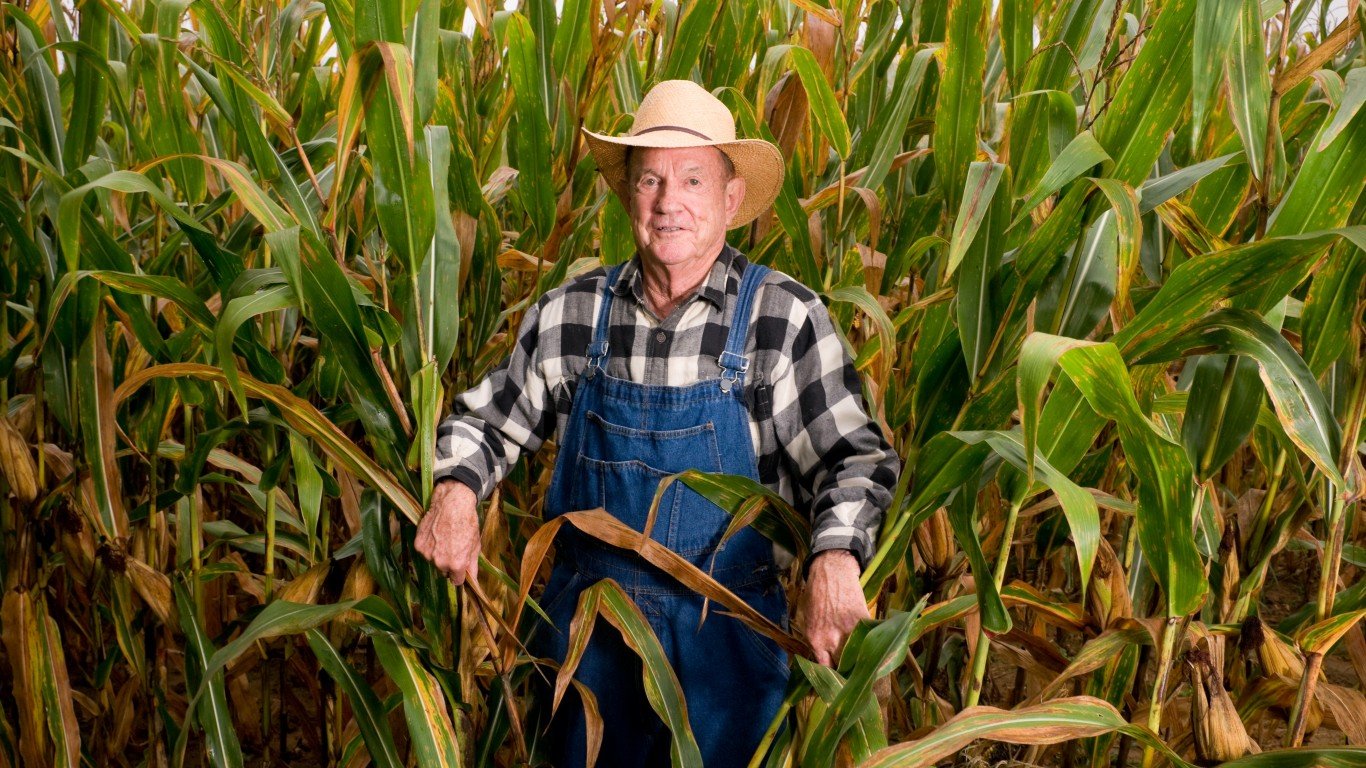
One trader is a working farmer hedging corn he expects to grow. The other is a retired investor who has never planted a seed. Same market, same gain, two entirely different categories of income in the eyes of Social Security.
The Field Behind the Trade Changes the Answer
Social Security’s retirement earnings test counts wages from a job and net earnings from self-employment. Investment gains normally fall outside it. A farmer who sells corn futures to protect the price of expected production is running a business hedge. When properly identified and tied to farm production, the resulting gain or loss is generally treated as ordinary income and reported on Schedule F. That means a gain increases farm income and flows into the farmer’s net earnings from self-employment.
That is precisely what puts it within reach of the Social Security earnings test. The retired investor’s speculative futures gain, by contrast, generally receives capital-gain treatment and stays outside net earnings from self-employment. It can raise the investor’s federal tax bill, but it does not ordinarily cause Social Security retirement checks to be withheld. The commodity and price are identical on both contracts. What differs is the business activity sitting behind the trade, and that business activity is what Social Security actually examines.
What $50,000 Can Do to an Early Claimant
For someone below full retirement age throughout 2026, Social Security withholds $1 in benefits for every $2 of earnings above $24,480. A higher limit of $65,160 applies during the specific year a claimant reaches full retirement age, and the earnings test disappears entirely once that milestone arrives.
The farmer’s actual exposure depends on the entire Schedule F, not the futures gain alone. Farm expenses, other income, and net earnings from self-employment all factor in. But consider a simplified scenario: if the $50,000 gain became $50,000 of net countable earnings with no other offsetting income, as much as $12,760 in benefits could be withheld.
$50,000 − $24,480 = $25,520
$25,520 ÷ 2 = $12,760
Beyond the withholding calculation, farm hedge income reported on Schedule F also carries a 15.3% self-employment tax on net profit. That is a separate burden the retired investor never faces on the same $50,000 gain. The investor realizes the capital gain without triggering either the earnings-test withholding or the self-employment tax, because capital gains are not earnings from work.
Benefits withheld under the earnings test are not permanently lost. At full retirement age, Social Security recalculates the monthly benefit to credit months in which checks were withheld. The immediate cash-flow disruption is still real, especially for a farmer who expected Social Security to help cover seed, fertilizer, or household expenses heading into the next growing season.
The Hedge Must Be Identified on Time
A farmer cannot wait until tax season to decide that a profitable trade was a hedge. According to the IRS Farmer’s Tax Guide, a hedging transaction must be clearly identified in the farm’s records before the end of the day the position is entered. The item or risk being hedged must also be identified at the same time.
Volume matters as well. A futures position reasonably tied to expected production supports hedge treatment. Contracts covering far more corn than the farm could realistically grow begin to look speculative in nature. A farmer may therefore hold hedging and speculative positions in the same year, each carrying different tax treatment. Separate brokerage accounts make that boundary far easier to document. At minimum, the records should identify the crop, expected production volume, specific contracts, trade dates, and the business risk being managed.
The classification cuts both ways. An ordinary hedge loss can reduce farm income directly, while a capital loss faces a cap on how much it can offset ordinary income in any single year. Hedge treatment is neither automatically better nor worse than capital treatment. It follows from the actual business purpose of the trade.
Capital Gains Still Reach Other Retirement Calculations
Escaping the earnings test does not make the investor’s $50,000 invisible. Capital gains enter adjusted gross income and can boost the taxable portion of Social Security benefits. A sufficiently large gain can also raise Medicare premiums two years later through the Income-Related Monthly Adjustment Amount (IRMAA) surcharge. In 2026, that surcharge kicks in for single filers once income exceeds $109,000, and for married couples filing jointly above $218,000. At the lowest surcharge tier, the standard Medicare Part B premium of $202.90 per month climbs to $284.10, a meaningful hit to a retiree’s budget.
The gap between the farmer and the investor is narrower on these downstream costs, but it is important. The farmer’s net business income triggers self-employment tax and can cause Social Security benefit withholding. The investor’s capital gain triggers neither. Both gains can still affect income taxes and Medicare premiums, which is why the $50,000 corn trade is never entirely invisible to the federal government regardless of how it is classified.
A farmer claiming Social Security early should consult an agricultural CPA before opening the position, specifically to clarify how the hedge will be identified and how a gain would move through Schedule F. Waiting until the trade closes leaves fewer choices and a weaker paper trail. The futures contract never changes. The acres behind it are what Social Security is really asking about.
Editor’s note: This update added the 2026 FRA-year earnings test threshold of $65,160, the 15.3% self-employment tax rate applicable to Schedule F net profit, and current IRMAA figures including the $202.90 standard Part B premium and the $109,000/$218,000 income thresholds at which the 2026 Medicare surcharge begins.
Contact [email protected] for any questions or corrections.
Gerelyn Terzo is the author of dividend investing handbook "Dividend Investing Strategies: How to Have Your Cake & Eat It Too." A veteran financial journalist, she covers agri-finance for outlets like Global AgInvesting and the broader stock market and personal finance for 24/7 Wall Street. She began at CNBC and later helped launch Fox Business in New York. Gerelyn currently resides in Woodland Park, Colorado and dabbles in nature photography as a hobby.